
Short-term rental hosts in the United States face a tax landscape that is anything but simple. Between federal income classification, passive activity loss limits, state lodging taxes, and the risk of local property reclassification, a single oversight can trigger penalties that far exceed any rental income earned. The challenge is not just reporting income correctly. It is knowing which rules apply to your specific situation, how federal restrictions interact with local obligations, and where platforms like Airbnb and VRBO leave you responsible for taxes they do not collect. This guide walks through each layer so you can manage your obligations with confidence.
Table of Contents
- How to classify rental income: Schedule E vs. Schedule C
- Deducting STR expenses: What you can (and can’t) write off
- Passive activity and at-risk rules: Navigating loss limitations
- State and local tax obligations: Sales, lodging, and property taxes
- The overlooked realities of STR tax compliance
- Simplify compliance with STR Comply
- Frequently asked questions
Key Takeaways
| Point | Details |
|---|---|
| Federal classification matters | How you classify your STR income controls which IRS forms, rules, and deductions you use. |
| Deduction limits apply | Passive activity and at-risk rules can restrict your loss deductions—even for highly involved hosts. |
| State and local taxes differ | Every city and state may impose unique sales, lodging, and property taxes with their own deadlines. |
| Compliance is ongoing | Laws, rates, and enforcement change frequently, making annual reviews and professional help critical. |
How to classify rental income: Schedule E vs. Schedule C
Now that you understand why clarity matters, let us examine how to determine how your STR income is classified for tax purposes.
The form you use to report rental income has real consequences for your tax bill. Most short-term rental hosts report income on Schedule E, which treats rental activity as passive income. However, if you provide substantial services to guests, such as daily cleaning, meals, or concierge-style assistance, the IRS may require you to report on Schedule C, which treats the activity as a business subject to self-employment tax (currently 15.3% on net earnings).
The IRS Tax Topic 415 outlines the core compliance methodology for U.S. STR hosts: determine the correct federal form based on services offered and rental use patterns, apply vacation-home or fewer-than-15-days rules when relevant, apply passive and at-risk loss limitations under Publication 925, and separately address state and local lodging and sales taxes for your exact jurisdiction.
Key criteria that determine your classification:
- Average rental period: If guests stay an average of 7 days or fewer, the IRS may treat the activity differently than longer-term rentals.
- Services provided: Hotel-like services push the activity toward Schedule C.
- Personal use days: If you use the property personally for more than 14 days or 10% of the days rented (whichever is greater), vacation-home rules apply and limit your deductions.
- Fewer-than-15-days rule: If you rent the property for fewer than 15 days per year, you do not need to report the income at all, but you also cannot deduct rental expenses. This is a narrow exception and rarely applies to active hosts.
| Classification | Form used | Self-employment tax | Loss rules |
|---|---|---|---|
| Passive rental (no services) | Schedule E | No | Passive activity limits apply |
| Active business (services provided) | Schedule C | Yes (15.3%) | At-risk and SE rules apply |
| Vacation home (personal use) | Schedule E (limited) | No | Deductions capped |
| Fewer than 15 days rented | No reporting required | No | No deductions allowed |
Understanding this table before you file prevents costly reclassification by the IRS after the fact.
Pro Tip: Keep a simple log of days rented, days used personally, and any services you provide. A basic spreadsheet updated monthly is enough to support your classification and defend your return if questioned.
For more guidance on federal tax rules and how they apply to STR operations, the STR tax compliance blog covers evolving IRS interpretations and practical filing strategies.
Deducting STR expenses: What you can (and can’t) write off
Once your federal income form is established, the next step is to maximize your deductions while staying within the rules.
The IRS allows hosts to deduct ordinary and necessary expenses related to their rental activity. However, the specific deductions available to you depend heavily on how the property is classified and how much personal use occurs.
Common deductible expenses for STR hosts:
- Mortgage interest on the rental property (subject to allocation if personal use applies)
- Property taxes allocated to rental days
- Repairs and maintenance directly related to the rental
- Utilities such as electricity, water, and internet, prorated for rental use
- Cleaning fees and turnover costs between guests
- Platform service fees charged by Airbnb, VRBO, or similar platforms
- Insurance premiums for rental-specific or short-term rental liability coverage
- Depreciation of the property and furnishings over their useful life
When personal use is involved, you must allocate expenses between personal and rental days. For example, if you rented the property for 200 days and used it personally for 50 days, only 80% of shared expenses (200 out of 250 total days) are deductible as rental costs.
The expense deduction rules become more restrictive when vacation-home rules apply. In that scenario, your rental deductions cannot exceed your gross rental income, meaning you cannot use the property to generate a tax loss.
Important: Under IRS Publication 925, a special allowance of up to $25,000 per year in passive rental losses may be available to hosts who actively participate in managing their rental and whose adjusted gross income (AGI) is $100,000 or less. This allowance phases out completely at $150,000 AGI. Active participation means you make management decisions, approve tenants, and set rental terms, even if a property manager handles day-to-day tasks.
This $25,000 allowance is one of the most valuable tax benefits available to smaller-scale STR hosts, and many miss it simply because they do not know it exists. Make sure you document your management involvement throughout the year to support this claim.
Passive activity and at-risk rules: Navigating loss limitations
Now that you know what you can deduct, let us look at what might prevent you from actually claiming those deductions.
Even when your STR generates a net loss on paper, you may not be able to use that loss to offset other income. Two separate sets of rules govern this: passive activity rules and at-risk rules.
Passive activity rules generally prevent you from deducting losses from passive activities (like most rental properties) against active income such as wages or business profits. Losses that cannot be used in the current year are “suspended” and carried forward to future years or until the property is sold.
At-risk rules limit your deductible losses to the amount you have actually invested in the property and could lose. If you financed the property with non-recourse debt (where you are not personally liable), that portion of the investment may not count toward your at-risk amount.
| Rule | What it limits | When it applies |
|---|---|---|
| Passive activity rules | Losses from passive rental activities | Most STR owners who do not materially participate |
| At-risk rules | Losses beyond your actual financial exposure | All rental activities, regardless of participation |
| Material participation exception | Allows non-passive treatment | Requires 500+ hours/year or other IRS tests |
| Real estate professional status | Removes passive limitation entirely | Requires 750+ hours/year in real estate activities |
The IRS Publication 925 confirms that loss deductibility can be constrained even when you materially participate or when a short average stay suggests active characterization. Tax outcomes depend on how the activity is treated within the passive and at-risk frameworks, not just your level of involvement.
This is where many experienced hosts are surprised. They assume that because they manage their properties actively, all losses are fully deductible. That is not always the case. Hosts who want to explore broader real estate passive investment strategies should understand how STR classification fits into their overall portfolio.
Pro Tip: Review Publication 925 each year before filing. The IRS periodically updates the thresholds and tests for material participation, and missing a change can result in incorrectly claimed deductions.
State and local tax obligations: Sales, lodging, and property taxes
Federal rules are just one side of the story. Your biggest risks often come from state and local taxes.

Every state and most municipalities impose their own tax obligations on short-term rentals. These vary widely and include transient occupancy taxes (also called hotel taxes or lodging taxes), sales taxes on rental transactions, and in some cases, property tax reclassification.
Quick compliance checklist by tax type:
- Transient occupancy tax (TOT): Charged per night by many cities and counties; rates typically range from 6% to 15% of gross rental revenue
- State sales tax: Some states apply general sales tax to short-term rental income; others exempt it
- Local business license: Many cities require a separate business license even if a permit is not required
- Short-term rental permit: Required in most major markets; failure to obtain one can result in fines or listing removal
- Property tax: Risk of reclassification from residential to commercial rates if local assessors determine the property is operating as a business
Platforms like Airbnb collect and remit certain taxes on behalf of hosts in many jurisdictions. However, this does not mean you are fully covered. Many local taxes fall outside platform agreements, and you remain personally liable for any gap.
| Market | Transient occupancy tax | State sales tax | STR permit required |
|---|---|---|---|
| New York City, NY | 5.875% city tax + state taxes | Yes (4% state + local) | Yes, with strict limits |
| Austin, TX | 9% hotel occupancy tax | Yes (6% state) | Yes, registration required |
| Los Angeles, CA | 14% transient occupancy tax | Yes (partial) | Yes, home-sharing permit |
One issue that catches many hosts off guard is property tax reclassification. Local assessors in jurisdictions like Bernalillo County, New Mexico, have moved to treat STRs as commercial properties, which can dramatically increase your property tax bill. This is a growing trend across the country.
The compliance resources available for each market can help you identify which taxes apply to your specific address. If you operate in multiple cities, the risk multiplies quickly. You can also generate a compliance report to get a detailed summary of your obligations by location.
The overlooked realities of STR tax compliance
Beyond the checklists and forms, STR tax compliance demands a deeper perspective that most guides do not address.
Here is the uncomfortable reality: federal tax compliance is the floor, not the ceiling. Most hosts who get into serious trouble are not failing to report income. They are unaware of a local ordinance that changed six months ago, or they assumed their platform was handling a tax that it stopped remitting in their jurisdiction. The gap between “I filed my federal return” and “I am fully compliant” is often where the real financial exposure lives.
Property tax reclassification deserves far more attention than it receives. In several markets, local governments have begun retroactively reassessing STR properties as commercial, sometimes going back multiple years. The resulting tax bills, combined with penalties and interest, can eliminate years of rental profit. This is not a hypothetical risk. It is happening in active enforcement markets right now.
There is also a dangerous assumption among hosts who rely on automation. Platform tax collection tools and compliance software are valuable, but they are not infallible. Tax rates change. Jurisdictions update their rules. Platforms renegotiate their collection agreements. A host who reviews their compliance position only at tax time is always working with outdated information.
Multistate operators face an additional layer of complexity. Each jurisdiction has its own audit triggers, enforcement priorities, and penalty structures. What is standard practice in one city may be a violation in another. Proactive tracking, ideally with professional guidance for complex portfolios, is not optional at that scale. It is essential.
The expert compliance tips available through STR-focused resources can help you stay ahead of these shifts. But the mindset shift matters just as much as the tools: treat compliance as an ongoing operational responsibility, not a once-a-year tax exercise.
Simplify compliance with STR Comply
If you want to eliminate tax guesswork and avoid expensive compliance missteps, here is an easy solution.
STR Comply is built specifically for short-term rental hosts and property managers who need accurate, city-specific compliance information without spending hours on legal research. The platform instantly identifies your permit requirements, tax obligations, and zoning restrictions based on your exact property address.
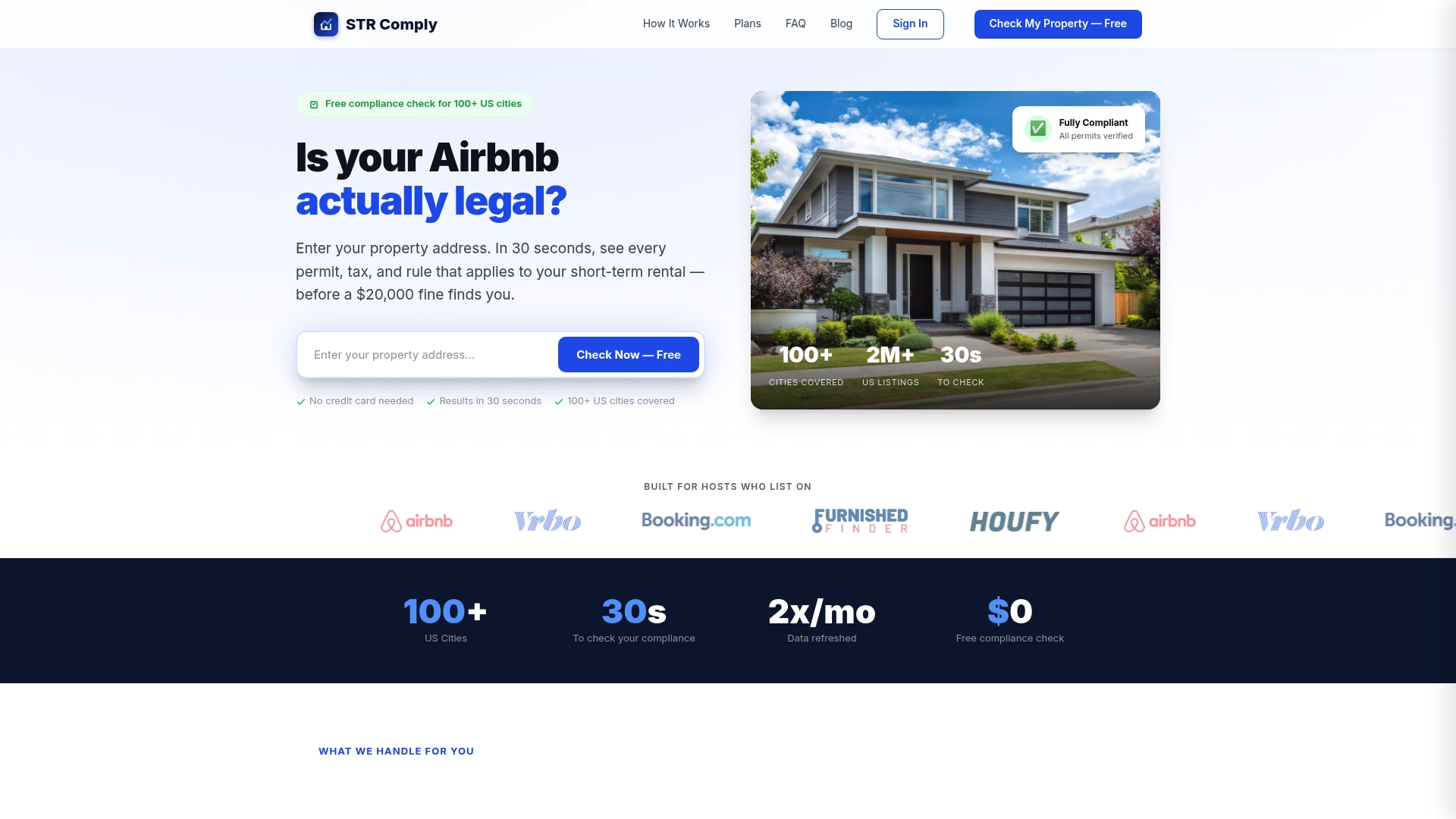
Whether you manage one listing or a growing portfolio, use STR Comply to check your current compliance status across every market you operate in. You can also get a compliance report that outlines your specific tax obligations, permit status, and any regulatory risks, giving you a clear action plan backed by current local data. Paid plans include renewal alerts and regulatory update notifications so you are never caught off guard by a rule change.
Frequently asked questions
Do I need to pay both federal and local taxes on my short-term rental income?
Yes, hosts must report STR income on their federal return and also comply with all applicable state and local sales, lodging, and property taxes. The IRS Tax Topic 415 confirms that state and local obligations must be addressed separately from federal reporting requirements.
How do short-term rental losses affect my taxes?
Your deduction for STR losses may be limited by passive activity and at-risk rules, even if you are actively involved in managing the property. IRS Publication 925 governs these loss limitation rules and outlines the specific tests and exceptions that apply.
What happens if my STR is reclassified as commercial property for tax purposes?
You may owe significantly higher property taxes and face additional compliance obligations if local authorities reclassify your STR as commercial rather than residential. This STR reclassification risk is an active enforcement issue in multiple U.S. markets.
Can I deduct all expenses related to my short-term rental property?
You can deduct ordinary and necessary rental expenses, but you must apportion costs for any personal use days and follow passive activity rules. The $25,000 special allowance under Publication 925 may offset some losses for eligible hosts with lower AGI levels.
Recommended
Check your city's STR regulations
Free compliance reports for 100+ US cities. Permits, taxes, zoning — all in one place.
Check My Address — Free