
Thousands of Airbnb and VRBO hosts across the United States believe that creating a listing and accepting bookings is all it takes to run a legal short-term rental. It is not. Rental registration, the formal process of filing your property with a local city or county government before you host guests, is a separate legal requirement that most jurisdictions enforce independently of the platform itself. Skipping it can lead to serious consequences: fines reaching thousands of dollars, forced delisting, and even legal action. This guide explains exactly what rental registration means, where it applies, how the process works, and what common mistakes to avoid.
Table of Contents
- What does rental registration mean for short-term rentals?
- Why and where is rental registration required?
- Step-by-step: The rental registration process for hosts
- Who must register? Common exemptions and eligibility limits
- The bigger picture: Rental registration debates and implications
- Our take: What most hosts miss, and what actually works for STR compliance
- Ready to register? Simplify STR compliance with expert tools
- Frequently asked questions
Key Takeaways
| Point | Details |
|---|---|
| Rental registration is required | Most U.S. cities require short-term rental hosts to register their property before listing it. |
| Requirements vary by location | Always check your city and state rules—some require multiple steps and have unique exemptions. |
| Registration keeps you compliant | Proper registration protects you from fines, loss of listings, and legal headaches. |
| Know your property type | Eligibility rules and exemptions can hinge on property type and whether you live there. |
What does rental registration mean for short-term rentals?
Now that you know what’s at stake, let’s dig into what rental registration actually means for short-term hosts.
For short-term rentals on platforms like Airbnb and VRBO, rental registration refers to formally filing your property with the city or county, typically to receive a certificate, permit, or registration number before you accept any bookings. This is not the same as creating a platform account. It is a government-side requirement that exists entirely outside of Airbnb or VRBO.

A short-term rental (STR) is generally defined as lodging rented for fewer than 30 consecutive days. This threshold is important because it determines which regulatory framework applies to your property. Long-term leases fall under landlord-tenant law. Short-term stays fall under STR ordinances, which typically require a separate registration or permit.
Platforms like Airbnb and VRBO increasingly require hosts to provide a registration or license number in their listing. This is because local governments have pressured platforms to enforce compliance on their end. If you cannot provide a valid registration number, your listing may be removed. In markets like Honolulu, hosts must be registered to comply with local law before any bookings can take place.
Here is a quick comparison of what being registered versus unregistered actually means in practice:
| Status | Fines risk | Platform access | Legal standing | Tax compliance |
|---|---|---|---|---|
| Registered | Low | Full access | Protected | On record |
| Unregistered | High (up to $10,000+) | Listing removal risk | Exposed | Non-compliant |
Staying current on the broader rental permit landscape matters especially as cities tighten enforcement. The table above illustrates that the risk of operating unregistered goes well beyond a simple fine. It affects your entire ability to do business on these platforms.
Why and where is rental registration required?
Understanding what registration is, it’s critical to explore why governments insist on it, and where the rules hit hardest.
Cities and counties use rental registration as a tool to accomplish several goals at once. First, registration creates accountability. Local governments can track who is operating an STR, where it is located, and whether it meets safety and zoning requirements. Second, registration ties directly into tax collection. Most jurisdictions require STR operators to collect and remit a transient occupancy tax (TOT), sometimes called a lodging tax or hotel tax, and registration is the mechanism that puts hosts on the tax rolls.
Some jurisdictions require only one registration, while others stack multiple requirements. Las Cruces, New Mexico, for example, requires hosts to complete a city STR registration and a separate lodgers tax registration. Failing to complete both leaves you out of compliance even if you have one of them. This multi-step approach is becoming more common in mid-sized cities that want to capture both accountability data and tax revenue in separate administrative systems.
Major U.S. STR markets including New York City, Los Angeles, Nashville, Denver, Chicago, and Austin all require some form of host registration or permit before listing. This is not limited to large cities. Smaller resort towns in Colorado, Florida, and the Carolinas have some of the most detailed local registration policies in the country, precisely because tourism drives a significant share of their local economy and residents have pushed for stronger oversight.
Common reasons cities require STR registration include:
- Tax collection: Ensuring hosts remit transient occupancy taxes on all bookings
- Safety standards: Verifying that properties meet fire safety, smoke detector, and egress requirements
- Data tracking: Knowing how many STRs operate in a given neighborhood or zone
- Neighborhood impact: Managing noise complaints, parking issues, and housing availability concerns
- Code enforcement: Creating a formal record that allows inspectors to follow up on complaints
Understanding which of these motivations applies in your market helps you anticipate what documentation and inspections your local government may require during the registration process.
Step-by-step: The rental registration process for hosts
With the “why” and “where” in mind, you might ask: what does actually registering involve? Here’s how to do it right.
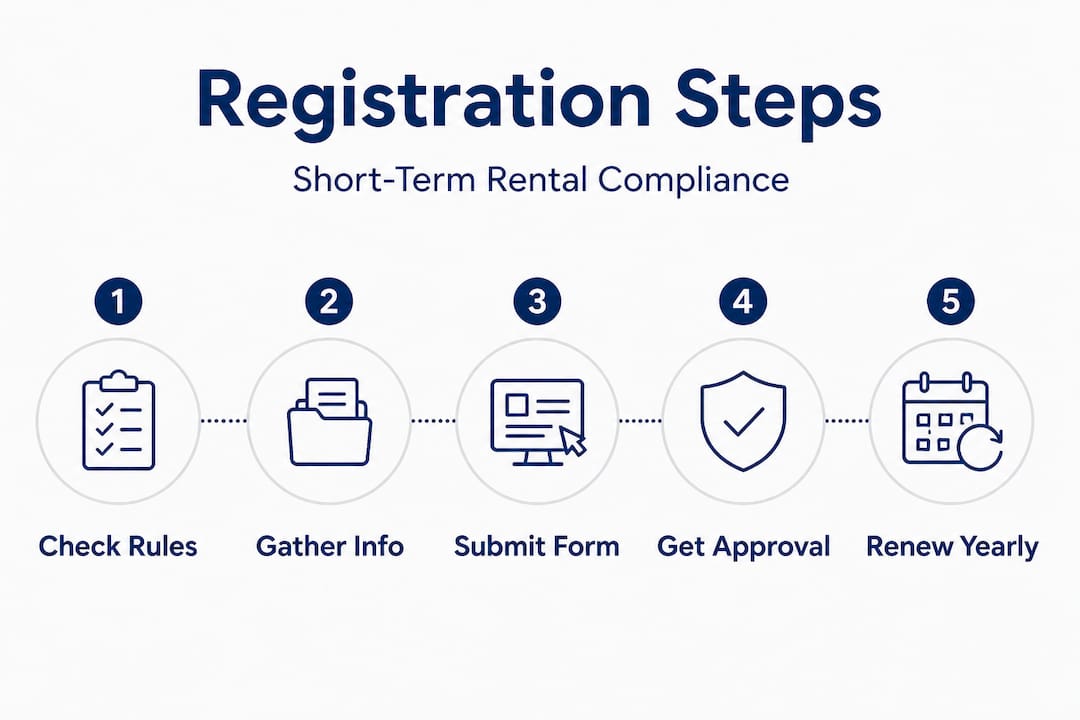
The STR registration process follows a predictable pattern across most U.S. jurisdictions, even though the specific requirements vary. Here are the five key steps most hosts will encounter:
- Determine zoning eligibility: Before anything else, confirm that your property is in a zone where STR operation is permitted. Some zones allow owner-occupied STRs but not investor-owned units. Others ban STRs entirely in residential zones.
- Gather required documents: Most applications require proof of property ownership (deed or title), a valid government-issued ID, and sometimes a floor plan or occupancy diagram. If a property manager is applying on behalf of an owner, a notarized authorization letter is commonly required.
- Submit the application and pay fees: Applications are typically filed online through the city or county portal. Fees range from under $100 in some smaller cities to several hundred dollars in larger markets. Some cities require an initial inspection before approval.
- Receive your registration or license number: Once approved, you will receive a registration number, certificate number, or license number. This is the official proof of compliance that you will need to display or enter into your listing.
- Display the number in your listing: Airbnb and VRBO both have fields for registration numbers. In many cities, failure to display this number is itself a violation, separate from the failure to register in the first place.
Pro Tip: Update your registration immediately if property ownership or management changes hands. In cities like Las Cruces, the registration is tied to the specific owner or operator, not just the property address. A new owner or manager typically needs to file a new registration, and operating under the old one may constitute a violation.
Common mistakes to avoid include missing annual renewal deadlines (many registrations expire and must be renewed yearly), misunderstanding owner-occupancy exemptions, and assuming that a state-level license covers local registration requirements. These are separate obligations. Local rules layer on top of state rules, not in place of them.
You can review the full compliance report process to understand how to verify your standing across multiple requirements at once, which is especially useful for hosts managing more than one property.
Who must register? Common exemptions and eligibility limits
Even with the process down, many hosts wonder: do these rules apply to every host and property, or are there ways out?
Not every property or host is automatically subject to STR registration requirements. Registration requirements vary significantly by location, property type, and host eligibility. Some jurisdictions set specific conditions that determine who must register and who may be exempt. However, it is critical to understand that these exemptions represent the floor, not the ceiling. Local governments can impose stricter rules on top of any state or provincial baseline.
Key factors that determine eligibility or trigger exemptions include:
- Owner-occupancy status: Some cities exempt hosts who live on the property (a room rental in your primary home) from full STR registration, though they may still require a simpler notification or permit.
- Property type: Hotels, licensed bed-and-breakfasts, and boarding houses often fall under different licensing frameworks and may not need an STR-specific registration.
- Rental duration: Properties rented for longer than 30 consecutive days typically fall outside STR regulations entirely.
- Grandfathered properties: Some jurisdictions allow existing operations that predate new ordinances to continue under older rules, but these protections are time-limited and conditional.
- Number of rooms or units: A few cities only regulate properties that rent out an entire dwelling unit, leaving single-room rentals in a separate category.
To check whether your property qualifies for an exemption, you need to look at your specific city and county rules, not just state law. Use the free tool at STR Comply to instantly check whether your Airbnb listing is operating within the bounds of local law. The nuance matters here because what is exempt in one city may be fully regulated two miles away in a different jurisdiction.
Here is a general overview of common exemption categories by property scenario:
| Scenario | Likely exemption status | Notes |
|---|---|---|
| Owner lives on property, rents one room | Possible partial exemption | Varies by city, still check local rules |
| Entire home, owner not present | Registration almost always required | Most cities regulate this fully |
| Condo in HOA-governed building | No exemption from city rules | HOA rules stack on top of city rules |
| Licensed bed-and-breakfast | May use different license type | Confirm with local authority |
| Rural property outside city limits | Check county rules | County regulations still apply |
The bigger picture: Rental registration debates and implications
Beyond the process, registration stirs real debate among hosts, cities, and housing advocates.
Local governments generally favor STR registration for practical reasons: it creates a paper trail, improves safety enforcement, and ensures that short-term rental operators contribute to local tax revenues alongside hotels and traditional lodging businesses. Cities with well-run registration programs can respond faster to noise complaints, building code violations, and habitability concerns because they know exactly which properties are operating as STRs and who is responsible for them.
Critics of registration requirements, including some host advocacy groups, argue that registration alone does not solve the larger housing affordability problems that often motivate these policies. A Columbus City Council proposal to establish a rental registry drew both support from accountability advocates and skepticism from those who questioned whether registration would meaningfully address housing availability or just add administrative burden to small landlords.
“Local governments promote registration to improve accountability and safety, while some proposals are criticized as potentially incomplete or not addressing broader housing affordability issues.” (WOSU, 2026)
This tension is real and ongoing. For hosts, it means that the political and regulatory environment around STR registration is not static. Cities that do not require registration today may require it next year. Cities that have simple registration programs may add inspections, caps on the number of permits, or primary-residence requirements as community pressure grows.
The pros and cons from different stakeholder perspectives include:
- Hosts (pro): Registration creates legal clarity and reduces the risk of sudden enforcement actions
- Hosts (con): Fees, paperwork, and renewal deadlines add ongoing administrative work
- Neighbors (pro): Accountability helps address persistent problem properties
- Neighbors (con): Registration does not guarantee good guest behavior
- Policymakers (pro): Tax data and compliance records improve city planning
- Housing advocates (con): Registration alone does not reduce the conversion of long-term housing into STRs
Staying informed about STR policy analysis in your target markets is the most reliable way to anticipate changes before they affect your listing.
Our take: What most hosts miss, and what actually works for STR compliance
Stepping back, the pattern we see most often is not hosts who deliberately ignored registration requirements. It is hosts who assumed they understood the rules based on what they read in one place, one time, and never checked again.
The real danger in STR compliance is not a hidden fee or an obscure tax form. It is a missed regulation that results in a delisting notice or a $5,000 fine that shows up without warning. The most common version of this is a host who registered correctly two years ago, renewed once, and then missed the third renewal because nothing reminded them. Many violations are not first-time failures. They are maintenance failures.
What actually works is building a compliance habit, not a one-time compliance task. Check your city and county rules at least once per year, because regulations change. Several cities have revised their STR ordinances multiple times in the past three years alone, adding primary-residence requirements, reducing permit caps, or changing the tax filing schedule.
Document everything and keep it organized. Keep copies of your registration certificate, your tax remittance receipts, your application confirmation, and any correspondence with local authorities. “Set and forget” is the mindset that leads to problems. The top compliance lessons from experienced hosts almost always include the same advice: treat compliance like a recurring business task, not a box you checked once at the start.
Pro Tip: Set calendar reminders 60 days before your registration renewal date, not 7 days. Many local portals process renewals slowly, and submitting late, even by a few days, can lapse your registration and expose you to penalties during the gap.
The hosts who stay compliant long-term are the ones who treat registration as part of their operating routine, right alongside pricing updates and guest communication.
Ready to register? Simplify STR compliance with expert tools
If the path still seems complicated, here’s how technology can help you stay compliant with less hassle.
STR Comply is built specifically for hosts who need fast, accurate answers about registration requirements, permits, taxes, and zoning restrictions for their properties.
You can check your Airbnb’s legal status for free in minutes, getting a detailed city-specific summary of what you need to register, what taxes apply, and what operational restrictions are in place. For hosts managing multiple properties or preparing to expand into new markets, the paid compliance dashboard tracks permit status, renewal deadlines, and regulatory updates automatically. Stop guessing and get a compliance report that tells you exactly where you stand and what your next steps are.
Frequently asked questions
Do I need to register my Airbnb if it’s just one room in my house?
Some cities offer a partial exemption for owner-occupied rentals, but most jurisdictions still require some form of registration or permit even for single-room listings. Always verify local exemption rules before assuming you are exempt.
How do I find out my city’s rental registration requirements?
Check your city or county’s official website under planning, zoning, or business licensing departments. For a faster answer, the Honolulu STR portal is one example of how cities publish their requirements online, and most major U.S. cities follow a similar format.
What happens if I skip rental registration as a host?
Penalties for operating an unregistered STR typically include monetary fines, forced removal of your listing by the platform, and in repeat cases, legal action by local authorities. Most platforms now require valid registration numbers to keep listings active.
Is rental registration only for short-term rentals under 30 days?
Most STR regulations define the threshold as fewer than 30 consecutive days, meaning rentals at or above that duration typically fall under long-term rental rules. However, some local jurisdictions set a different threshold, so confirm the definition that applies in your specific market.
Recommended
Check your city's STR regulations
Free compliance reports for 100+ US cities. Permits, taxes, zoning — all in one place.
Check My Address — Free