Airbnb host tax settings configuration is the process by which hosts set up tax collection, reporting, and remittance to comply with local occupancy laws and federal income requirements. Getting this right matters more than most hosts realize. Starting in 2025, Airbnb must issue Form 1099-K when gross payouts exceed $600 in a calendar year, down from the $5,000 threshold in 2024. That change means far more hosts will receive formal tax documents, and the IRS will expect matching income reports. Whether or not you receive a 1099-K, you are legally required to report all rental income.
What tax types do Airbnb hosts need to configure?
Airbnb hosts face multiple tax categories, and each one requires a different configuration or filing approach. Knowing which taxes Airbnb handles automatically and which ones fall on you is the foundation of any solid Airbnb tax setup guide.
Occupancy and lodging taxes are local taxes charged to guests on short-term stays. These are often called transient occupancy tax, hotel tax, or short-term rental tax depending on the jurisdiction. Airbnb collects and remits occupancy taxes automatically in many U.S. markets, but coverage is not universal. You must verify your specific location before assuming Airbnb handles it.
Federal income tax applies to all rental income above the 14-day rule threshold. The 14-day rule allows hosts who rent their property for 14 days or fewer per year to exclude that income from federal taxes entirely. Renting beyond 14 days requires full income reporting, and the form you use depends on your activity level.
- Schedule E applies to passive rental activity, where you provide minimal services to guests.
- Schedule C applies when you provide substantial services such as daily cleaning, meals, or concierge support. This classification triggers self-employment tax at 15.3% on the first $160,200 of net earnings.
- Estimated quarterly payments are required if you expect to owe $1,000 or more in federal tax for the year, since Airbnb withholds nothing from your payouts.
Pro Tip: Check your Airbnb payout statement for a “Taxes” line item under Account > Transaction History > Reservation payout breakdown. If that line is absent or shows zero, Airbnb is not collecting occupancy taxes in your area, and you must register and remit them yourself.
What do hosts need before configuring Airbnb tax settings?
Preparation before you touch any settings prevents costly errors later. Tax configuration for Airbnb hosts requires three things: the right registrations, the right documents, and the right tools.
-
Register with local tax authorities. If Airbnb does not collect occupancy taxes in your jurisdiction, you must register directly with your city or county revenue office. Many jurisdictions require a short-term rental tax permit or a transient occupancy tax registration number before you can legally collect from guests.
-
Obtain an EIN from the IRS. A federal Employer Identification Number separates your rental activity from your personal finances. Using an EIN to open a dedicated business checking account makes your income and expense records far cleaner and reduces audit risk significantly.
-
Download your Airbnb earnings summary and payout history. Log into your Airbnb account and export your annual earnings summary and transaction history. These documents show gross income, fees, and any taxes Airbnb already collected on your behalf.
-
Set up a bookkeeping system. A dedicated spreadsheet or accounting software log for rental income and deductible expenses is not optional. The IRS requires contemporaneous records with dates, property details, and hours of participation to substantiate deductions.
-
Consult a CPA with short-term rental experience. Tax rules for short-term rentals vary by state and city. A qualified CPA can confirm your classification, identify deductions, and flag local registration requirements you may have missed.
Pro Tip: Do not use your personal bank account for rental income, even temporarily. Commingled funds make it nearly impossible to produce a clean audit trail and can cause the IRS to disallow legitimate deductions.
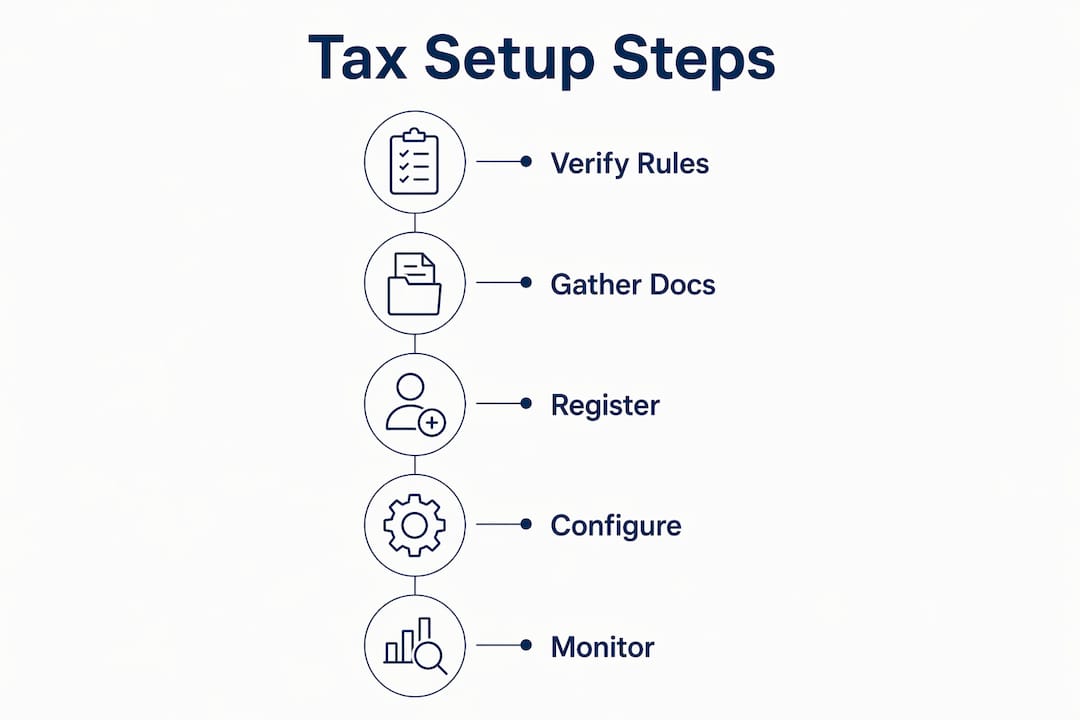
How to configure tax settings on Airbnb step by step
This is the practical core of any Airbnb host tax settings configuration guide. The steps below apply to hosts who need to add or verify tax collection within their Airbnb listing.
-
Log in and navigate to your listing. Go to Airbnb.com, select “Listings,” and choose the property you want to configure.
-
Open the pricing and taxes section. Within the listing editor, find “Pricing” and then locate the “Taxes” subsection. Airbnb displays any taxes it currently collects automatically for your jurisdiction here.
-
Verify automatic collection. If Airbnb already collects occupancy taxes in your area, the tax type and rate will appear with a note that Airbnb remits directly to the authority. You do not need to add these manually. Confirm the rate matches your local requirement.
-
Add a custom tax if needed. If Airbnb does not cover your local tax, select “Add a tax.” Airbnb offers several charge types: percentage per booking, fee per guest per night, or a flat fee per booking. Choose the type that matches your local tax ordinance exactly.
-
Enter your registration number and tax rate. Input the rate your local authority requires and your tax registration number. This creates a paper trail linking your collection to your official registration.
-
Set exemptions if applicable. Some jurisdictions exempt stays longer than 30 days from occupancy taxes. Airbnb allows you to configure these exemptions within the tax settings tab.
-
Save and test. After saving, create a test booking preview to confirm the tax appears correctly in the guest price breakdown.
The table below summarizes the main custom tax types Airbnb supports and when to use each one.
| Tax charge type | When to use it |
|---|---|
| Percentage per booking | Standard occupancy or lodging tax expressed as a percentage of the booking subtotal |
| Fee per guest per night | Per-person nightly taxes required by some city ordinances |
| Flat fee per booking | Fixed municipal fees charged once per reservation regardless of length |
| Percentage with exemption | Occupancy tax that exempts stays over a defined number of nights |

Pro Tip: Misconfiguring the taxable base, for example applying a percentage to the total including cleaning fees when your ordinance taxes only the nightly rate, can cause under-collection and guest disputes. Read your local tax ordinance carefully before selecting a charge type.
How to maintain compliance and avoid common tax mistakes
Configuring your settings once is not enough. Year-round management is what separates hosts who file confidently from those who face penalties.
- Review your payout statements monthly. Checking payout statements regularly confirms that tax collection is working as expected on every booking. A rate change or a new city ordinance can affect your setup without warning.
- Keep a participation log. Record the dates you worked on your rental, the tasks performed, and the time spent. This log substantiates your tax classification and deductions if the IRS ever questions your filing.
- Make quarterly estimated tax payments. If you expect to owe $1,000 or more in federal tax, submit IRS Form 1040-ES by the quarterly deadlines in april, june, september, and january. Missing these payments triggers underpayment penalties.
- File zero-balance informational returns where Airbnb collects. Airbnb’s bulk payment process sends tax funds to authorities without individual host identifiers. Filing a zero-balance return with an explanatory letter creates a protective paper trail in case of a local audit.
- Never mix personal and rental finances. Use your EIN and business checking account for all rental transactions. Mixing funds is one of the most common and most damaging mistakes hosts make.
“Many hosts mistakenly believe that Airbnb’s automatic tax collection covers all their obligations. Verifying your local rules and consulting a tax professional is the only way to confirm you are fully covered.”
For a complete breakdown of what you owe at the federal and state level, the short-term rental tax obligations guide from Strcomply covers 2026 requirements in detail. Hosts managing multiple markets should also review rental income reporting best practices to understand how different tax regimes interact.
Key Takeaways
Accurate Airbnb tax settings configuration requires verifying automatic collection, registering with local authorities, using an EIN for clean records, and filing quarterly estimated payments to stay fully compliant.
| Point | Details |
|---|---|
| Verify automatic collection first | Check your payout statement for a “Taxes” line before adding any custom taxes manually. |
| Register locally when Airbnb does not collect | Obtain a local tax registration number before configuring custom tax rates in your listing. |
| Use an EIN and separate account | A dedicated business account tied to your EIN protects your audit trail and simplifies filing. |
| File quarterly estimated payments | Submit IRS Form 1040-ES if you expect to owe $1,000 or more to avoid underpayment penalties. |
| Keep contemporaneous records year-round | Participation logs and monthly payout reviews are your best defense in an IRS or local audit. |
What I have learned from watching hosts get this wrong
Most hosts I have worked with treat tax configuration as a one-time task. They set it up during onboarding and never look at it again. That approach works until a city updates its ordinance, Airbnb changes its collection coverage, or a new property crosses a state line with different rules.
The biggest misconception I see is that Airbnb’s automatic collection means full compliance. It does not. Airbnb remits taxes in bulk, without individual host identifiers attached. That means a local auditor has no way to connect the payment to your specific listing. Filing a zero-balance informational return with your local tax authority is a simple step that most hosts skip, and it is the one that protects you most in an audit.
I also think the 14-day rule is widely misunderstood. Hosts hear “14 days tax-free” and assume it applies to them. Applying it incorrectly, especially when personal use days are not tracked carefully, can create a larger tax liability than simply reporting the income from the start.
My honest advice: get a CPA who specializes in short-term rentals before your first filing, not after your first audit notice. The cost of one consultation is a fraction of the penalty for a missed local registration or a misclassified Schedule C.
— Jure
How Strcomply helps you stay on top of Airbnb tax compliance
Tax rules for short-term rentals change constantly, and keeping up manually across multiple markets is a real challenge.
Strcomply is built specifically for Airbnb hosts and property managers who need to know exactly what their tax and permit obligations are, by city, without hours of legal research. The platform provides instant compliance checks, city-specific tax summaries, and permit tracking with renewal alerts. Paid plans include a full portfolio dashboard so you can monitor every listing’s compliance status in one place. If you want to confirm your Airbnb tax setup is complete and current, Strcomply gives you a clear answer in under a minute.
FAQ
Does Airbnb collect all occupancy taxes automatically?
Airbnb collects occupancy taxes automatically in many U.S. markets, but coverage is not universal. Check your payout statement for a “Taxes” line item to confirm whether Airbnb collects in your jurisdiction.
What is the 1099-K threshold for Airbnb hosts in 2025?
Starting in 2025, Airbnb must issue Form 1099-K when gross payouts exceed $600 in a calendar year. All rental income must be reported regardless of whether you receive a 1099-K.
When does self-employment tax apply to Airbnb income?
Self-employment tax at 15.3% applies when your rental activity is classified as an active business, typically when you provide substantial services to guests and file on Schedule C rather than Schedule E.
How do I add a custom tax to my Airbnb listing?
Go to your listing editor, open the Pricing section, and select “Add a tax” under the Taxes subsection. Choose the correct charge type, enter your local tax rate and registration number, and configure any applicable exemptions.
What records should Airbnb hosts keep for tax purposes?
Hosts should maintain contemporaneous logs with dates, hours, and property details, along with monthly payout statements and annual earnings summaries from Airbnb. These records substantiate deductions and support your tax classification in an audit.
Recommended
Check your city's STR regulations
Free compliance reports for 100+ US cities. Permits, taxes, zoning — all in one place.
Check My Address — Free