
City occupancy limits define the maximum number of people who can legally occupy a rental property at any given time, based on building codes, room dimensions, exit capacity, and local safety standards. For short-term rental hosts on platforms like Airbnb and VRBO, understanding these limits is not optional. Violations carry real financial consequences. In Bloomington, Indiana, for example, unregistered rental fines reach $100 per day. This guide breaks down how to explain city occupancy limits, how they are calculated, what laws govern them, and how you can stay compliant.
How are city occupancy limits calculated?
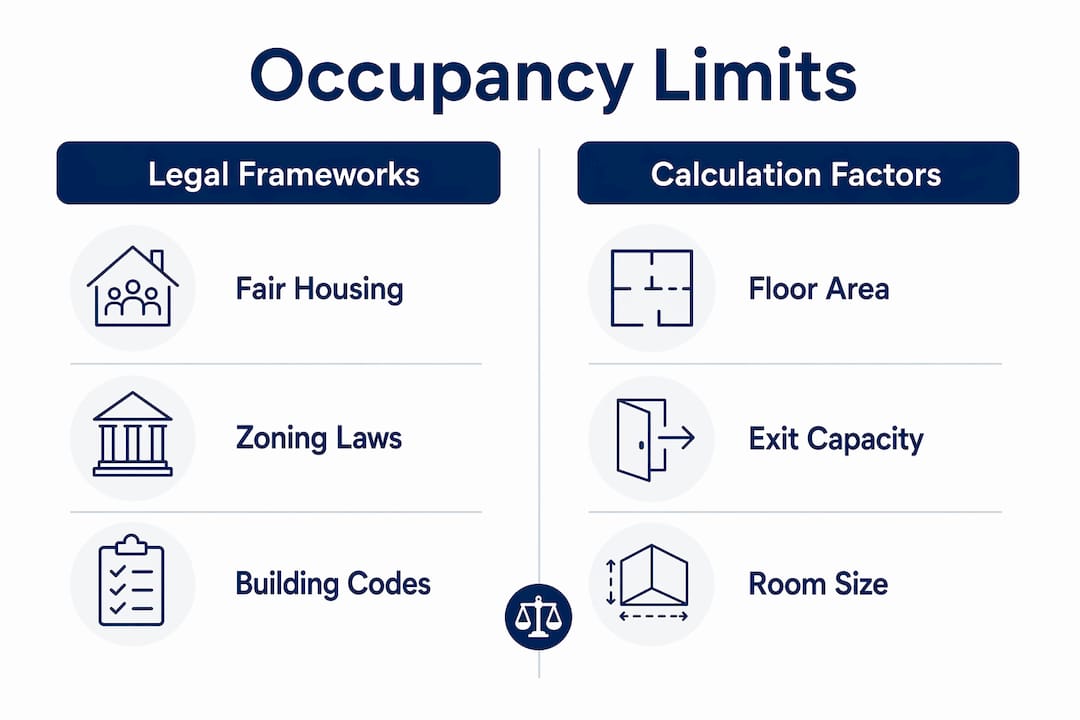
City occupancy limits, formally known as occupant load calculations, are determined by a combination of floor area, room use type, and exit capacity. The International Building Code assigns occupant load factors for different space types, which guides the maximum number of people any given area can legally hold. For a residential bedroom, the calculation starts with usable floor area divided by the assigned load factor for that room type.

Net vs. gross floor area
The distinction between net and gross floor area is where many hosts make their first mistake. Net floor area excludes walls, columns, and fixed obstructions. Gross floor area includes them. Using gross instead of net area inflates your occupancy number and can result in violations when inspectors apply the correct measurement. Always use net floor area when calculating occupant load for any room in your rental.
When you complete the calculation, round up. Partial occupants are not permitted under the International Building Code. If your math produces 6.3 people, the legal occupant load is 7.
Exit capacity as the hard ceiling
Exit capacity sets an absolute upper limit on occupancy, regardless of what your floor area calculation produces. A building’s exit width and number of exits cap the maximum occupant load legally allowed. This is called the weakest link principle. If your exits can only safely accommodate 8 people during an emergency evacuation, your occupancy limit cannot exceed 8, even if your square footage calculation suggests more.
- Bedroom count: Local codes often use a bedroom-based formula as a starting point, commonly two persons per bedroom plus two additional occupants.
- Square footage per person: Many jurisdictions set a minimum of 70 square feet of habitable space per occupant.
- Exit capacity: The number and width of exits cap the final occupant load.
- Room use type: A living room and a bedroom carry different load factors under the International Building Code.
- Certificate of Occupancy: This document records the official permitted occupant load for your property.
Pro Tip: Pull your property’s Certificate of Occupancy before listing it on any platform. The Certificate of Occupancy is the only definitive legal record of your building’s permitted occupant load. Relying on informal estimates or platform defaults puts you at direct legal risk.
What legal frameworks regulate city occupancy limits?
Multiple overlapping legal frameworks govern residential occupancy rules. Understanding which applies to your property type and location is critical for compliance.
The Fair Housing Act and the two-per-bedroom standard
The Fair Housing Act does not set a specific occupancy number, but federal guidance known as the Keating Memo establishes that two persons per bedroom is a generally reasonable occupancy standard. This means a landlord or host who enforces a stricter limit without a legitimate, non-discriminatory reason may face a Fair Housing complaint. For short-term rental hosts, this standard applies when setting your listing’s guest maximum.
Zoning laws and unrelated adults
Building codes and zoning laws are separate legal instruments, and both affect your occupancy limits. Zoning laws can restrict how many unrelated adults may live together in a single dwelling, independent of what the building code allows. A property that can physically and structurally accommodate eight people may be zoned to allow only four unrelated adults. This distinction matters especially for hosts renting to groups of friends or co-travelers.
The International Property Maintenance Code adds another layer. It sets minimum room size requirements, including a minimum of 70 square feet for the first occupant in a sleeping room and 50 additional square feet for each additional occupant. Local jurisdictions frequently adopt these standards with amendments.
| Standard | Governing body | Key rule |
|---|---|---|
| Two persons per bedroom | Fair Housing Act (Keating Memo) | Baseline for reasonable occupancy |
| Occupant load factor | International Building Code | Floor area divided by use-type factor |
| Minimum room size | International Property Maintenance Code | 70 sq ft for first occupant in sleeping room |
| Unrelated adult cap | Local zoning ordinances | Varies by city and district |
| Permitted occupant load | Certificate of Occupancy | Legally binding record for the property |
Local governments frequently amend these baseline standards. A city like New York or San Francisco may impose stricter rules than the International Building Code defaults. Always check local zoning laws for your specific market before setting your listing’s guest maximum.
What enforcement actions do hosts face for violations?
Enforcement of city occupancy regulations is active, not theoretical. Local governments use fire marshal inspections, rental registration programs, and complaint-driven investigations to identify violations.
Signage requirements
Occupancy signs are mandatory for assembly spaces and are inspected by fire marshals. For short-term rentals that include common areas or gathering spaces, this requirement may apply directly to your property. Signs must meet fire code and ADA placement standards. Failure to update signage after a remodel counts as a separate violation.
Financial penalties
The financial exposure from occupancy violations is significant. Fines for willful overcrowding or missing occupancy signs can reach $5,000 per violation. In Bloomington, Indiana, operating an unregistered short-term rental carries a fine of $100 per day. These penalties compound quickly. A 30-day period of non-compliance in Bloomington alone produces a $3,000 fine before any additional legal costs.
Common enforcement actions hosts face include:
- Mandatory registration: Many cities require short-term rentals to register annually and pass inspections before operating.
- Fire marshal inspections: Inspectors verify occupant load signs, exit widths, and smoke detector placement.
- Daily fines: Unregistered or non-compliant rentals accumulate fines for every day of operation.
- Forced closure: Repeated or serious violations result in an order to cease all rental activity.
- Legal action: Cities can pursue civil or criminal penalties for willful violations.
For a detailed breakdown of rental legal penalties by jurisdiction, review your city’s specific enforcement code before your first booking.
How can hosts practically ensure compliance?
Compliance with maximum occupancy guidelines requires a documented, repeatable process. Informal knowledge of your property is not sufficient when an inspector arrives.
Start with your Certificate of Occupancy. This document, issued by your local building department, records the legally permitted occupant load for your property. Many hosts skip this step and rely on bedroom count alone. That approach misses exit capacity limits, room size minimums, and zoning restrictions that may apply.
Next, review your local building code annually. Municipalities update occupancy standards, and changes to the International Building Code are adopted on rolling cycles by different jurisdictions. A rule that applied last year may have been amended. Staying current with rental legal requirements is an ongoing responsibility, not a one-time task.
Post required occupancy signs where your local code mandates them. If your property includes a deck, rooftop, or indoor gathering space, check whether assembly occupancy rules apply. Keep copies of all permits, inspection reports, and occupancy certificates in a single file you can produce quickly if questioned.
Pro Tip: Contact your local building department directly and ask for a copy of your property’s occupant load calculation on record. This takes one phone call and gives you the exact number your city will enforce. Do not rely on the number listed in your original purchase documents, as those may predate current code.
How do occupancy limits affect different property types?
Occupancy rules apply differently depending on whether your rental is a single-family home, a multi-family unit, or a dedicated short-term rental property.
Single-family homes are typically governed by the two-per-bedroom standard plus local zoning rules on unrelated adults. A three-bedroom house in a city that caps unrelated adult occupants at four people cannot legally host six unrelated guests, even if the floor area calculation would permit it.
Multi-family units, such as apartments and condos, face both building-wide occupant load limits and unit-level restrictions. The building’s overall exit capacity affects every unit’s effective limit. A host in a high-rise building may face a lower practical occupancy limit than a host in a standalone house with the same bedroom count.
Short-term rental listings on Airbnb and VRBO are subject to the same city occupancy regulations as long-term rentals. Platforms do not verify local occupancy compliance on your behalf. Setting a guest maximum that exceeds your city’s legal limit creates liability for you, not the platform.
Key property-type considerations for hosts:
- Single-family homes: Apply bedroom count formula and check zoning cap on unrelated adults.
- Condos and apartments: Confirm building-wide exit capacity does not reduce your unit’s effective limit.
- Multi-room STR properties: Calculate occupant load for each room type separately, then apply the weakest link principle.
- Properties with outdoor spaces: Decks and rooftop areas may trigger separate assembly occupancy rules.
Review operational restrictions for STR hosts to understand how these property-type rules interact with platform policies in your market.
Key takeaways
City occupancy limits are legally binding, calculated from floor area, exit capacity, and zoning rules, and enforced with fines that can reach $5,000 per violation.
| Point | Details |
|---|---|
| Occupant load calculation | Divide net floor area by the assigned load factor; always round up partial occupants. |
| Exit capacity is the ceiling | Exits set the hard upper limit on occupancy, regardless of floor area results. |
| Fair Housing Act baseline | Two persons per bedroom is the federally recognized reasonable occupancy standard. |
| Certificate of Occupancy | This document is the only legally binding record of your property’s permitted occupant load. |
| Penalty exposure | Daily fines for unregistered rentals and per-violation fines for overcrowding can accumulate fast. |
What I’ve learned from watching hosts get this wrong
Jure here. After working with short-term rental hosts across dozens of markets, the single most common mistake I see is treating occupancy limits as a listing preference rather than a legal ceiling. Hosts set their guest maximum based on bed count, post the listing, and move on. They never pull the Certificate of Occupancy. They never check whether their city has a zoning cap on unrelated adults. Then an inspection happens, or a neighbor files a complaint, and the fines start.
The second mistake is assuming that because a platform allows a certain guest count, the city does too. Airbnb and VRBO do not verify local occupancy compliance. That responsibility sits entirely with you.
My honest advice: treat your Certificate of Occupancy the way you treat your insurance policy. You hope you never need it in a dispute, but you absolutely need to know what it says before one starts. Call your local building department, get the document, and set your listing maximum accordingly. Proactive compliance costs almost nothing. Reactive compliance, after a fine or a forced closure, costs significantly more.
— Jure
Strcomply keeps your occupancy compliance current
Tracking city occupancy regulations across multiple listings is time-consuming. Rules change, permits expire, and local amendments rarely come with advance notice.
Strcomply gives short-term rental hosts a free, instant compliance check that covers permit requirements, zoning restrictions, and local ordinance requirements for Airbnb and VRBO listings across the United States. Paid plans add a portfolio dashboard with permit tracking, renewal alerts, and regulatory update notifications, so you know when your city changes its occupancy standards before an inspector does. Visit Strcomply to check your listing’s compliance status today.
FAQ
What is a city occupancy limit?
A city occupancy limit is the maximum number of people legally permitted to occupy a rental property at one time, determined by local building codes, floor area calculations, exit capacity, and zoning rules.
How is maximum occupancy calculated for a rental property?
Maximum occupancy is calculated by dividing the net floor area of each room by its assigned occupant load factor under the International Building Code, then applying the weakest link principle based on exit capacity.
Does the Fair Housing Act affect how I set my guest maximum?
The Fair Housing Act, through the Keating Memo, recognizes two persons per bedroom as a reasonable occupancy standard. Setting a stricter limit without a documented, non-discriminatory reason may expose you to a Fair Housing complaint.
What fines can I face for violating occupancy limits?
Fines vary by city. In Bloomington, Indiana, unregistered rentals incur $100 per day. Willful overcrowding or missing occupancy signage can result in fines up to $5,000 per violation in jurisdictions that follow standard fire code penalty schedules.
Where do I find my property’s legal occupancy limit?
Your property’s legally permitted occupant load is recorded in its Certificate of Occupancy, issued by your local building department. This document is the authoritative source and supersedes any informal estimate or platform default.
Recommended
Check your city's STR regulations
Free compliance reports for 100+ US cities. Permits, taxes, zoning — all in one place.
Check My Address — Free