Defining occupancy limits in Airbnb rentals sounds straightforward until you realize that three separate authorities may each have a different answer. Your city’s fire code, your local short-term rental permit, and Airbnb’s own platform policies can all specify different numbers. Set your listing too high and you risk fines, permit revocation, or a noise complaint that triggers a regulatory audit. Set it too low and you leave revenue on the table. This guide walks you through how to read each layer of regulation, align it with Airbnb’s rules, and build an occupancy policy that holds up under real-world pressure.
Table of Contents
- Key takeaways
- Legal and regulatory foundations of occupancy limits
- Airbnb’s policies on guest capacity and maximum occupancy
- Best practices for setting and enforcing occupancy limits
- Challenges and nuances in defining guest limits
- My take on occupancy limits after years in this space
- How Strcomply helps you get occupancy limits right
- FAQ
Key takeaways
| Point | Details |
|---|---|
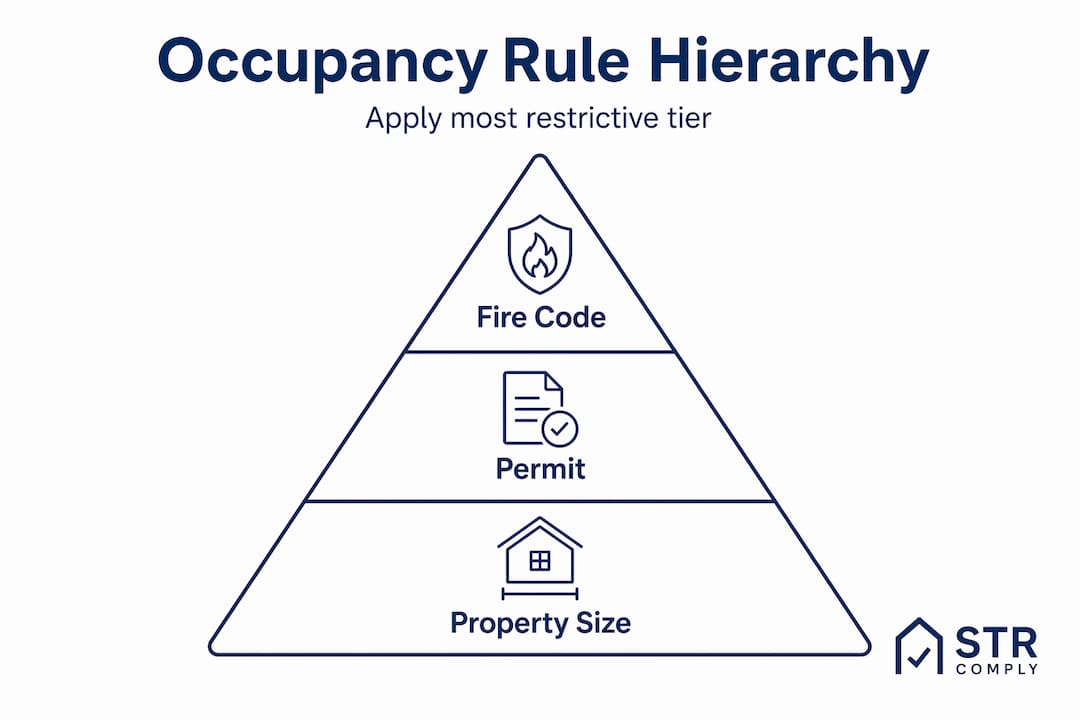
| Most restrictive rule governs | Always apply the most restrictive limit across fire code, building permit, and STR permit. |
| Airbnb caps at 16 guests | No listing can exceed 16 guests regardless of physical property size. |
| Build in an operational buffer | Setting limits slightly below the legal maximum reduces noise complaints and property wear. |
| Consistency across platforms | Occupancy limits must match on every booking channel to avoid legal and liability exposure. |
| Children require careful handling | Blanket age-based limits can trigger Fair Housing Act discrimination claims. |
Legal and regulatory foundations of occupancy limits
The first question every host needs to answer is: which rule actually applies to my property? The answer is almost always the same. You follow the most restrictive input, whether that comes from your local fire code, your building permit, or your short-term rental permit. Occupancy limits should reflect whichever of those three sources sets the lowest number.
Fire codes are the most commonly referenced starting point. Many jurisdictions use a baseline calculation of two persons per sleeping room plus two additional guests for the property as a whole. A three-bedroom home would therefore yield a fire code limit of eight guests under that formula. But fire codes are written for life-safety purposes, not rental management. Your STR permit or local zoning ordinance may impose a stricter cap, sometimes as low as two or four guests regardless of bedroom count.
The table below shows how common local standards vary across different regulatory layers:
| Regulation type | Typical occupancy standard | Example |
|---|---|---|
| State fire code | 2 per bedroom + 2 | 3-bed home = 8 guests |
| Local STR permit | Fixed cap by unit type | Max 6 guests regardless of bedrooms |
| Zoning ordinance | Varies by residential zone | Some zones prohibit groups over 4 |
| HOA rules | Often stricter than municipal code | Max 4 occupants including hosts |
| Airbnb platform policy | Global cap of 16 guests | Applies to all listings worldwide |
Failing to respect the most restrictive of these layers carries real consequences. Cities like New York, Los Angeles, and Denver have all levied fines ranging from hundreds to thousands of dollars per violation. Beyond fines, repeated violations can result in your STR permit being revoked, making your property ineligible for short-term rental use entirely.
Pro Tip: Before finalizing your listing’s guest capacity, pull the actual text of your local STR permit. Many cities post permit conditions online. The number printed on your permit is legally binding, even if it’s lower than what Airbnb’s platform would technically allow.
Understanding your local zoning restrictions is not optional. Zoning laws often restrict occupancy based on residential density goals, not just safety. A home in a single-family residential zone may face stricter limits than a property zoned for multi-family or mixed use, even if both homes have the same number of bedrooms.
Airbnb’s policies on guest capacity and maximum occupancy
Airbnb sets a firm global ceiling on Airbnb guest capacity. The platform caps all listings at 16 guests per booking, regardless of how large the property is or what local regulations permit. This limit exists primarily to prevent large gatherings and disruptive parties. Even if you own a 10-bedroom estate legally permitted for 25 guests, Airbnb will not allow your listing to reflect that number.
Here is how Airbnb’s occupancy-related policies work in practice:
- Guest count in listing settings: Hosts set their maximum guest count through the listing editor. Airbnb will not allow a number above 16 to be saved.
- Anti-party screening: Airbnb’s automated systems flag reservations with patterns associated with large events, particularly one-night bookings near holidays by local accounts.
- Booking restrictions: Guests under 25 booking locally face additional screening for properties with high guest capacities.
- House rules enforcement: Hosts can specify in their listing rules that only registered guests are allowed on the premises.
- Penalties for violations: Hosts who allow undisclosed guests face account suspension, removal of listings, or permanent bans.
Airbnb’s anti-party technology has proven effective. Fewer than 0.06% of U.S. stays resulted in reported parties in 2025, a figure the company attributes directly to its booking screening systems. That said, the platform’s policies do not replace your obligation to comply with local law. Airbnb’s 16-guest cap is a ceiling, not a recommendation. Your actual listing limit should be set at whatever your most restrictive local regulation specifies, which in most residential markets is well below 16.
The practical step here is to align your Airbnb listing settings with local permit conditions. If your STR permit authorizes six guests, your Airbnb listing should reflect six. Any gap between what your listing advertises and what your permit allows creates legal exposure that Airbnb’s terms of service will not protect you from.
Best practices for setting and enforcing occupancy limits
Knowing your legal maximum is only half the job. How you set and communicate that limit operationally determines whether you actually stay within it. Here is a step-by-step approach that professional hosts and property managers use:
- Set your listing capacity slightly below your legal maximum. Professional hosts set occupancy below the fire code or permit ceiling to create a practical buffer. For a property permitted for eight guests, listing at six gives you flexibility to handle edge cases without exceeding legal limits.
- Synchronize limits across every booking channel. If you list on Airbnb, VRBO, and a direct booking site, every channel must show the same maximum guest count. Occupancy limits must be enforced consistently across all platforms to avoid liability discrepancies.
- Write specific house rules. State clearly that only the number of guests listed in the reservation may be on the property. House rules with strict language identifying unauthorized visitors as trespassing have been shown to deter guests from bringing extra people.
- Include occupancy terms in your welcome message. Restate the guest limit in your pre-arrival communication. Guests are far less likely to push boundaries when limits are restated as a direct, personal message rather than buried in a terms document.
- Charge appropriate additional guest fees. Setting a per-guest fee above your base occupancy number compensates for added wear and signals that the limit is enforced, not arbitrary.
- Deploy technology to support enforcement. Smart home technologies such as noise monitors and smart locks give you objective data when occupancy violations occur and allow you to respond before situations escalate.
Pro Tip: Noise monitoring devices like Minut or NoiseAware do not record audio or video, so they comply with privacy regulations in most U.S. jurisdictions. They measure decibel levels only, which gives you defensible data without raising privacy concerns.
The combination of a conservative listing cap, clear house rules, and smart monitoring creates a layered approach that addresses the three most common failure points: guests who misrepresent group size, guests who invite others after check-in, and guests who genuinely did not read the rules.

Challenges and nuances in defining guest limits
Even with a solid policy in place, a few recurring complications catch hosts off guard. Understanding them before they come up saves you from reactive decision-making.
The two-per-bedroom baseline is not absolute. Fire codes use that formula as a minimum safety standard, but courts and regulators have sometimes interpreted rigid application as unreasonably restrictive. Applying a blanket two-per-bedroom rule while refusing to make any exceptions can attract scrutiny, particularly when children are involved.
Children create legal complexity. The Fair Housing Act prohibits occupancy policies that discriminate based on familial status. Setting a rule like “no more than two people per bedroom and children count as full occupants” can be legally defensible, but only if it is applied consistently and is grounded in legitimate property or safety concerns. A policy that effectively bars families with children from booking a two-bedroom unit at a capacity of two guests would likely fail a reasonableness test.
The safer approach is to define your limit by guest count without referencing age, then apply it uniformly to all bookings. If a local fire code permits eight guests and you set your listing at six, you are not creating a discriminatory policy. You are applying a uniform number-based limit.
- Local enforcement is largely complaint-driven. Regulatory inspections are often triggered by neighbor complaints about noise, parking, and late arrivals. A conservative occupancy limit reduces the probability of those complaints occurring.
- Consistency matters as much as the number itself. Granting exceptions to one guest group while denying them to another creates both legal risk and operational inconsistency. Your written policy should govern every booking.
- Over-listing damages neighborhood relationships. Hosts who consistently book at maximum capacity in residential neighborhoods tend to face formal complaints to local governments. That scrutiny often results in tighter municipal regulations affecting all hosts in the area.
“The occupancy limit you publish is also a statement about what kind of operation you run. Hosts who set conservative limits and enforce them consistently rarely face the regulatory problems that plague hosts who treat maximum capacity as a default setting.”
My take on occupancy limits after years in this space
I’ve seen hosts make the same mistake repeatedly. They look at their property’s physical space, calculate what it could technically hold, and set their Airbnb listing to match that number. That approach optimizes for the best-case booking while ignoring every risk that comes with maximum-capacity stays.
In my experience, the hosts with the fewest problems are not the ones with the biggest properties or the most permissive local rules. They are the ones who set limits below what they are technically allowed to post and communicate those limits clearly from the first point of contact with a guest.
What I’ve found is that technology actually changes the dynamic in your favor. A noise monitor does not just detect problems. It changes guest behavior before problems start. Guests who know the property is monitored behave differently from the first night. The investment pays for itself in avoided damage claims and neighbor complaints.
The nuance most articles skip is the coordination failure. Hosts who list on multiple platforms often discover that their Airbnb limit and their direct booking site limit do not match. That gap creates real liability. If a guest books through a channel that shows a higher occupancy number and a violation occurs, your ability to enforce your house rules becomes much weaker.
Set a number you can defend, apply it everywhere, and use tools that give you documentation when something goes wrong. The operational benefit is not just legal protection. Guests who book conservative-capacity listings tend to have better experiences because the property is not strained. That shows up directly in your reviews.
— Jure
How Strcomply helps you get occupancy limits right
Setting the correct occupancy limit requires knowing what your specific city or county actually requires. That research is time-consuming, and local regulations change more often than most hosts realize.
Strcomply gives hosts a fast, free way to check their listing’s compliance against local regulations, including permit conditions, zoning restrictions, and occupancy rules that apply to their specific address. Instead of spending hours parsing municipal code, you get a city-specific compliance summary that covers what your STR permit allows, what your local zoning zone restricts, and where your current setup may carry risk. For hosts managing multiple properties, Strcomply’s paid plans include permit tracking and regulatory update alerts, so a rule change in your market does not catch you off guard. Visit Strcomply to run your free compliance check today.
FAQ
What is the maximum number of guests allowed on Airbnb?
Airbnb enforces a global occupancy cap of 16 guests per listing, regardless of property size. Your actual limit may be lower based on local regulations.
How do I calculate the right occupancy limit for my rental?
Start with the most restrictive figure across your local fire code, building permit, and STR permit. Many fire codes use two persons per bedroom plus two as a baseline, but your permit may set a lower number.
Can I set my Airbnb occupancy limit below the legal maximum?
Yes. Setting your listing capacity below the permitted maximum is a recognized best practice. It creates an operational buffer that reduces noise complaints, property wear, and the risk of inadvertently exceeding your permit limit.
Do children count toward Airbnb occupancy limits?
Children typically count as guests for both Airbnb’s platform settings and local regulatory purposes. Policies that treat children differently from adults can raise Fair Housing Act concerns, so apply a uniform numeric limit to all guests regardless of age.
What happens if guests exceed the occupancy limit I set?
You can address the violation using your house rules, which form a contractual agreement through the Airbnb platform. Hosts who state house rules clearly and document violations with technology have stronger grounds to pursue refunds, security deposit claims, or guest removal.
Recommended
Check your city's STR regulations
Free compliance reports for 100+ US cities. Permits, taxes, zoning — all in one place.
Check My Address — Free