
Operating a short-term rental on Airbnb or VRBO without the right paperwork is not just risky. It can cost you the listing entirely. Essential rental compliance documents vary by city, and the requirements are detailed enough that even experienced hosts get caught short. Missing a single form, using the wrong insurance policy, or submitting a document with an inconsistent address can trigger rejection, fines, or forced delisting. This guide covers exactly what documents you need, how to prepare them correctly, and how to avoid the most common and costly mistakes.
Table of Contents
- Key criteria for essential compliance documents
- Essential document types every short-term rental host needs
- Common pitfalls and expert tips for preparing your compliance documents
- Comparison table of essential compliance documents by US city examples
- How to decide which compliance documents apply to your rental
- A fresh perspective on document compliance: Why precision beats speed
- Simplify your rental compliance with STR Comply
- Frequently asked questions
Key Takeaways
| Point | Details |
|---|---|
| Documentation timing | Compliance documents generally must be dated within the last 60 days to be valid. |
| Exact address matching | All paperwork must use the same precise address format to avoid application delays. |
| Commercial insurance | Homeowners insurance is insufficient; commercial liability coverage is required in most cities. |
| Multiple document types | You need to provide varied proof such as ID, utility bills, and insurance to fulfill requirements. |
| Preparation is key | Thorough and consistent preparation of documents prevents costly registration delays or penalties. |
Key criteria for essential compliance documents
To navigate compliance successfully, understanding core document criteria is the first step. Before you gather a single form, know what makes a document acceptable in the first place. Local authorities are not just looking for any paperwork. They check specific properties of each document.
Here are the core criteria your rental compliance documents must meet:
- Recency: Most jurisdictions require documents dated within 60 days of your application. Older bills or statements are routinely rejected.
- Address consistency: Every document must show the exact same property address format. Even small differences like “Ave” versus “Avenue” can cause problems.
- Document variety: You typically need multiple types of documents from different source categories. One utility bill alone rarely satisfies the requirement.
- Platform and local alignment: Documents must meet both your city’s municipal requirements and, in some cases, the documentation standards of the platform you list on.
Understanding rental license requirements in your jurisdiction before you start gathering documents will save you significant time. Many hosts skip this step and end up submitting the wrong combination of forms entirely.
Essential document types every short-term rental host needs
Knowing what to look for, let’s explore each essential document type in detail. The categories below represent what most US jurisdictions require, though local rules determine the specifics.
- Proof of primary residency or ownership: Accepted documents typically include utility bills, property tax statements, mortgage statements, or voter registration cards. The key is that they must come from different categories, not two utility bills from the same provider.
- Commercial general liability insurance: This is where many hosts stumble. Insurance coverage of $1,000,000 is a standard minimum, and the policy often needs to name the city or local authority as an additional insured party. Standard homeowners insurance will not satisfy this requirement.
- Government-issued photo ID: Your ID must match the address on file for the rental or your legal residence. Expired IDs are not acceptable.
- Detailed floor plan: A clear floor plan showing all rooms, exits, window locations, and the maximum occupancy for each bedroom is required in most cities. This is a safety and zoning document, not just an administrative one.
- HOA or landlord approval letters: If your rental is in a condo building, managed community, or you are a tenant subletting, you will likely need written approval from the homeowners association or property owner.
Understanding the full scope of rental registration details before submitting helps you anticipate documents you may not have considered.
Pro Tip: Order a fresh copy of your property tax statement directly from your county assessor’s office. It carries authority as a primary source and typically includes the exact official address format regulators expect to see on all other documents.
Common pitfalls and expert tips for preparing your compliance documents
To help ensure your documents meet standards, consider the common pitfalls and expert advice that follow. These are the errors that show up repeatedly in denied applications across US markets.
- Address mismatches: Address inconsistency causes most delays in short-term rental applications. Use your official property tax bill as the address reference and make sure every other document mirrors it exactly.
- Wrong insurance policy type: Hosts commonly submit homeowners or renters insurance thinking it qualifies. It does not. You need a commercial general liability policy written specifically for short-term rental operations.
- Outdated documents: A utility bill from three months ago may be past the acceptable window. Check the specific date requirement for your city before collecting documents.
- Poor record keeping: Random audits and neighbor complaints happen. If you cannot produce your compliance documents quickly, it creates legal exposure even if your original registration was approved.
- Missing jurisdiction-specific steps: Some cities require an in-person inspection, a notarized statement, or an interview with a local housing officer before issuing a permit. Research the full inspection rules for your specific municipality.
“The single most preventable reason short-term rental applications are rejected is address inconsistency across documents. Use your property tax bill as the master reference and copy that exact format onto every other submission.”
Pro Tip: Create a dedicated compliance folder, physical or digital, for each property you operate. Keep a copy of every submitted document, the date it was submitted, and the city portal or contact it was sent to. This record becomes essential if your registration is ever questioned.

Comparison table of essential compliance documents by US city examples
Reviewing these regional document requirements helps prepare hosts for varying local compliance landscapes. The table below highlights how major US markets differ in their mandatory leasing documents and housing compliance forms.
| Document type | Chicago | Boulder County | New York City |
|---|---|---|---|
| Proof of primary residency | Two recent documents from different categories, within 60 days | Proof of primary residence including tax payment records | Two proofs of permanent occupancy from different categories |
| Government-issued photo ID | Required, must match address | Required | Required |
| Commercial liability insurance | $1,000,000 minimum, city named as insured | Required with specific endorsements | Required |
| Floor plan | Required showing all rooms, exits, occupancy | Required | Required |
| HOA or landlord approval | Required if applicable | Required if applicable | Lease required if tenant |
| Local manager contact | Not standard | Required | Not standard |
| Property tax documentation | Used as address reference | Proof of tax payment required | Not separately required |
What this table makes clear is that the core document categories overlap significantly across cities. What differs is the level of specificity. For example, Boulder County requires proof of actual property tax payment, not just a statement. New York City structures its residency proof requirements around “permanent occupancy,” a legal term with specific meaning under local law. Always check zoning laws and permit checklists for your exact city before assuming that what worked in one market will transfer to another.
How to decide which compliance documents apply to your rental
With the varying rules in mind, follow these steps to apply the requirements to your specific rental effectively.
- Identify your city’s exact requirements. Start with your city’s official housing or licensing department website. Look for the short-term rental section specifically. Do not rely on blog summaries alone, including this one, as a substitute for the official checklist.
- Gather documents that match local formats and timeframes. Collect documents within the required date window, using the official address format from your property tax record as the reference point.
- Verify your insurance meets commercial coverage standards. Confirm your policy states “commercial general liability” and that the endorsement names the required local authority. Call your insurer directly if you are unsure.
- Keep copies and maintain currency. Compliance does not end at registration. Permits expire, insurance policies renew, and cities update their rules. A permit renewal system helps you track these deadlines before they catch you off guard.
- Respond promptly to all compliance inquiries. If a city auditor or platform contacts you about your registration status, respond within the requested timeframe. Delays signal non-compliance even when your documents are in order. Also ensure you understand your tax obligations alongside permit requirements, since transient occupancy tax registration is often a separate process.
One point worth emphasizing: false primary residence declarations carry serious consequences. Fines reaching $10,000 and potential criminal charges are not hypothetical. Regulators in cities like Chicago actively cross-reference registration data with other public records.
Pro Tip: Set calendar reminders 60 days before any permit or insurance policy expiration date. Renewing proactively, rather than reactively, prevents the gaps in legal status that attract penalties and platform suspensions.
A fresh perspective on document compliance: Why precision beats speed
Most hosts approach compliance paperwork the way they approach online forms in general: fill it in, submit it, move on. That instinct is understandable. But it is exactly the mindset that drives the majority of application rejections.
The reality is that automated review systems used by many city portals are not forgiving. They flag discrepancies that a human reviewer might overlook, such as a unit number formatted as “#3B” on one document and “Unit 3B” on another. Address mismatches trigger automatic holds, and resolving them often means restarting the process entirely rather than simply correcting the error.
Speed matters far less than accuracy when it comes to rental property compliance. A submission that takes an extra week to prepare correctly will always beat a fast submission that gets rejected and delayed by months. The hosts who maintain clean compliance records over time are not the ones who move fastest. They are the ones who treat documentation as a discipline rather than a task.
There is also a longer view worth taking. When you build a reputation as a compliant, well-documented host, renewals go smoother, platform reviews carry less risk, and regulatory changes are less disruptive. The host compliance insights available to well-organized hosts demonstrate that consistent preparation reduces both administrative stress and financial exposure over time.
Proactive document collection, where you maintain a current, organized compliance file before you need it rather than scrambling when an application window opens, is the single most underused practice in the short-term rental industry.
Simplify your rental compliance with STR Comply
Gathering and managing essential rental compliance documents across multiple listings and jurisdictions is time-consuming work. STR Comply is built specifically to reduce that burden for Airbnb and VRBO hosts across the United States.
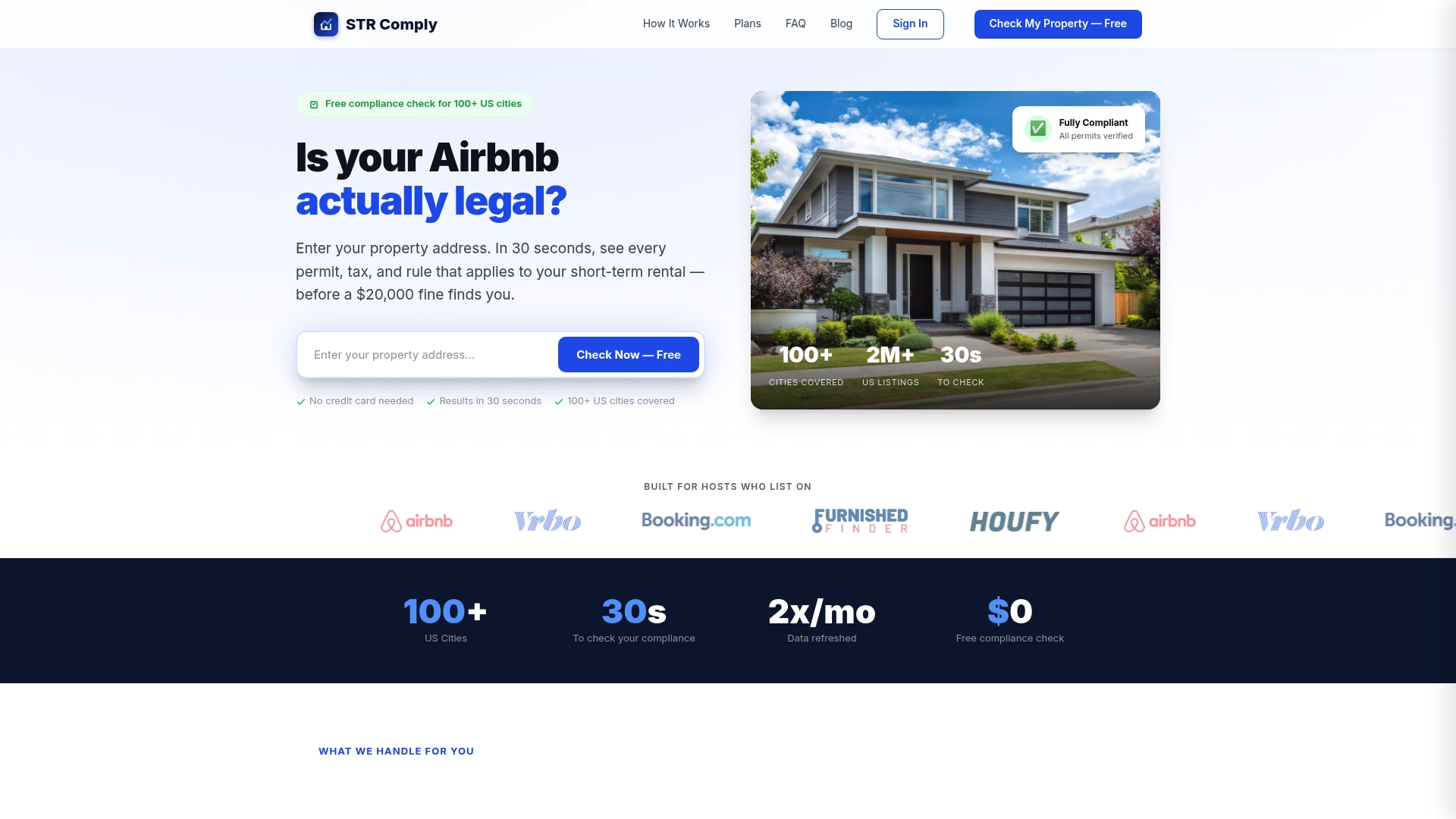
You can run an instant legal check on your property in seconds to see exactly what permits, taxes, and documentation your specific city requires. No guesswork, no hours of research. STR Comply provides city-specific compliance summaries, renewal deadline alerts, and a centralized dashboard to manage your entire portfolio. Whether you operate one property or twenty, staying current with local regulations is easier when the information comes directly to you. Visit STR Comply to check your listing today, and review our terms of service to understand exactly what the platform covers.
Frequently asked questions
What documents prove primary residency for short-term rental registration?
You must provide at least two recent documents from different categories, such as utility bills, property tax statements, or voter registration cards, all matching your rental address and typically dated within the last 60 days.
Is homeowners insurance enough for rental compliance?
No. Homeowners insurance does not qualify for short-term rental registration. You need commercial general liability insurance with at least $1,000,000 in coverage, and many cities require the policy to name local authorities as an additional insured party.
How can I avoid delays or rejections in the rental registration process?
Use your property tax bill as the master address reference and copy that exact format across all documents. Submit only documents within the required date window and follow each step in your city’s official checklist.
What penalties exist for false residency declarations?
False residency declarations can result in fines up to $10,000 and potential criminal charges, making accuracy in all primary residence documentation a legal necessity, not just a formality.
Do I need a floor plan for rental registration?
Yes, most jurisdictions require a floor plan showing rooms, exits, and maximum occupancy limits for each bedroom to verify that the property meets local safety and zoning standards.
Recommended
Check your city's STR regulations
Free compliance reports for 100+ US cities. Permits, taxes, zoning — all in one place.
Check My Address — Free