
Multi-city compliance for short-term rental hosts is defined as the ongoing process of meeting every permit, tax, zoning, and operational requirement in each city where you list a property. Managing this across jurisdictions is one of the highest-risk areas in short-term rental management today. A single missed permit renewal or an outdated transient occupancy tax filing can trigger fines, delisting from platforms like Airbnb or VRBO, or legal liability. Knowing how to stay compliant in multiple cities requires a deliberate system, not a one-time checklist. This guide gives you that system.
How to stay compliant in multiple cities using a compliance matrix
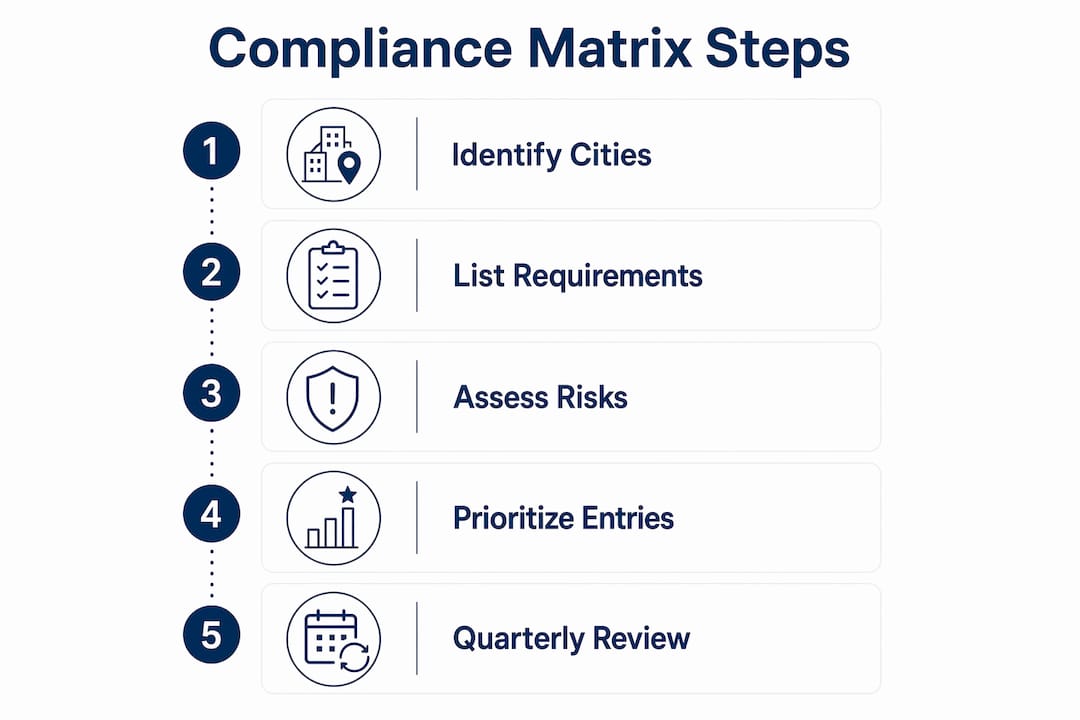
A compliance matrix is the most effective starting point for managing city-specific compliance rules across a portfolio. It is a structured document that maps each city against key regulatory domains: short-term rental permits, transient occupancy tax registration, zoning restrictions, liability coverage requirements, and operational rules like noise ordinances or occupancy caps. The matrix gives you a single view of where you stand in every market.
Quarterly reviews are the recommended minimum for updating a compliance matrix. City councils pass new ordinances, tax rates change, and permit renewal windows shift. A matrix you built in january may be dangerously outdated by april without a scheduled review process.
Prioritize your matrix entries by two factors: enforcement risk and revenue exposure. A city that generates 40% of your rental income and has a history of active code enforcement deserves more attention than a low-revenue market with minimal regulatory activity. Legal experts advise evaluating each city’s penalty history and enforcement frequency to focus efforts where risk is greatest.

The table below shows a simplified compliance matrix structure for a three-city portfolio.
| City | STR Permit | Transient Occupancy Tax | Zoning Status | Next Renewal |
|---|---|---|---|---|
| Austin, TX | Active | Registered | Compliant | march 2027 |
| Nashville, TN | Pending renewal | Registered | Review needed | june 2026 |
| Denver, CO | Active | Not registered | Compliant | october 2026 |
Pro Tip: Color code each cell green, yellow, or red based on status. A red cell means immediate action is required. This visual system lets you scan a 20-city portfolio in under two minutes.
What tools and technologies help automate multi-city compliance?
Manual compliance tracking across multiple cities is unsustainable. Regulatory churn is constant, and human error in spreadsheet-based systems creates gaps that inspectors and platform algorithms will find before you do. Automation is not optional at scale. It is the only way to keep pace.
The right technology stack for multi-city rental compliance covers four functions:
- Regulatory monitoring: Automated alert systems that flag new ordinances, tax rate changes, or permit requirement updates in your active markets. Without this, you rely on news searches and word of mouth.
- Centralized document management: A single repository for all permits, tax registration certificates, and zoning approvals across every city. This eliminates the “I think it’s in my email” problem during an inspection.
- Audit scheduling and task assignment: Workflow tools that assign compliance tasks to specific team members with deadlines. Accountability requires named owners, not shared inboxes.
- Renewal alerts: Automated reminders tied to permit and license expiration dates. Compliance deadlines across cities frequently do not align, creating an ongoing management burden beyond annual cycles.
Role-based access control matters when you manage a team. A property manager in Nashville should see Nashville’s compliance documents. A portfolio director needs the full picture. Mixing access levels creates confusion and increases the risk of unauthorized changes to critical records.
Pro Tip: Integrate your compliance platform with your property management system and accounting software. When a permit renewal triggers a fee, that expense should flow automatically into your financial records without a manual entry.
Strcomply is built specifically for this workflow. Its dashboard centralizes permit tracking, renewal alerts, and city-specific regulatory updates for short-term rental portfolios across the United States.
How to audit compliance documents, permits, and training across cities
Audits are the mechanism that confirms your compliance matrix reflects reality. A matrix entry that says “permit active” means nothing if the physical permit document is expired or stored in a system no one can access. Audits close that gap.
Schedule compliance audits at least quarterly. This frequency aligns with the recommended review cycle for multi-location operators and reduces citation risks caused by outdated or headquarters-level policy reliance. Annual audits are not sufficient when city councils can pass new ordinances in a single meeting.
A complete audit for each city should cover the following steps:
- Verify permit status. Confirm that every active short-term rental permit is current, correctly listed on your platform profiles, and stored in your document system.
- Check tax registration and filings. Confirm transient occupancy tax registration is active and that recent filings match reported revenue. Discrepancies here attract audits from city revenue departments.
- Review zoning compliance. Confirm the property still falls within the permitted zone for short-term rentals. Zoning maps change, and a property that was compliant last year may now require a variance.
- Audit operational restrictions. Check that your listings comply with current occupancy limits, noise ordinance disclosures, and any required safety postings like fire escape routes or emergency contact numbers.
- Document corrective actions. When you find a gap, log it with a resolution date and the name of the person responsible. This audit trail demonstrates due diligence if a city inspector arrives.
Pro Tip: Keep a dated audit log for every city in your portfolio. If a regulator questions your compliance history, a documented trail of quarterly audits is your strongest defense.
How to manage differing city regulations without losing your mind
Local ordinances frequently impose stricter standards than federal or state law, and they sometimes contradict each other. A host operating in three cities may face three different definitions of what constitutes a “short-term rental,” three different permit fee structures, and three different rules about owner-occupancy requirements.
The strictest-denominator approach resolves much of this complexity. You identify the most demanding requirement across all your markets and apply it as your internal standard everywhere. If one city requires a fire safety inspection annually and others do not, you conduct annual fire safety inspections at every property. This approach reduces the risk of non-compliance and simplifies staff training.
The table below illustrates how conflicting rules can be resolved using this method.
| Regulatory area | City A requirement | City B requirement | Internal standard applied |
|---|---|---|---|
| Max occupancy disclosure | Not required | Required on listing | Required at all properties |
| Permit display | Physical posting required | Not required | Physical posting at all properties |
| Noise ordinance hours | 10 PM cutoff | 11 PM cutoff | 10 PM cutoff enforced everywhere |
| Owner-occupancy rule | Not required | Required | Tracked and documented for all |
The strictest-denominator approach does have a cost. It raises your baseline operational requirements. The tradeoff is worth it because location of the asset determines applicable regulations, not your company’s headquarters. A policy written for your home market will fail in every other city you enter.
For cities where enforcement is rare and penalties are low, you can apply a lighter monitoring cadence. Focus your resources on high-enforcement markets first. This is not cutting corners. It is risk-based resource allocation.
Common mistakes when managing compliance across multiple cities
Most compliance failures in multi-city portfolios share the same root causes. Recognizing them early prevents expensive corrections later.
- Relying on headquarters policies. A policy written for your home market will not meet the requirements of every city you operate in. Each location has its own rules, and compliance must be location-specific and dynamic.
- Skipping regulatory monitoring. Even voluntary local benchmarking programs can evolve rapidly into mandatory, penalty-backed standards. What is optional today may carry fines by next quarter.
- Treating audits as annual events. Quarterly audits are the minimum. Annual reviews leave too much time for undetected violations to accumulate.
- Using spreadsheets for large portfolios. Spreadsheets break down above five or six cities. Version control errors and missed updates are common. Dedicated compliance platforms eliminate these failure points.
- Ignoring penalty exposure in new markets. Non-compliance in cities like New York City can result in fines of $268 per ton CO2e over the limit under Building Performance Standards. That scale of financial exposure demands attention before you list, not after.
“Successful multi-city compliance requires moving beyond annual compliance cycles to continuous real-time monitoring integrated into capital planning and operational workflows.”
Real-time monitoring means your system flags a regulatory change the day it passes, not the day your permit renewal bounces. That speed is the difference between a quick update and a citation.
Key takeaways
Staying compliant across multiple cities requires a location-specific, technology-supported system that maps requirements, monitors changes, and audits status on a quarterly basis.
| Point | Details |
|---|---|
| Build a compliance matrix | Map every city against permits, taxes, zoning, and operational rules, and review it quarterly. |
| Automate regulatory monitoring | Use dedicated platforms to receive real-time alerts on ordinance changes and renewal deadlines. |
| Audit quarterly, not annually | Quarterly audits catch violations before they become citations or platform delistings. |
| Apply the strictest standard | Use the most demanding local rule as your internal baseline to cover all markets at once. |
| Prioritize by enforcement risk | Focus compliance resources on high-enforcement, high-revenue cities first. |
The compliance mistake I see most often
I have worked with property managers who run tight operations in their home market and then expand to three or four new cities assuming the same rules apply. They do not. The permit that works in Phoenix means nothing in Austin. The transient occupancy tax rate in Nashville is not the same as in Denver. Every city writes its own rules, and the gap between what hosts assume and what the law actually requires is where fines happen.
The operators who stay out of trouble share one habit: they treat compliance as an ongoing operational function, not a setup task. They schedule quarterly reviews. They assign named owners to each city’s compliance file. They use technology to catch changes they would otherwise miss. They check local regulation requirements before they list, not after a citation arrives.
The hosts who struggle tend to centralize everything at headquarters and assume that one policy covers all markets. It never does. The city where your property sits determines the rules, not the city where your office is. That single shift in thinking changes how you build your entire compliance system.
My practical advice: start with your two highest-revenue markets and build a complete compliance file for each one. Get those right, then replicate the process. Trying to fix all cities at once leads to shallow coverage everywhere. Depth in your top markets first, then expand the system. That approach holds up under scrutiny.
— Jure
Strcomply makes multi-city compliance manageable
Managing compliance across a growing short-term rental portfolio gets harder as you add cities. Each new market brings new permit requirements, tax obligations, and zoning rules that your existing processes may not cover.

Strcomply is built specifically for this challenge. The platform gives hosts and property managers a centralized dashboard for permit tracking and renewal alerts, city-specific compliance summaries, and real-time regulatory updates across U.S. markets. You can check whether a listing meets local requirements before you go live, then monitor ongoing compliance without manual research. For hosts managing portfolios across multiple cities, Strcomply reduces the time spent on regulatory research and the risk of missing a critical deadline. Visit Strcomply to check your listings today.
FAQ
What is multi-city compliance for short-term rentals?
Multi-city compliance is the process of meeting all permit, tax, zoning, and operational requirements in each city where you operate a short-term rental. Requirements vary by location and cannot be managed with a single unified policy.
How often should I audit my compliance status across cities?
Quarterly audits are the recommended minimum for multi-city short-term rental portfolios. This frequency reduces citation risks from outdated permits, tax filings, or zoning changes.
What is the strictest-denominator approach to compliance?
The strictest-denominator approach means applying the most demanding local rule across all your markets as your internal standard. It simplifies staff training and reduces the risk of non-compliance in any single city.
Why can’t I use my headquarters policy for all cities?
The location of your property determines which regulations apply, not where your business is registered. Each city sets its own permit requirements, tax rates, and operational restrictions independently.
How does Strcomply help with compliance across cities?
Strcomply provides city-specific compliance summaries, permit tracking, renewal alerts, and regulatory updates for short-term rental hosts operating across multiple U.S. markets. You can learn more about multi-market compliance on the Strcomply blog.
Recommended
Check your city's STR regulations
Free compliance reports for 100+ US cities. Permits, taxes, zoning — all in one place.
Check My Address — Free