
Running a short-term rental feels straightforward until tax season arrives. The tax obligations for hosts span federal income reporting, state sales taxes, local lodging levies, and registration requirements, each with its own rules, deadlines, and penalties. Many hosts assume their booking platform handles everything. It does not. Getting this wrong can result in back taxes, fines, or losing your ability to operate legally. This guide breaks down every major obligation you need to understand, with specific examples and practical steps to keep your rental compliant in 2026.
Table of Contents
- Key Takeaways
- 1. Understanding what determines your tax obligations as a host
- 2. Federal rental income reporting
- 3. Occupancy and lodging tax collection and remittance
- 4. State sales tax obligations
- 5. Local transient guest taxes and multilayered fees
- 6. Self-employment tax exposure on Schedule C
- 7. Schedule E vs. Schedule C: knowing which applies
- 8. Licensing and registration requirements
- 9. Recordkeeping and audit readiness
- 10. Tax workflow strategies hosts often overlook
- My take on tax obligations for hosts in 2026
- How Strcomply helps you manage your tax obligations
- FAQ
Key Takeaways
| Point | Details |
|---|---|
| Federal income still applies | Even without a Form 1099-K, all rental income must be reported to the IRS. |
| Schedule E vs. Schedule C matters | The level of guest services you provide determines which form you use and whether self-employment tax applies. |
| Local taxes are your responsibility | Even when platforms collect some taxes, hosts often must still register, report, and reconcile independently. |
| The 14-day rule has limits | Federal income may be exempt under this rule, but local lodging taxes still apply regardless. |
| Early registration prevents penalties | Licensing and tax remittance registration must happen before you start collecting, not after. |
1. Understanding what determines your tax obligations as a host
Before you can manage your tax obligations for hosts correctly, you need to understand what triggers them. Not every rental situation is treated the same way by the IRS or local governments.
The most critical factors include:
- Rental frequency and duration. The 14-day rule exempts rental income from federal reporting if you rent your property for fewer than 15 days per year. However, local lodging and occupancy taxes still apply during those days. Federal exemption does not cancel local obligations.
- Level of guest services. If you offer hotel-like amenities such as daily housekeeping, concierge assistance, or prepared meals, the IRS may classify your activity as a business rather than a rental. That shifts your reporting from Schedule E to Schedule C.
- Gross income and transaction volume. For tax year 2026, Form 1099-K requires both $20,000 in gross payments and 200 transactions before a platform issues the form. Critically, income is taxable whether or not you receive this form.
- Local registration requirements. Many cities require hosts to register for a rental license and a tax remittance certificate before they collect a single dollar from guests.
- Platform behavior in your jurisdiction. Some platforms collect and remit lodging taxes on your behalf in certain cities. Others do not. You cannot assume your platform covers all applicable taxes.
Pro Tip: Check your city’s revenue or finance department website directly. Platform tax collection pages are often incomplete or lagging behind local law changes.
2. Federal rental income reporting
Every dollar you earn from renting your property is taxable income at the federal level, regardless of how you receive it. The IRS does not require a 1099-K for you to owe taxes. Income is taxable even if you never receive the form.

Most hosts without substantial services report rental income on Schedule E of their personal tax return. This form allows deductions for mortgage interest, property taxes, insurance, repairs, and depreciation proportional to rental use.
If your state has lower 1099-K thresholds than the federal standard, you may receive the form even if your earnings fall below the $20,000 federal threshold. States like Illinois, Maryland, Massachusetts, Missouri, Vermont, Virginia, and Washington, D.C. apply lower state thresholds, meaning platforms must issue the form earlier in those jurisdictions.
3. Occupancy and lodging tax collection and remittance
Transient occupancy taxes (TOT) and lodging taxes are separate from your federal income tax. These are taxes your guests owe, and you are responsible for collecting them on the government’s behalf and remitting them to the correct local authority.
Understanding your local occupancy tax obligations before you list your property is not optional. Failure to collect and remit these taxes makes you personally liable for the amounts owed, plus potential penalties and interest.
Some platforms collect and remit lodging taxes automatically in specific jurisdictions. But even where they do, hosts are often still required to register with the local tax authority and file periodic reports. Local compliance frequently requires monthly reconciliations beyond trusting platform collection.
Pro Tip: Download your monthly earnings summary from your platform and compare it against what you remitted locally. Discrepancies discovered during an audit are far more costly than catching them early yourself.
4. State sales tax obligations
Short-term rentals are subject to state sales tax in many states, and how that tax gets collected varies significantly. In some states, the platform collects and remits state sales tax automatically. In others, the responsibility falls entirely on you.
Missouri is a notable example where hosts cannot assume the platform handles state sales tax. In states like this, you may need to register for a state sales tax permit, collect the appropriate percentage from guests, and file returns on a monthly or quarterly basis.
Check the tax authority website for every state where you operate. State sales tax rates, filing frequencies, and registration requirements differ meaningfully from one jurisdiction to the next.
5. Local transient guest taxes and multilayered fees
Some cities layer multiple taxes on top of each other, and every one of them requires separate tracking and remittance. Kansas City is a clear example. Hosts there must manage transient guest tax, occupancy fees, state sales tax, and a KCMO earnings tax, each with its own filing deadline and remittance process.
This kind of layered structure is more common than most hosts expect. Cities with high tourism activity often have multiple overlapping tax authorities, each with independent rules. Assuming one registration covers all of them is a costly mistake.
Read the complete local STR tax obligations for every city where you host. Never assume your registration in one tax program satisfies the requirements of another.
6. Self-employment tax exposure on Schedule C
If you provide substantial services to guests, the IRS may treat your rental activity as a business. That means reporting income on Schedule C and paying self-employment tax at 15.3% on net profit, in addition to regular income tax.
Hosts who provide hotel-like services such as concierge assistance, prepared meals, or daily housekeeping report on Schedule C. Standard cleaning between guest stays does not qualify as substantial services. The distinction matters significantly because Schedule C also allows broader business deductions but comes with higher overall tax exposure.
Documenting the services you provide is critical if the IRS ever questions your classification. Keep records of service logs, receipts, and any marketing materials that describe what guests receive.
7. Schedule E vs. Schedule C: knowing which applies
The choice between these two forms has a large impact on your total tax bill. Here is a direct comparison:
| Factor | Schedule E | Schedule C |
|---|---|---|
| Typical use case | Passive rental income, minimal services | Active business with substantial guest services |
| Self-employment tax | Not applicable | Applies at 15.3% on net profit |
| Deductible expenses | Rental-proportional expenses | Broader business expense deductions |
| Loss treatment | Passive loss rules apply | Active loss may offset other income |
| IRS classification | Rental activity | Business activity |
Tax form choice depends more on the level of guest services rendered than on rental duration alone. A host who rents a property for 30 days with no added services uses Schedule E. A host who provides daily amenities for 10 days may be required to use Schedule C.
Pro Tip: If you are unsure which form applies to your situation, document your services in detail before filing. This documentation protects you if the IRS questions your classification, and a tax professional can use it to make a defensible determination.
8. Licensing and registration requirements
Registration is not just paperwork. In most jurisdictions, you are legally required to hold a valid rental license and a tax remittance certificate before you accept your first booking. Operating without them can result in fines, forced removal of your listing, or both.
Cities like Bend, Oregon require hosts to register and file monthly reports even when platforms collect lodging taxes on their behalf. The city still requires hosts to reconcile platform gross earnings against their own records and submit documentation to maintain their license.
Understanding what rental registration involves in your specific city is the starting point for every other tax obligation. Without registration, remittance alone does not protect you from penalties.
9. Recordkeeping and audit readiness
Strong recordkeeping is the backbone of any defensible tax filing. Hosts who cannot document their income, expenses, and service levels are exposed during audits even when they have complied in good faith.
Keep these records for every property and every tax period:
- Monthly gross earnings reports from each platform
- Receipts for all deductible expenses (repairs, supplies, utilities, insurance)
- Records of personal use days versus rental days
- Documentation of any guest services provided
- Copies of all filed tax returns and remittance receipts
- Correspondence with local tax authorities
Hosts should develop monthly workflows using gross earnings data from their platforms for accurate remittance and audit readiness. Waiting until year-end to compile this data creates errors and missed deductions.
10. Tax workflow strategies hosts often overlook
Several essential tax tips for hosts fall outside the standard compliance checklist, yet they prevent costly problems.
File your W-9 immediately. If you do not provide your tax ID to the platform, they are required to withhold 28% of your gross rental income. That 28% withholding rate may significantly exceed your actual tax liability, tying up cash you could otherwise use.
Understand what your platform actually remits. Platforms publish tax collection tables by jurisdiction, but these change. Verify what your platform remits in your city at least quarterly, and reconcile it against what is owed.
Separate personal use from rental use. Every day you use your property personally affects what you can deduct. Mixed-use properties require expense allocation, and the IRS scrutinizes this closely.
Consult a tax professional for complex situations. If you operate in multiple states, provide substantial services, or manage several properties, a CPA with short-term rental experience will save you more than their fee.
Pro Tip: Set a recurring monthly calendar event to pull your platform earnings report, compare it to your local remittance obligations, and file any required reports. Keeping this current prevents the year-end scramble that leads to filing errors.
My take on tax obligations for hosts in 2026
I’ve worked with enough short-term rental hosts to recognize a consistent pattern. The hosts who face the most painful compliance problems are not the ones who ignored taxes completely. They are the ones who assumed their platform handled more than it did.
In my experience, the most underestimated risk is local compliance. Hosts correctly report federal income and then discover months later that they owe back taxes, penalties, and interest to a city they never registered with. A city like Bend or Kansas City does not care that Airbnb collected some taxes on your behalf. If you were supposed to register and file monthly reports independently, that obligation stands regardless of what the platform did.
What I’ve learned is that proactive tax planning is far less expensive than reactive fixes. A qualified CPA familiar with short-term rentals, combined with a compliance tool that monitors local registration requirements, reduces risk dramatically. The cost of getting ahead of this is a fraction of what a back-tax assessment or listing suspension costs.
The hosts who run profitable, sustainable operations treat compliance as a fixed operating cost, not as a problem to solve when something goes wrong. That mindset shift changes how you set pricing, manage cash flow, and approach expansion into new markets.
— Jure
How Strcomply helps you manage your tax obligations
Short-term rental tax compliance involves tracking federal filings, local registrations, remittance deadlines, and platform-specific tax collection behavior across multiple jurisdictions. Doing that manually across even two or three properties is a significant administrative burden.
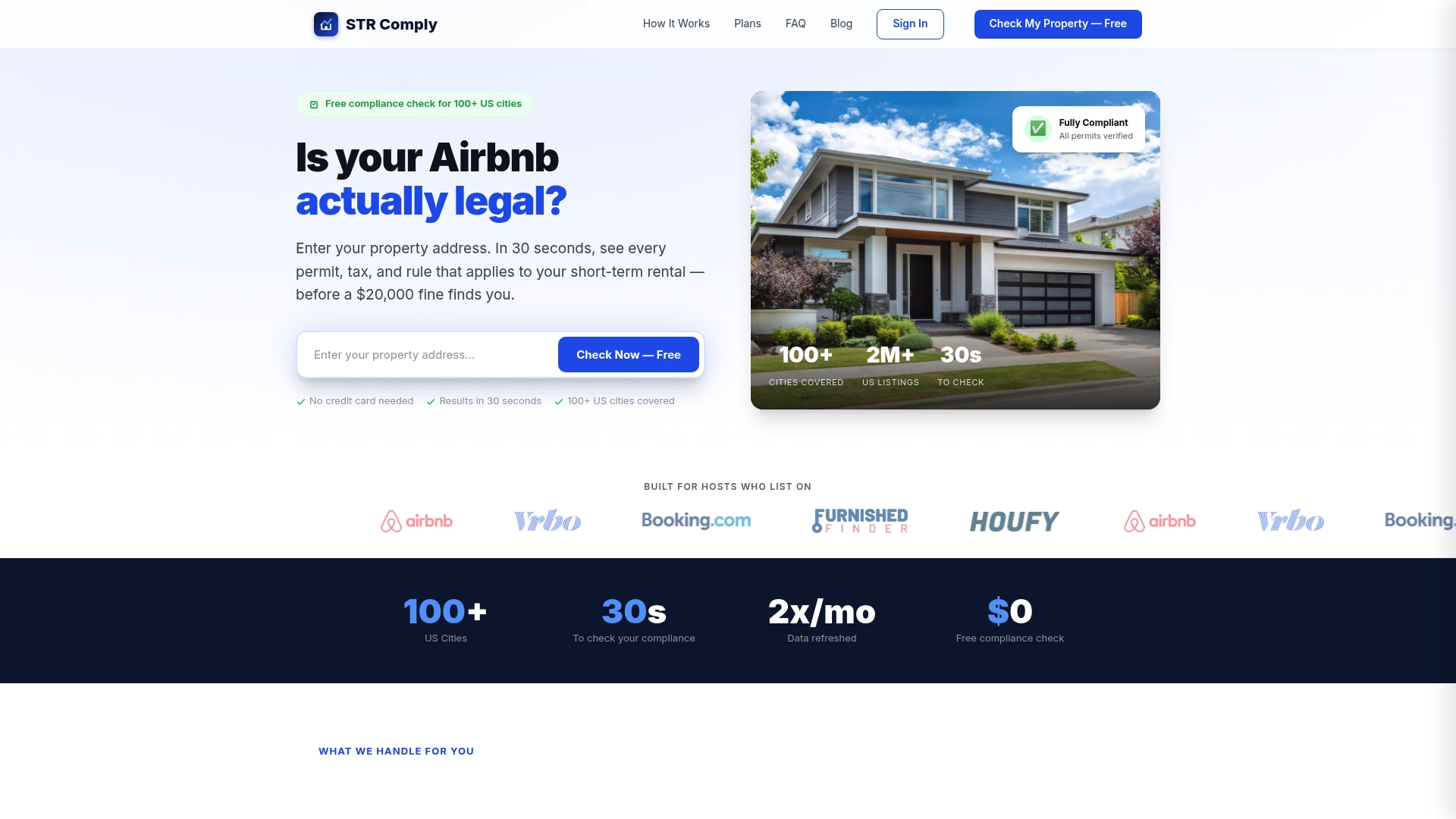
Strcomply provides city-specific compliance summaries that detail permit requirements, tax obligations, and operational restrictions for your listings on Airbnb, VRBO, and similar platforms. The platform’s dashboard tracks registration status, renewal deadlines, and regulatory updates so nothing falls through the gaps. For hosts managing multiple properties or expanding into new markets, Strcomply reduces the research burden that typically requires hours of legal review. You can check your listing’s compliance status and review your service terms to understand exactly what Strcomply covers before you commit. Staying compliant should not require a law degree. Strcomply makes that a realistic standard for every host.
FAQ
What are the main tax obligations for short-term rental hosts?
Hosts typically owe federal income tax on rental earnings, state sales tax, and local lodging or transient occupancy taxes. Registration with local tax authorities is often required separately from income reporting.
Does the 14-day rule eliminate all tax obligations?
No. The 14-day rule exempts rental income from federal reporting if the property is rented fewer than 15 days, but local lodging and occupancy taxes still apply during those rental days.
When does a host use Schedule C instead of Schedule E?
Schedule C applies when a host provides substantial services to guests, such as daily housekeeping, concierge, or meals. Standard cleaning between guests does not qualify, and most passive rentals use Schedule E.
Does receiving a Form 1099-K mean my income was not taxable before?
No. Rental income is taxable whether or not a 1099-K is issued. The form is a reporting tool for the IRS, not the trigger for your tax liability.
What happens if I do not register with my local tax authority?
Operating without required registration can result in back taxes, penalties, interest, and forced removal of your listing. Cities like Bend, Oregon require registration even when platforms remit lodging taxes automatically.
Recommended
Check your city's STR regulations
Free compliance reports for 100+ US cities. Permits, taxes, zoning — all in one place.
Check My Address — Free