
Local ordinances are the primary legal framework governing short-term rental operations on platforms like Airbnb, dictating where hosts can list, what permits they must hold, and what penalties apply for violations. The role of local ordinances in Airbnb is not passive. Cities from New York to San Diego have moved from passive rule-setting to active enforcement, using platform data, automated monitoring, and significant fines to bring hosts into compliance. If you operate or plan to operate a short-term rental in the United States, understanding this regulatory framework is no longer optional. It is the foundation of a legally sound hosting business.
How do local zoning laws shape short-term rental permissions?
Zoning codes define the permitted uses for every parcel of land in a municipality, and zoning restrictions are the first legal barrier most Airbnb hosts encounter. A residential zone designation does not automatically permit short-term rentals. Many cities treat STRs as a commercial activity, which means operating one in a purely residential zone can be a direct zoning violation before a single guest checks in.
Courts and cities have increasingly relied on the legal distinction between “dwelling” and “transient occupancy” to regulate STRs without passing new ordinances. This matters because a city can effectively ban Airbnb-style rentals by enforcing existing zoning language rather than writing new law. Hosts who assume silence in the code means permission are frequently wrong.
The impact of zoning laws on STR legality varies significantly by zone type:
- Residential zones (R1, R2): Often the most restrictive. Many cities prohibit non-owner-occupied STRs entirely or cap rental nights per year.
- Multi-family housing zones: Frequently subject to additional restrictions, including building-wide bans or limits on the number of units that can operate as STRs.
- Historic districts: Cities like Charleston, South Carolina, and Savannah, Georgia, apply overlay restrictions that limit STR density to protect neighborhood character.
- Mixed-use and commercial zones: Generally more permissive, but still require permits and may impose operational conditions.
Pro Tip: Before listing any property, pull the parcel’s zoning designation from your city’s GIS map or planning department portal. Cross-reference it with the municipal code’s definition of “short-term rental” or “transient occupancy.” This single step can prevent a costly compliance violation.
What permits and licenses do Airbnb hosts typically need?
Short-term rental permits are the most common Airbnb legal requirement imposed by local ordinances, and most U.S. cities now require at least one form of registration before a host can legally operate. STR permit fees range from $50 to $500 annually in cities like Nashville, Denver, Austin, and most California markets. That range reflects the significant variation in how cities structure their programs, not just cost differences.
The typical permit framework includes several layers:
- Short-term rental permit or license: The core registration that establishes your listing as legally recognized. Most cities require annual renewal.
- Business license: Required in cities like Denver and Portland, treating the STR as a commercial enterprise regardless of scale.
- Transient occupancy tax (TOT) registration: Separate from the permit, this registers you as a tax collector for the city. Airbnb remits TOT on behalf of hosts in many markets, but registration is still the host’s responsibility.
- Primary residence certification: Cities including San Francisco, New York, and Los Angeles restrict STR permits to a host’s primary residence, limiting the number of nights non-primary properties can be rented.
- Occupancy limit compliance: Most permits specify maximum guest counts, often tied to bedroom count or square footage.
| Requirement | What it means for hosts |
|---|---|
| STR permit ($50–$500/year) | Must be obtained before listing; renewal deadlines vary by city |
| Business license | Treats your rental as a commercial activity; required in many major cities |
| TOT registration | You are legally responsible for tax collection even if the platform remits it |
| Primary residence rule | Non-primary properties face stricter limits or outright bans in many cities |
| Occupancy cap | Guest limits are set by code, not by host preference |
Pro Tip: Display your permit number on your Airbnb listing. Many cities now require it, and platforms like Airbnb and VRBO have fields specifically for registration numbers. Missing this detail can trigger a compliance flag even if your permit is valid.
How are local ordinances enforced and what risks do non-compliant hosts face?
Enforcement of short-term rental rules has shifted from complaint-driven inspections to data-driven platform cooperation, and the results are dramatic. After New York City enacted Local Law 18, Airbnb listings dropped from approximately 38,000 in early 2023 to about 3,000 by mid-2025. That is a reduction of over 90%, achieved primarily through requiring platforms to verify host registration before allowing listings to go live.

California’s SB 346, effective in 2026, mandates that platforms share host data quarterly with cities, including addresses, booking history, and registration status. This law removes the enforcement gap that previously allowed unregistered hosts to operate invisibly. Cities that adopt enabling ordinances under SB 346 now have direct access to the data they need to identify and penalize non-compliant hosts.
The financial risks of non-compliance are significant:
- Standard fines: Operating without a required permit typically carries fines of $1,000 to $5,000 per violation in most jurisdictions.
- Daily compounding penalties: San Francisco imposes a $484 daily fine for unlicensed listings. A single month of non-compliance can generate over $14,000 in penalties.
- Misdemeanor charges: Some jurisdictions, including parts of California and New York, treat repeat violations as criminal offenses.
- Platform delisting: Cities with platform enforcement agreements can require Airbnb or VRBO to remove non-compliant listings without notice to the host.
- Permit revocation: A single substantiated complaint can trigger a permit review, and violations can result in permanent revocation.
San Diego’s enforcement model illustrates how self-funded programs work. The city generated $7.5 million in STR license fees, which covered a $6.7 million enforcement budget and led to the removal of 7,000 illegal listings. This model is being replicated in cities across the country, meaning enforcement capacity is growing, not shrinking.
Pro Tip: Check whether your city has a data-sharing agreement with Airbnb or VRBO. If it does, assume your listing is visible to local enforcement. Operating as if you are invisible is the most common and costly mistake hosts make.
How do operational rules beyond zoning affect day-to-day Airbnb hosting?
Cities apply a dual regulatory approach to short-term rentals: zoning ordinances determine where STRs are permitted, while separate operational ordinances govern how they must behave. Hosts who clear the zoning hurdle still face a second layer of rules that directly affect guest experience and daily operations.
Common operational restrictions include:
- Noise ordinances: Most cities apply general noise rules to STRs, but some jurisdictions have STR-specific quiet hours, typically between 10 p.m. and 8 a.m. Violations can generate complaints that trigger permit reviews.
- Parking requirements: Cities like Santa Monica and Miami Beach require STR hosts to provide a minimum number of off-street parking spaces per bedroom. Failure to meet this standard can void a permit application.
- Occupancy limits: Local codes set maximum guest counts, often at two per bedroom plus two additional guests. These limits are separate from Airbnb’s platform settings and take legal precedence.
- Trash and waste management: Some municipalities require STR hosts to provide guests with written waste disposal instructions and to maintain compliance with collection schedules.
- HOA and condo association rules: HOA boards can prohibit short-term rentals through CC&Rs even where local law permits them. These restrictions are enforceable through fines, legal action, and in some cases, forced sale provisions.
The HOA layer is particularly important for condominium and townhouse operators. A city permit does not override an HOA prohibition. Both sets of rules apply simultaneously, and the more restrictive one governs.
What practical steps can Airbnb hosts take to stay compliant?
Compliance with local short-term rental rules is a process, not a one-time task. Regulations change, permits expire, and enforcement priorities shift. The following steps reflect current best practices for hosts operating in regulated markets.
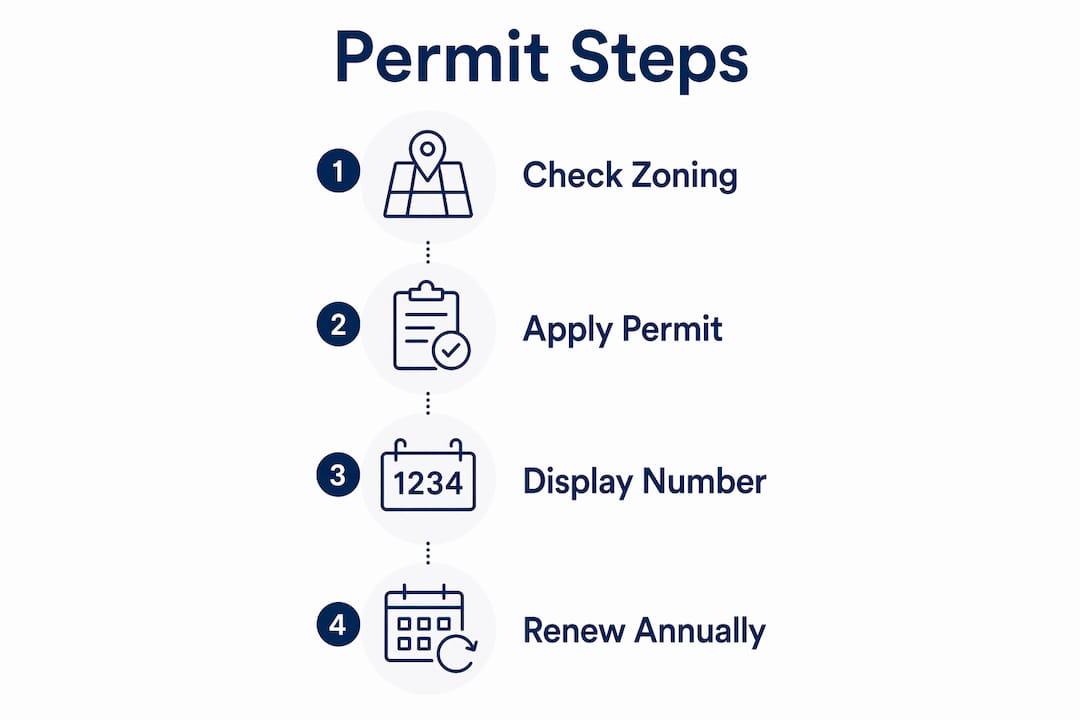
- Verify zoning eligibility before listing. Check your property’s zoning designation against your city’s STR ordinance. Confirm whether your property qualifies as a primary residence if that is a local requirement.
- Obtain all required permits and licenses. Apply for your STR permit, business license, and TOT registration before your first booking. Keep copies of all approvals accessible.
- Display your registration number. Add your permit number to your Airbnb or VRBO listing profile. Many cities now require this, and platforms are increasingly flagging listings without valid registration numbers.
- Monitor regulatory updates. Cities amend STR ordinances regularly. Subscribe to your city’s planning department newsletter or use a regulatory monitoring service to receive alerts when rules change.
- Track permit renewal deadlines. Most STR permits require annual renewal. Missing a renewal deadline can result in an automatic lapse in legal status, exposing you to the same penalties as operating without a permit.
- Audit your operational compliance. Review your listing against local noise, parking, and occupancy rules at least once per year. Update your house rules to reflect current legal requirements.
Pro Tip: If you manage multiple properties across different cities, use a portfolio-level compliance tool to track permit statuses, renewal dates, and regulatory changes by market. Managing this manually across five or more listings creates significant risk of oversight.
Key takeaways
Local ordinances control every material aspect of Airbnb hosting, from where you can list to how much you pay in fines if you do not comply.
| Point | Details |
|---|---|
| Zoning determines legality | Confirm your property’s zone type before listing; residential zones often restrict or ban STRs. |
| Permits are mandatory | Most U.S. cities require STR permits costing $50 to $500 annually, plus business licenses and TOT registration. |
| Enforcement is data-driven | Platform data-sharing laws like NYC Local Law 18 and California SB 346 make non-compliant listings visible to authorities. |
| Fines compound quickly | San Francisco’s $484 daily fine means a single month of non-compliance can exceed $14,000 in penalties. |
| HOA rules apply independently | An HOA prohibition overrides a city permit; both sets of rules must be satisfied simultaneously. |
Why most hosts underestimate the compliance burden
The most common mistake I see hosts make is treating compliance as a one-time checkbox rather than an ongoing obligation. You get the permit, you list the property, and you assume you are done. That assumption breaks down the moment your city amends its ordinance, your permit lapses, or a new data-sharing agreement goes live between your platform and local government.
There is also a false sense of security that comes from operating in cities with weak enforcement. Many local ordinances are paper laws without real enforcement capacity, and hosts in those markets have operated without permits for years without consequence. The problem is that enforcement capacity is expanding rapidly. Cities that lacked the staff or technology to enforce their rules in 2022 are now using Host Compliance software, platform data feeds, and self-funded enforcement programs to close that gap. The hosts who treated lax enforcement as permanent permission are the ones facing the largest penalties now.
The other underestimated risk is the HOA layer. I have seen hosts invest in permits, pay their taxes, and build a compliant operation, only to receive a cease-and-desist from their condo association. Municipal compliance and HOA compliance are separate legal obligations. You need both. Checking Airbnb legal requirements at the city level is necessary but not sufficient if you own a unit in a managed community.
The hosts who operate sustainably long-term are the ones who treat compliance as a business function, not an administrative nuisance. That means budgeting for permit fees, scheduling renewal reviews, and staying informed about regulatory changes in every market where you operate.
— Jure
Stay compliant with Strcomply
Managing local ordinance compliance across one property is demanding. Across a portfolio, it becomes a full-time job. Strcomply is built specifically for Airbnb hosts and property managers who need to stay current with city-specific permit requirements, zoning rules, transient occupancy tax obligations, and operational restrictions without spending hours on legal research.
With Strcomply, you can check your listing’s compliance in under 30 seconds, receive renewal alerts before permits lapse, and monitor regulatory changes across every market where you operate. Paid plans include portfolio dashboards that track permit status, tax obligations, and enforcement updates by city. If you want to avoid the fines, delisting risks, and legal exposure that come with non-compliance, Strcomply gives you the tools to stay ahead of local ordinance changes before they affect your listings.
FAQ
What is the role of local ordinances in Airbnb hosting?
Local ordinances set the legal rules for short-term rentals, including where they are permitted, what permits are required, and what penalties apply for violations. They are the primary compliance framework every Airbnb host must satisfy before listing a property.
How do I find out if my property is zoned for short-term rentals?
Check your city’s zoning map and municipal code, searching for terms like “short-term rental,” “transient occupancy,” or “vacation rental.” Your city’s planning department can confirm whether your parcel’s zoning designation permits STR activity.
What happens if I operate an Airbnb without a permit?
Fines for unlicensed STR operation typically range from $1,000 to $5,000 per violation, with some cities like San Francisco imposing daily fines of $484. Repeat violations can result in misdemeanor charges, platform delisting, and permanent permit revocation.
Does an Airbnb permit override HOA rules?
No. A city-issued STR permit and an HOA’s CC&Rs are separate legal instruments. An HOA can prohibit short-term rentals and enforce that prohibition through fines or legal action even if the local government permits them.
How does platform data-sharing affect Airbnb compliance enforcement?
Laws like NYC Local Law 18 and California SB 346 require platforms to share host registration data with cities, enabling direct identification of non-compliant listings. After Local Law 18 enforcement, NYC listings dropped from approximately 38,000 to about 3,000, demonstrating how effectively platform cooperation drives compliance.
Recommended
Check your city's STR regulations
Free compliance reports for 100+ US cities. Permits, taxes, zoning — all in one place.
Check My Address — Free