
Local regulation compliance for short-term rentals is defined as the process of identifying and fulfilling all municipal business licenses, zoning laws, permits, and enforcement rules required to operate legally in a given jurisdiction. Failing to obtain a local business license alone can result in fines from $100 to over $1,000 and immediate suspension orders. For Airbnb and VRBO hosts, that risk is compounded by the fact that local rules are almost always stricter than state or federal requirements. This local regulation compliance guide covers every layer you need to address, from zoning feasibility to permit renewals, so you can operate with confidence and avoid costly enforcement actions in 2026.
What local regulations apply to short-term rental properties?
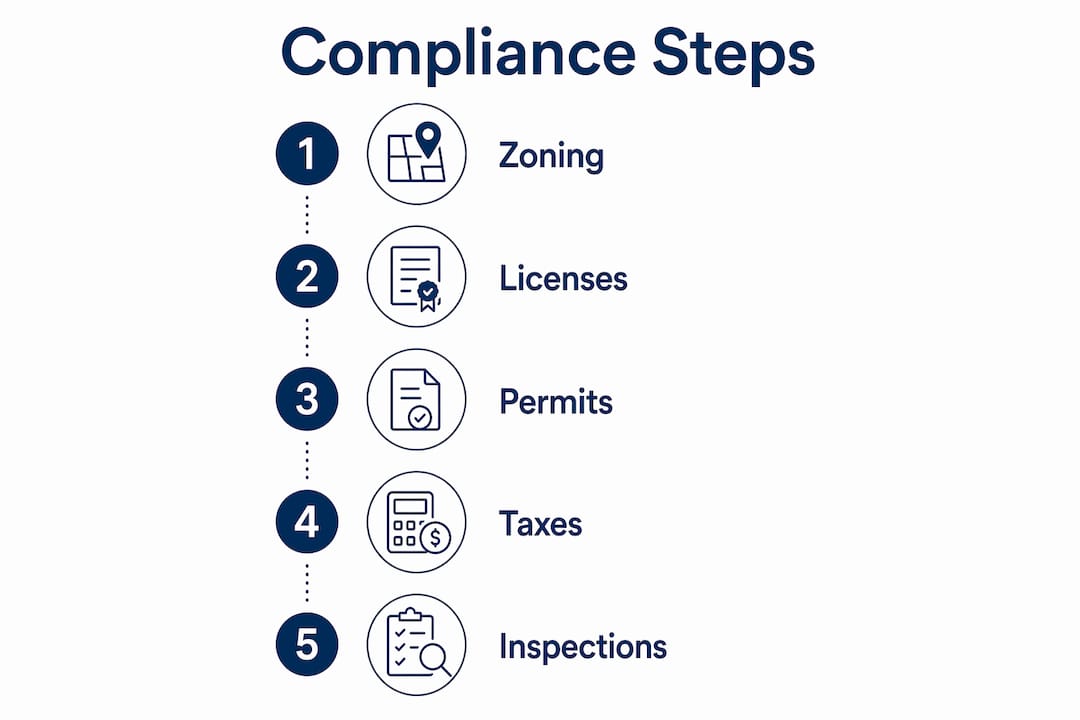
Local compliance requirements for short-term rentals typically fall across five distinct regulatory layers. Each layer carries its own application process, fee schedule, and renewal cycle. Missing any one of them can trigger fines or force a temporary shutdown.
The five regulatory layers to check
- Business license. Most municipalities require a general business license before you can collect revenue from guests. Annual fees typically range from $25 to $500, based on gross receipts or a flat rate set by city ordinance.
- Zoning and land use approval. Your property must sit in a zone that permits short-term rental use. Zoning blueprints and land use maps are the primary tool for confirming this, and skipping this step is the top cause of permit application failures.
- Home Occupation Permit. If you rent a primary residence, many cities require this separate permit for home-based business activity. Failing to secure this permit can trigger daily fines even for low-profile, single-unit rentals.
- Building and safety permits. Fire inspections, occupancy load limits, smoke detector certifications, and carbon monoxide compliance all fall here. Some cities require a formal inspection before issuing a short-term rental license.
- Health and signage permits. Depending on your jurisdiction, you may need a health department clearance or a permit governing any exterior signage on the property.
The most reliable way to research your specific local compliance requirements is to start with your city or county’s official website, then cross-reference with databases like Municode, which publishes municipal codes for thousands of jurisdictions across the United States.
Pro Tip: Start every code research session by reading the definitions section of your municipal code first. Legal definitions for terms like “short-term rental” or “dwelling unit” often differ significantly from common usage, and the wrong interpretation can invalidate your entire permit application.
The table below summarizes the typical local compliance categories and what each one covers.
| Regulatory category | What it covers |
|---|---|
| Business license | Authorization to operate commercially within city or county limits |
| Zoning approval | Confirmation that rental use is permitted at your property’s location |
| Home Occupation Permit | Authorization for home-based business activity in residential zones |
| Building and safety permits | Fire, occupancy, and structural safety inspections |
| Health and signage permits | Health department clearance and exterior signage authorization |
How do you obtain and maintain required local permits?
Getting licensed is a sequential process. Attempting to skip steps or submit applications out of order is one of the most common reasons operators face delays. Follow this numbered sequence to move from research to active compliance.
- Confirm zoning eligibility first. Before spending time or money on any application, verify that your property’s zoning designation allows short-term rental use. Contact your local planning department or review the zoning compliance guide for your jurisdiction. If the zoning does not permit rentals, apply for a conditional use permit or variance before proceeding.
- Gather required documents. Standard documentation includes proof of property ownership or a lease agreement, a government-issued ID, a floor plan or site map, proof of liability insurance, and any prior inspection certificates. Some cities also require a transient occupancy tax registration number before issuing a short-term rental license.
- Submit your business license application. File with your city clerk’s office or the relevant municipal department. Processing times range from a few days to several weeks depending on the jurisdiction. Pay the applicable fee, which typically falls in the $25–$500 range.
- Apply for your Home Occupation Permit if required. This is a separate filing from the business license. Check your municipal code to determine whether your rental activity qualifies as a home occupation under local definitions.
- Schedule required inspections. Fire safety, building, and health inspections must be completed and passed before many cities will issue a final short-term rental operating permit. Book these early, as inspection slots can be limited.
- Track renewal dates from day one. Most business licenses and short-term rental permits require annual renewal. Missing a renewal deadline can result in the same penalties as operating without a license.
Pro Tip: Store all permit documents, inspection reports, and renewal notices in a single digital folder organized by jurisdiction. Review the essential compliance documents checklist to confirm you have every required filing on file before your first guest checks in.
Common fees and timelines vary widely. A single-family rental in a small city may require only a $50 business license and a fire inspection. A multi-unit property in a major metro like Los Angeles, Chicago, or Denver can involve multiple agencies, fees exceeding $500, and a 60-day processing window.
What systems help you manage ongoing compliance?
Tracking compliance across even two or three properties in different jurisdictions becomes unmanageable without a deliberate system. The most effective approach is to build a Compliance Map, a structured document that records every jurisdiction, required license or approval, current status, and renewal date for each property in your portfolio.

A Compliance Map reduces non-compliance errors significantly by giving you a single reference point instead of scattered emails and paper files. This matters because fragmented city, county, and state agencies are the most common cause of missed filings.
Your Compliance Map should track the following for each property:
- Jurisdiction name and the specific agency responsible for each permit type
- License or permit number and issue date
- Renewal deadline and associated fee
- Inspection due dates and last passed date
- Current status: active, pending, expired, or under review
Beyond the map itself, set calendar reminders 90 days, 30 days, and 7 days before every renewal deadline. That three-stage alert system gives you enough lead time to gather documents and pay fees without rushing.
One detail most operators overlook is the difference between a law’s enactment date, effective date, and enforcement date. These three milestone dates are distinct, and enforcement often begins months after a law officially takes effect. Tracking all three prevents you from acting too early on a rule that is not yet enforced, or too late on one that already is.
Pro Tip: Review property manager compliance tips for 2026 to identify which jurisdictions have updated their short-term rental ordinances this year. Several major cities have moved to stricter enforcement calendars, and the effective dates are not always well publicized.
How should you respond to violations and enforcement actions?
Receiving a code enforcement notice does not automatically mean your rental is shut down. The response window and the severity of consequences depend on the violation type and your jurisdiction’s enforcement procedures.
Owners typically have 30 days or less to remedy code enforcement violations after receiving written notice. Hazards such as blocked fire exits or missing smoke detectors can trigger immediate citations with no grace period. That 30-day window is not a suggestion. Missing it converts a correctable violation into an escalating fine situation.
The table below compares common violation types, their typical penalties, and the recommended response.
| Violation type | Typical penalty | Recommended response |
|---|---|---|
| Operating without a business license | $100–$1,000+ fine, suspension order | Apply immediately; request a compliance hearing |
| Zoning violation | Daily escalating fines | Cease rental activity; file for variance or appeal |
| Failed safety inspection | Permit hold; potential closure | Schedule re-inspection within 30 days |
| Unlicensed home occupation | Daily fines | Apply for Home Occupation Permit; document correction |
| Repeat or unresolved violations | Cease-and-desist order | Engage a local attorney; file administrative appeal |
Municipal penalties for repeat offenses can climb above $1,000 and may include cease-and-desist orders for unlicensed operations. That level of enforcement can also trigger de-listing by Airbnb or VRBO if the platform receives notice of a legal action against your property.
When you receive a violation notice, document everything. Photograph the property, note the date and time of the notice, and confirm the correction deadline in writing with the issuing agency. If you believe the citation is incorrect, most municipalities allow an administrative appeal within 10–30 days of the notice date. File that appeal promptly and in writing.
Pro Tip: Building a working relationship with your local code enforcement office before a violation occurs is one of the most underrated compliance strategies available. A brief introductory call or email asking about local requirements signals good faith and can result in more cooperative treatment if an issue arises later.
Key Takeaways
Short-term rental operators who build a structured compliance system covering zoning, permits, licenses, and enforcement timelines face significantly fewer fines and operational disruptions than those who rely on ad hoc research.
| Point | Details |
|---|---|
| Start with zoning | Confirm zoning eligibility before applying for any license or permit to avoid wasted fees. |
| Track all three permit layers | Business licenses, Home Occupation Permits, and safety inspections are each separate filings. |
| Build a Compliance Map | Record every jurisdiction, permit status, and renewal date in one centralized document. |
| Know your enforcement dates | Track enactment, effective, and enforcement dates separately to time compliance actions correctly. |
| Respond to violations within 30 days | Written correction within the notice window prevents escalating fines and cease-and-desist orders. |
Why local compliance is harder than most operators expect
Local municipal rules carry the strictest compliance obligations of any regulatory tier, stricter than state licensing requirements and far stricter than federal rules. Most operators I have seen run into trouble are not ignoring compliance. They are focused on the wrong level of government.
The assumption that a state-level short-term rental registration covers local requirements is one of the most expensive mistakes in this industry. A state license does not override a city zoning restriction. A federal tax ID does not substitute for a municipal business license. Local rules operate independently, and local enforcement agencies do not check whether you are compliant at the state level before issuing a fine.
The other pattern I see repeatedly is operators who comply at launch and then let renewals lapse. A permit that was valid in January can become a liability by December if the renewal was missed. The Compliance Map approach is not optional for anyone managing more than one property. It is the minimum viable system for staying out of trouble.
The operators who manage this best treat compliance as an ongoing operational function, not a one-time setup task. They assign a specific person or tool to monitor renewal dates, check for ordinance updates quarterly, and confirm that every new property is fully permitted before the first booking is accepted. That discipline is what separates operators who scale successfully from those who face enforcement actions at the worst possible time.
— Jure
How Strcomply simplifies your local compliance management
Keeping up with local compliance requirements across multiple properties and jurisdictions is a full-time task without the right tools. Strcomply is built specifically for short-term rental operators who need a centralized system to track permits, licenses, renewal deadlines, and jurisdiction-specific regulatory updates without spending hours on manual research.
The Strcomply platform provides city-specific compliance summaries covering permit requirements, transient occupancy tax obligations, and operational restrictions for Airbnb, VRBO, and similar listings across the United States. Paid plans include portfolio dashboards, renewal alerts, and documentation storage so nothing falls through the cracks. If you want to confirm your current listings are fully compliant or check requirements before entering a new market, Strcomply gives you that answer in minutes.
FAQ
What is a local regulation compliance guide for short-term rentals?
A local regulation compliance guide is a structured reference that outlines the business licenses, zoning approvals, permits, and enforcement rules a short-term rental operator must satisfy in a specific municipality. It covers how to research requirements, apply for permits, and maintain compliance over time.
How do I find local compliance requirements for my rental property?
Start with your city or county’s official website and cross-reference with Municode, which publishes municipal codes for thousands of jurisdictions. Always read the definitions section of the local code first, since legal terms like “short-term rental” often carry meanings that differ from common usage.
What happens if I operate a short-term rental without a local business license?
Operating without a local business license can result in fines ranging from $100 to over $1,000 per violation, along with immediate suspension orders. Repeat or unresolved violations can escalate to cease-and-desist orders and potential de-listing from platforms like Airbnb or VRBO.
How often do short-term rental permits need to be renewed?
Most municipal business licenses and short-term rental operating permits require annual renewal. Missing a renewal deadline carries the same penalties as operating without a license, so tracking renewal dates with calendar reminders at least 90 days in advance is the standard practice.
What is a Compliance Map and why do I need one?
A Compliance Map is a centralized document that records every jurisdiction, required license or permit, current status, and renewal date for each property in your portfolio. It reduces non-compliance errors by replacing scattered files with a single reference point, which is especially critical for operators managing properties across multiple cities or counties.
Recommended
Check your city's STR regulations
Free compliance reports for 100+ US cities. Permits, taxes, zoning — all in one place.
Check My Address — Free