
Short-term rental taxation is defined as the set of federal, state, and local tax rules that govern how hosts report income, collect occupancy taxes, and claim deductions on properties listed through platforms like Airbnb and VRBO. The must-know STR tax obligations span everything from the IRS 14-day rule to transient occupancy tax registration, Schedule C versus Schedule E classification, and material participation documentation. Failing to understand even one of these requirements can trigger audits, back taxes, or platform delisting. This guide covers the ten most critical short-term rental tax requirements every host and property manager must know in 2026.
1. Reporting your rental income under the 14-day rule
The IRS 14-day rule is the starting point for every STR host’s federal tax obligations. Under this rule, if you rent your property for 14 days or fewer per year, you do not need to report that rental income on your federal tax return. That exemption sounds simple, but it comes with a critical catch: local occupancy taxes typically still apply regardless of how few days you rented.
Once you exceed 14 rental days, all rental income becomes federally taxable and must be reported. Platforms like Airbnb and VRBO issue Form 1099-K to both you and the IRS when your earnings cross reporting thresholds. This means the IRS already has a record of your income before you file, so any discrepancy between your return and the 1099-K will draw scrutiny.

You must reconcile your 1099-K against your actual rental income on your tax return. If the 1099-K overstates your income due to platform fees or refunds, document the difference clearly. Refer to the 2026 host guide for detailed reconciliation steps under current IRS guidelines.
Pro Tip: Submit a W-9 to every booking platform you use. Without it, platforms withhold 28% of your gross rental income as backup withholding, which you then have to recover through your tax return.
2. Choosing between Schedule C and Schedule E
Schedule C versus Schedule E classification is not a choice you make freely. The IRS determines it based on two objective factors: the average length of guest stays and whether you materially participate in the rental activity. Getting this wrong means either overpaying taxes or triggering an audit.
If your average guest stay is more than 7 days, you report income on Schedule E as passive rental income. If the average stay is 7 days or fewer and you materially participate, the IRS treats your STR as a business, and you report on Schedule C. Schedule C income is subject to self-employment tax at 15.3% of net profit. On a $60,000 net profit, that equals approximately $9,180 in additional tax.
| Factor | Schedule E | Schedule C |
|---|---|---|
| Average guest stay | More than 7 days | 7 days or fewer |
| Material participation | Not required | Required |
| Self-employment tax | No | Yes (15.3%) |
| Passive loss rules | Apply | Do not apply |
| Audit scrutiny | Moderate | Higher |
High-income earners face an additional layer. If your modified adjusted gross income exceeds $200,000 (single) or $250,000 (married), passive rental income on Schedule E is subject to a 3.8% Net Investment Income Tax. On $100,000 in net profit, that adds $3,800 to your tax bill.
Pro Tip: If you are close to the 7-day average threshold, track your actual guest stay lengths throughout the year. A single long-term booking can shift your classification from Schedule C to Schedule E and change your entire tax picture.
3. Registering for and collecting local occupancy taxes
Transient occupancy tax, also called lodging tax or hotel tax, is a local or state levy that STR hosts must collect from guests and remit to the relevant authority. Most localities impose rates ranging from 1% to 20%, with Miami-Dade County reaching approximately 12% and New York City reaching up to 15% to 20% in combined local taxes.
Airbnb and VRBO automatically collect and remit occupancy taxes in many jurisdictions, but not all. In markets where platforms do not collect on your behalf, you are personally responsible for registering with the local tax authority, collecting the correct rate from guests, and remitting it on the required schedule. Assuming the platform handles everything is one of the most common and costly STR tax mistakes hosts make.
Registration requirements vary significantly by city and county. Some jurisdictions require a separate lodging tax permit in addition to a general business license. Others require monthly remittance while some allow quarterly filings. Review the transient occupancy tax rules for your specific market before your first booking goes live.
4. Filing taxes in the state where the property is located
STR income is taxed where the property is located, not where you live. This is a filing obligation that catches many out-of-state investors off guard. Hosts often must file non-resident state income tax returns in the property’s state, in addition to their home state return.
If you own STR properties in multiple states, you face multiple non-resident filings, each with different forms, deadlines, and tax rates. Some states have no income tax, which simplifies matters, but most require a separate return for rental income earned within their borders. Ignoring this obligation does not make it disappear. State tax authorities share data with the IRS and with platforms, so income reported on a 1099-K in one state can surface in another.
Work with a CPA who specializes in multi-state real estate taxation if you operate across state lines. The cost of professional filing is almost always less than the penalties for missed non-resident returns.
5. Claiming deductible expenses correctly
Deductible expenses are the primary tool STR hosts use to reduce taxable income, and the IRS allows a broad range of them for rental properties. Eligible deductions include mortgage interest, property taxes, cleaning fees, platform service fees, property management costs, repairs, and depreciation on the building and its contents.
The deduction rules become more complex when you also use the property personally. If you use the property for personal stays, you must allocate expenses between rental and personal use based on the number of days each applies. The IRS does not allow you to deduct expenses tied to personal use days, and misallocating them is a common audit trigger.
Key deductible expense categories for STR hosts:
- Mortgage interest and property taxes: Deductible in proportion to rental use days
- Platform fees: Airbnb and VRBO service fees are fully deductible as a business expense
- Cleaning and maintenance: Deductible when directly tied to rental activity
- Furnishings and equipment: Depreciable over 5 years, with bonus depreciation available on qualifying items through 2026
- Building depreciation: Calculated over 27.5 years for residential rental property
- Professional services: CPA fees, legal fees, and compliance platform subscriptions are deductible
Bonus depreciation on furnishings is phasing out after 2026, so purchasing qualifying items this year captures a larger immediate deduction. A cost segregation study can accelerate depreciation on components like appliances and flooring, generating significant deductions in the early years of ownership.
6. Understanding the STR loophole and its real requirements
The STR loophole is not a secret strategy. It is a set of established IRS regulations that allow STR losses to offset active income when two specific conditions are met: the average guest stay is 7 days or fewer and the host materially participates for more than 100 hours per year with no other person contributing more hours. When both conditions are satisfied, the activity is treated as non-passive, and losses can offset W-2 or business income directly.
This is particularly valuable for high-income earners who cannot use passive rental losses under normal rules. A host with $50,000 in STR losses and $200,000 in W-2 income could potentially reduce their taxable income to $150,000, assuming all IRS criteria are met. The tax savings can be substantial, but the documentation burden is equally significant.
Hosts who claim this treatment without proper records face full disallowance of the losses and potential penalties. The IRS scrutinizes STR loophole claims closely, and a single year of poor records can unwind multiple years of tax benefits. Pairing this strategy with a short-term rental investment that generates genuine operating activity makes the material participation case far more credible.
7. Documenting material participation for audit readiness
Material participation is a legal standard, not a self-assessment. The IRS defines it through seven qualifying tests, the most commonly used being participation of more than 500 hours per year in the activity, or more than 100 hours with no other person contributing more time. Simply saying you were involved is not sufficient.
Effective documentation requires a contemporaneous time log. Each log entry must include the date, the specific task performed, the number of hours spent, the person performing the task, and the property involved. Qualifying activities include guest communication, coordinating maintenance, inspecting the property, reviewing financial records, and managing vendors. Passive activities like reviewing platform analytics without taking action do not count.
Build your time log as a habit, not a year-end reconstruction. The IRS treats reconstructed logs with significant skepticism. A simple spreadsheet updated weekly is sufficient, but it must be consistent and detailed. Store it alongside your other compliance documents so everything is accessible if you receive an audit notice.
The four steps to building an audit-ready participation record:
- Create a dedicated log for each property you own
- Record every qualifying activity within 48 hours of completing it
- Attach supporting evidence where possible, such as email timestamps or contractor invoices
- Review your total hours quarterly to confirm you are on track to meet the threshold
Key takeaways
STR tax compliance requires managing federal income reporting, local occupancy taxes, income classification, deductions, and material participation documentation simultaneously.
| Point | Details |
|---|---|
| The 14-day rule has limits | Federal income exemption applies under 14 rental days, but local occupancy taxes still apply. |
| Classification is not optional | Schedule C or Schedule E is determined by average stay length and material participation, not preference. |
| Occupancy tax is your responsibility | Verify whether Airbnb or VRBO remits in your market; register independently if they do not. |
| Deductions require allocation | Personal use days reduce your deductible expenses proportionally under IRS rules. |
| Material participation needs records | Time logs must be contemporaneous, detailed, and stored with supporting evidence to survive audit. |
What I’ve learned from watching hosts get this wrong
The hosts who run into serious tax problems are rarely the ones who ignored their obligations entirely. They are the ones who made confident assumptions: that the platform handled all their taxes, that their CPA understood STR-specific rules, or that the STR loophole was straightforward to claim. Those assumptions cost real money.
The classification question between Schedule C and Schedule E is where I see the most expensive mistakes. Hosts who assume they qualify for non-passive treatment because they “manage everything themselves” often cannot produce a single hour log when the IRS asks. The loophole is real and it is legal, but it requires the same level of documentation discipline as any other IRS position. If you cannot prove your hours with contemporaneous records, you do not qualify. It is that direct.
The multi-state filing obligation surprises even experienced investors. Owning one property in Arizona while living in California means two state returns, two sets of deadlines, and two tax authorities with different rules. Platforms report your income to the IRS, and states increasingly share that data. Assuming a non-resident filing will slip through unnoticed is a miscalculation.
My practical advice: treat your STR like the business it is from day one. Set up a dedicated bank account for rental income and expenses, log your participation hours weekly, verify your occupancy tax obligations before your first booking, and work with a CPA who has handled STR returns specifically. The tax advantages available to STR hosts are genuine, but they require genuine effort to claim and defend.
— Jure
How Strcomply simplifies your 2026 STR tax compliance
Managing STR tax requirements across multiple jurisdictions is time-consuming and error-prone without the right tools.
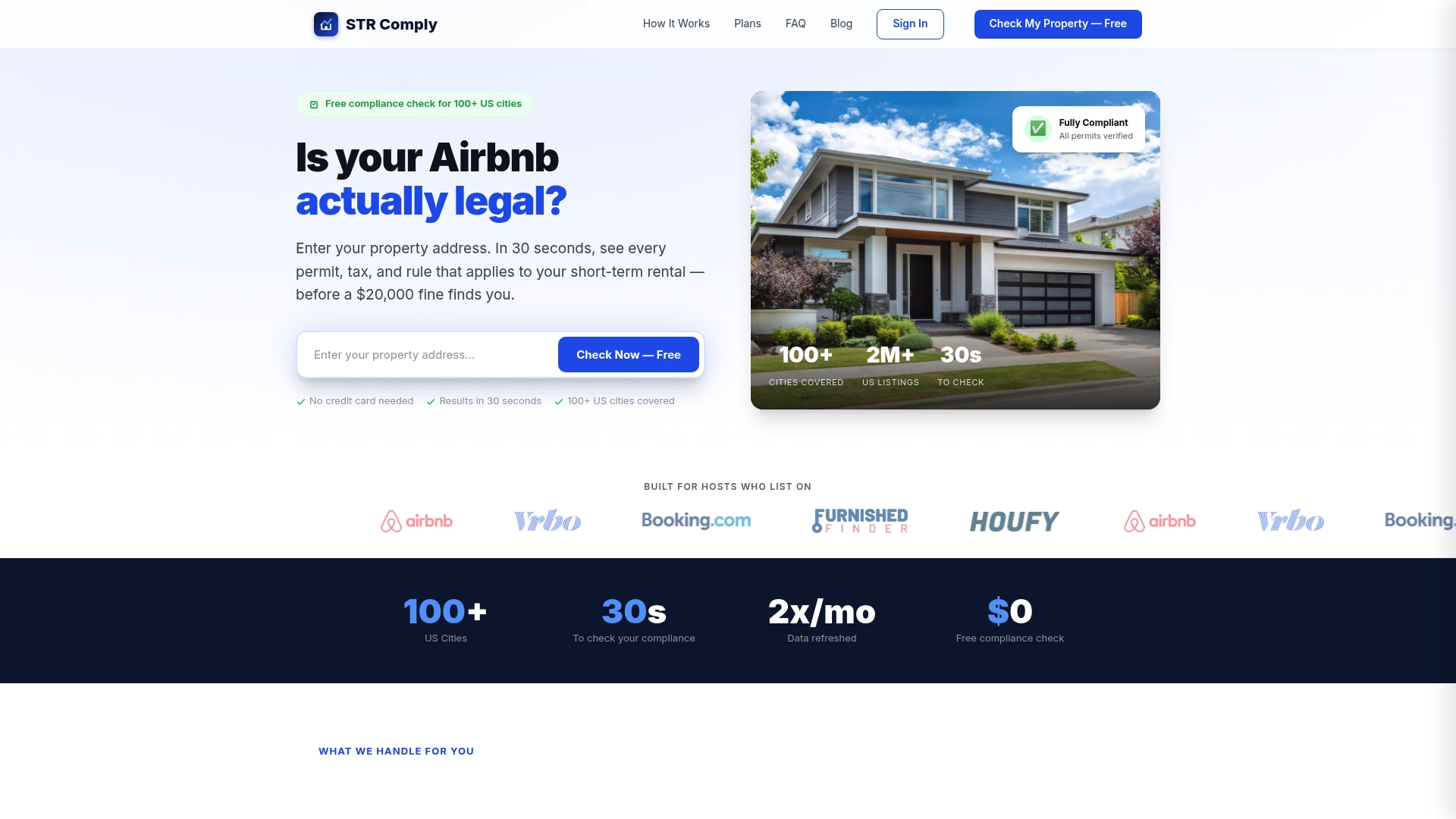
Strcomply gives hosts and property managers instant access to city-specific compliance summaries covering permit requirements, local tax obligations, and operational restrictions for Airbnb, VRBO, and similar platforms. The platform tracks regulatory changes and sends renewal alerts so you never miss a filing deadline or registration requirement. For hosts managing multiple properties, the portfolio dashboard consolidates compliance status across all markets in one place. Check your listings against current local regulations for free at Strcomply and know exactly where you stand before tax season arrives.
FAQ
What are the must-know STR tax obligations for hosts?
The core STR tax obligations include federal income reporting under the IRS 14-day rule, local occupancy tax collection and remittance, correct Schedule C or Schedule E classification, deductible expense tracking, and material participation documentation. Each obligation applies independently, meaning compliance with one does not satisfy the others.
Does Airbnb collect and remit all my occupancy taxes?
Airbnb collects and remits occupancy taxes in many jurisdictions, but not all. Hosts must verify whether their specific city or county is covered and register independently with local tax authorities if the platform does not remit on their behalf.
What triggers an IRS audit for STR hosts?
The IRS focuses audit attention on STR hosts who claim non-passive losses under the STR loophole without adequate material participation records, report income that does not match their 1099-K, or fail to allocate expenses correctly between rental and personal use days.
How does the 14-day rule affect my local tax obligations?
The 14-day federal exemption applies only to federal income tax reporting. Local transient occupancy taxes typically apply from the first rental day regardless of how many days you rent annually.
What records do I need for material participation?
Material participation records must include a contemporaneous time log with the date, task description, hours spent, person performing the task, and the property involved for each qualifying activity. Reconstructed year-end logs carry significantly less weight with the IRS than records maintained throughout the year.
Recommended
Check your city's STR regulations
Free compliance reports for 100+ US cities. Permits, taxes, zoning — all in one place.
Check My Address — Free