
An operational compliance checklist for investors is a structured tool that maps every regulatory, reporting, and operational task required to keep short-term rental properties legally protected. Real estate investors who skip this process face fines, permit revocations, and platform de-listings on Airbnb and VRBO. The industry term for this practice is compliance program management, and it covers everything from local zoning permits and transient occupancy tax filings to incident reporting and annual policy reviews. Investors who treat compliance as an ongoing operational discipline, not a one-time paperwork task, consistently avoid the penalties that catch unprepared landlords off guard.
What are the essential components of an operational compliance checklist for investors?
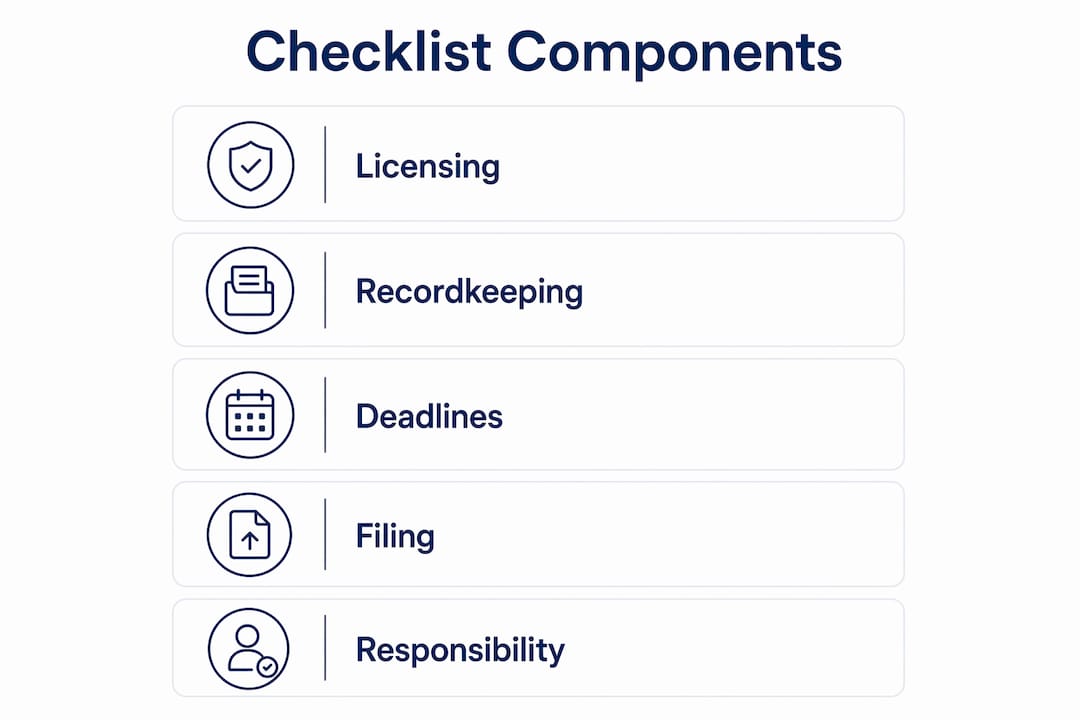
A complete investor compliance checklist covers five core categories: licensing, recordkeeping, reporting deadlines, policy review, and operational controls. Skipping any one of them creates a gap that regulators and auditors will find.
Licensing and permit verification is the starting point. Every short-term rental market in the United States has its own permit requirements, zoning restrictions, and occupancy rules. You need to confirm that each property holds a valid local short-term rental license, that the license is current, and that any renewal deadlines are tracked in advance. Platforms like Airbnb and VRBO can de-list properties that fall out of permit compliance without warning.

Recordkeeping obligations are non-negotiable. Regulatory standards require maintaining client records and trade documentation for 5–7 years, with the first 2 years requiring ready accessibility. For real estate investors, this means keeping lease agreements, tax filings, inspection reports, and permit copies organized and retrievable on short notice.
Critical filing deadlines must appear on your checklist with specific dates. Material change filings must be updated within 30 days of a triggering event. Missing that window creates a compliance gap that regulators treat as a red flag.
Policy review is a formal requirement in regulated industries. Annual review of written policies by a qualified compliance officer is mandatory under SEC Rule 206(4)-7 for registered advisers. Real estate investors should apply the same discipline: assign a designated compliance owner and schedule a formal annual review of all operating procedures.
Operational controls round out the checklist. These include incident reporting procedures, vendor oversight protocols, dispute management processes, and liability coverage verification. Controls are the daily behaviors that prove your compliance program actually works.
- Local short-term rental permit status and renewal dates
- Transient occupancy tax registration and quarterly payment records
- Zoning compliance documentation for each property
- Liability insurance coverage verification (type, limits, and expiration)
- Incident and guest complaint logs with resolution records
- Vendor contracts and background check records
- Annual policy review sign-off by a designated compliance owner
Pro Tip: Assign a specific person, not a team, as the compliance owner for each property. Shared responsibility produces gaps. One named owner produces accountability.
How can investors implement and maintain an effective compliance checklist?
Building a checklist is straightforward. Keeping it current and testable is where most investors fall short. A risk assessment is the foundational document underlying effective operational compliance. Auditors expect to see it first, and a missing or stale risk register weakens every other document in your file.
-
Perform a risk assessment. Identify every regulation that applies to each property, including local short-term rental ordinances, state tax codes, and federal reporting obligations. Rate each risk by likelihood and impact. This document directs where you spend compliance resources.
-
Map controls to regulations. Mapping single controls to multiple regulatory obligations reduces operational effort while increasing compliance coverage. A quarterly permit review, for example, can satisfy local licensing requirements, platform terms of service, and your internal audit schedule simultaneously.
-
Assign accountability. Every control on your checklist needs an owner and a due date. Use a simple spreadsheet or a dedicated compliance platform to track status. Unassigned tasks do not get completed.
-
Define review cadences. Some controls are daily (incident logs), some are monthly (tax payment confirmations), and some are annual (policy reviews, insurance renewals). Build a calendar that reflects these frequencies and send automated reminders before each deadline.
-
Collect evidence continuously. Standardizing evidence collection and validating documentation throughout the year prevents weak audit responses. Save access logs, payment receipts, inspection certificates, and permit renewals in a centralized folder organized by property and date.
-
Conduct periodic internal audits. Test your controls at least twice a year. Pull a sample of incident reports and verify they were filed correctly. Check that insurance certificates are current. Confirm that tax payments match filed returns. Internal audits catch problems before regulators do.
-
Establish escalation channels. Every compliance program needs a clear path for reporting problems. Designate who receives compliance concerns, how quickly they must respond, and what documentation is required. Anonymous reporting options increase the likelihood that issues surface early.
Pro Tip: Keep a shared digital folder for each property with subfolders labeled by compliance category. When an auditor requests documents, you retrieve a folder, not a pile of emails.
What common challenges do investors face with operational compliance?
The most damaging misconception in real estate investment compliance is that a checklist, once created, is finished. Regulatory priorities shift annually, requiring compliance programs to adapt rather than sit static. A checklist written in january 2024 may miss ordinances that took effect in march 2025.
A second major challenge is evidence collection. Many investors maintain policies on paper but cannot produce proof that those policies were followed. Regulatory examiners focus on effectiveness of compliance implementation, looking beyond documentation to behaviors and controls in practice. If you cannot show an examiner an incident log, a signed policy review, or a dated permit renewal, the policy itself carries no weight.
“Compliance is fundamentally operational, requiring testable daily processes and clear escalation paths rather than static policy checklists.” — University of Pittsburgh School of Law
A third challenge is scale. Investors managing properties across multiple markets face different rules in every city. What satisfies permit requirements in Nashville may not meet the standards in Denver or Miami. The solution is a master checklist framework that includes a city-specific column for local variations, rather than a separate checklist for every market.
Common pitfalls to avoid:
- Treating permit acquisition as a one-time task rather than a recurring renewal obligation
- Storing compliance documents in personal email rather than a centralized, searchable system
- Failing to update checklists after local ordinance changes
- Assigning compliance tasks to whoever is available rather than a designated owner
- Skipping internal audits because no external exam is scheduled
Investors who maintain ongoing compliance for STR hosts as a daily operational rhythm avoid the scramble that comes with surprise inspections or platform audits.
What does a sample operational compliance checklist look like?
The table below shows a practical investor checklist template organized by category, frequency, and responsible party. Use it as a starting point and add city-specific requirements for each market you operate in.
| Checklist category | Task | Frequency | Owner | Regulatory impact |
|---|---|---|---|---|
| Licensing | Verify permit status and renewal date | Monthly | Compliance owner | Avoids de-listing and municipal fines |
| Tax compliance | Confirm transient occupancy tax payment | Quarterly | Accountant | Prevents back taxes and penalties |
| Insurance | Review liability coverage limits and expiration | Annual | Property manager | Protects against guest injury claims |
| Recordkeeping | Archive permits, leases, and tax receipts | Ongoing | Compliance owner | Meets 5–7 year retention standard |
| Policy review | Review and sign off on operating procedures | Annual | Designated CCO or owner | Demonstrates program effectiveness |
| Incident tracking | Log guest complaints and resolution actions | Per incident | On-site manager | Supports dispute defense and audit readiness |
| Vendor oversight | Confirm contractor licenses and insurance | Per engagement | Property manager | Reduces liability exposure |
For investors managing a multi-market portfolio, add a column for jurisdiction and flag any city with pending ordinance changes. Cities like New York, San Francisco, and Los Angeles update short-term rental rules frequently. Tracking those changes in your checklist prevents surprise violations.
Customizing this template is straightforward. Start with the categories above, then layer in the specific permit numbers, tax account IDs, and renewal dates for each property. A checklist that contains actual dates and names is far more useful than a generic template. Reviewing property manager compliance tips for 2026 can help you identify additional line items specific to your market.
Key takeaways
An operational compliance checklist for investors works only when it is treated as a living document with assigned owners, real deadlines, and continuous evidence collection.
| Point | Details |
|---|---|
| Start with a risk assessment | A current risk register is the first document auditors review and the foundation of every other control. |
| Assign named owners | Every checklist item needs one accountable person, not a shared team, to get completed reliably. |
| Collect evidence continuously | Save permits, receipts, and logs throughout the year so audits require retrieval, not reconstruction. |
| Map controls across regulations | One quarterly permit review can satisfy local, platform, and internal audit requirements simultaneously. |
| Update checklists regularly | Regulatory priorities shift annually; a static checklist from two years ago creates undetected gaps. |
Why I think most investors are one audit away from a serious problem
I have reviewed compliance setups for real estate investors across a range of portfolio sizes, and the pattern is consistent. Investors who built their checklists during the permit application process and never touched them again are the ones who panic when a city inspector calls. The checklist they have is accurate for the day they wrote it. The regulations have moved on.
The investors who sleep well are the ones who treat compliance like property maintenance. They schedule it, assign it, and document it. They do not wait for a renewal notice to check permit status. They do not scramble for insurance certificates when a guest files a claim. They have a folder, a calendar, and a named person responsible for each task.
The other thing I have noticed is that technology changes the math significantly. When you use a platform that tracks permit expiration dates and sends renewal alerts automatically, the compliance burden drops to a fraction of what it costs to manage manually. The reasons real estate investors need rental compliance are well documented, but the practical case is simpler. One missed permit renewal can cost more in fines than a full year of compliance management. The return on staying organized is not abstract. It shows up directly in your operating costs.
Compliance is not a competitive disadvantage. Investors who maintain clean compliance records face fewer platform restrictions, smoother financing conversations, and lower legal exposure. That is a real edge in a market where regulatory scrutiny of short-term rentals is increasing every year.
— Jure
How Strcomply helps investors stay ahead of compliance requirements
Strcomply is built specifically for short-term rental investors who need to track permits, taxes, and local regulations across multiple markets without spending hours on legal research.

The platform provides city-specific compliance summaries covering permit requirements, transient occupancy tax obligations, and zoning restrictions for Airbnb and VRBO listings across the United States. Paid plans include a portfolio dashboard with permit tracking, renewal alerts, and regulatory update notifications, so your checklist stays current without manual monitoring. Investors managing properties in cities with frequent ordinance changes, such as those in California, New York, or Florida, get automatic updates when local rules shift. Visit Strcomply to check your listings against current local regulations and build a compliance record that holds up under scrutiny.
FAQ
What is an operational compliance checklist for investors?
An operational compliance checklist for investors is a structured document that tracks all regulatory, reporting, and operational tasks required to keep short-term rental properties legally compliant. It covers permits, tax filings, insurance, recordkeeping, and policy reviews.
How often should investors update their compliance checklist?
Investors should review and update their checklist at least annually, and immediately after any local ordinance change or material operational change. Regulatory priorities shift annually, so a static checklist quickly becomes outdated.
What records do short-term rental investors need to keep?
Investors should retain permits, tax receipts, lease agreements, inspection reports, and incident logs. Regulatory standards set a 5–7 year retention period for key documents, with the first 2 years requiring immediate accessibility.
What is the biggest compliance mistake short-term rental investors make?
The most common mistake is treating compliance as a one-time task completed at property acquisition. Continuous evidence collection throughout the year is what separates investors who pass audits from those who scramble to reconstruct records.
How can investors manage compliance across multiple markets?
Use a master checklist framework with a jurisdiction-specific column for each city’s unique permit, tax, and zoning requirements. Platforms like Strcomply provide city-level compliance summaries that make multi-market due diligence faster and more reliable. You can also review real estate buyer tips for additional due diligence guidance before entering a new market.
Recommended
Check your city's STR regulations
Free compliance reports for 100+ US cities. Permits, taxes, zoning — all in one place.
Check My Address — Free