
Operational limits for Airbnb hosts are the legal and platform-based rules that control how long you can rent, how many guests you can host, what permits you must hold, and how your property can be used under local law. These rules are not set by Airbnb alone. They come from multiple government levels, including neighborhood, city, county, and state jurisdictions, and they vary dramatically from one ZIP code to the next. A valid Airbnb booking does not guarantee you are operating legally. Understanding the full scope of short-term rental (STR) compliance requirements is the first step toward protecting your listing and your income.
What operational limits apply to airbnb hosts?
The term “operational limits” covers every rule that defines how and when you can legally rent your property. In the STR industry, these are also called hosting restrictions or short-term rental compliance requirements. They fall into five main categories.
- Booking duration caps. Most jurisdictions define a short-term rental as a stay of fewer than 30 days per reservation. Some cities impose additional caps on total annual nights rented.
- Guest number limits. Local fire codes and zoning ordinances set maximum occupancy. Airbnb’s own ground rules for guests let you enforce those limits directly in your listing.
- Permit and license requirements. Many jurisdictions require an annual operational permit, a business license, or both before you can accept any bookings.
- Primary residence rules. Several cities restrict STR activity to a host’s primary residence, capping the number of nights a property can be rented when the host is not present.
- Tax registration. Transient occupancy tax (TOT) registration is a separate obligation from a rental permit and is required in most U.S. markets.
Compliance is multi-layered: satisfying Airbnb’s platform requirements does not mean you have satisfied local law. Hosts who skip permit registration or ignore night caps face fines, delisting, and back-tax assessments.
Pro Tip: Check your city’s municipal code directly, not just Airbnb’s help center. Airbnb’s platform rules are a floor, not a ceiling. Local rules are almost always stricter.

How do hosting rules differ across u.s. markets?
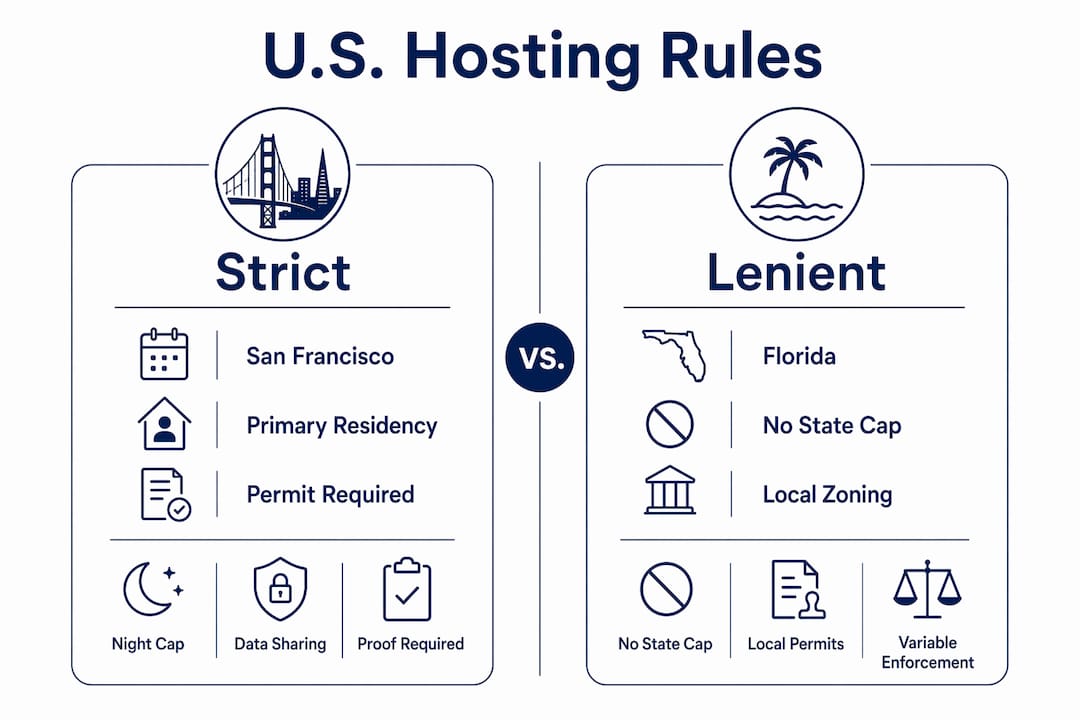
Jurisdictional differences are where most hosts get caught off guard. The table below compares four major U.S. markets to show how wide the gap can be.
| Market | Night Cap | Primary Residence Required | Permit Required | Key Enforcement Tool |
|---|---|---|---|---|
| San Francisco, CA | No annual cap (hosted); 90 nights unhosted | Yes, 275-night minimum occupancy | Yes, Office of Short-Term Rentals | $484 daily fines, listing removal |
| California (statewide) | 90–120 nights for unhosted rentals (varies by city) | Varies by city | Yes, tiered permits in most cities | SB 346 platform reporting |
| Florida (statewide) | No statewide cap | No statewide requirement | Yes, state license required | Local zoning enforcement |
| Grant County, WA | Fewer than 30 days per reservation | No | Yes, annual fire and life safety permit | Annual inspections, permit expiration |
San Francisco represents one of the most restrictive frameworks in the country. Hosts must prove primary residency with utility bills and tax returns, occupy the property for at least 275 nights per year, and register with the Office of Short-Term Rentals. Violations carry fines of $484 per day, plus listing removal and tax assessments. That is not a theoretical risk. San Francisco actively cross-checks platform data against registration records.
California’s statewide picture is shaped by SB 346, which requires platforms to share host data with local governments. This means cities can identify unregistered listings without conducting physical inspections. Some California cities cap unhosted rentals at 90 nights per year, while others set the limit at 120 nights. The specific cap depends on the city ordinance, not state law.
Grant County, Washington takes a different approach. Every host must obtain an Annual Fire and Life Safety Operational Permit before accepting any booking. The permit expires one year from issuance and requires a physical inspection. Stays must be fewer than 30 days per reservation. This is a permit-first model: no permit, no legal operation, regardless of what Airbnb’s platform allows.
Florida has no statewide night cap, but local zoning rules in cities like Miami Beach and Orlando impose their own restrictions. Hosts in Florida often underestimate local ordinances because state law appears permissive. That gap between state and local rules is where violations happen.
Pro Tip: When you research a new market, look up the local ordinances for your specific city or county, not just the state. State law rarely tells the full story.
How should hosts manage and enforce operational limits?
Managing hosting restrictions is an ongoing process, not a one-time setup. The following workflow covers the core steps every host and property manager should follow.
- Register before you list. Obtain all required permits and tax registrations before your first booking. In markets like Grant County and San Francisco, operating without a permit is an immediate violation, regardless of how long you have been hosting.
- Set guest limits in your listing. Use Airbnb’s ground rules feature to specify your maximum occupancy. Guests see and agree to these rules before booking. This creates a documented record if a dispute arises.
- Document your residency and permits. Keep digital copies of your permit, registration certificate, utility bills, and tax returns in a single folder. Inspectors and auditors ask for these documents on short notice. Organized audit-ready documentation is your first line of defense.
- Communicate rules before check-in. Send guests a pre-arrival message that restates your house rules, quiet hours, and occupancy limits. Written communication reduces misunderstandings and gives you evidence if a guest violates the rules.
- Track permit renewal dates. Permits expire. A lapsed permit in Grant County means you are operating illegally even if your listing is still active on Airbnb. Set calendar reminders 60 days before each renewal deadline.
- Work with a co-host or property manager in complex markets. In cities with frequent inspections or strict primary residence requirements, a local co-host who understands rental property oversight can handle compliance tasks when you are not on-site.
Pro Tip: Store all compliance documents in a cloud folder shared with your co-host or property manager. If an inspector arrives unannounced, anyone with access can pull the right paperwork immediately.
What happens when hosts violate operational limits?
Enforcement is more active than most hosts expect. Local governments use several mechanisms to identify non-compliant listings.
- Platform data sharing. Under laws like California’s SB 346, Airbnb and similar platforms share host data with local governments. Cities use this data to identify listings that lack permits or exceed night caps.
- Cross-document audits. Regulators compare registration records, tax filings, and booking data. A host who files for a homeowner’s property tax exemption but also claims rental income triggers an automatic review in many jurisdictions.
- Neighbor complaints. Noise complaints and parking violations often initiate inspections. A single complaint can prompt a city inspector to verify your permit status.
Penalties follow a predictable escalation. First violations typically result in a warning and a deadline to obtain the missing permit. Repeated violations lead to daily fines. San Francisco’s $484 daily fine accumulates fast. A two-week delay in correcting a violation costs nearly $7,000. Beyond fines, cities can order Airbnb to delist your property, and back-tax assessments can reach several years of unpaid transient occupancy tax.
Airbnb’s own enforcement mirrors local rules. Guests who violate house rules face suspension or removal from the platform. Hosts who repeatedly operate outside local regulations risk losing Superhost status, reduced search visibility, and eventual account suspension. Proactive compliance is the only reliable way to protect your listing’s long-term viability.
Key takeaways
Operational limits for Airbnb hosts are defined by local law, not Airbnb’s platform, and hosts must satisfy permit, residency, tax, and occupancy requirements independently of their booking status.
| Point | Details |
|---|---|
| Local law governs compliance | Airbnb platform approval does not satisfy city, county, or state permit requirements. |
| Night caps vary by market | San Francisco caps unhosted rentals at 90 nights; Grant County limits stays to under 30 days per reservation. |
| Permits expire and must be renewed | Annual permits like Grant County’s fire safety permit require inspections and lapse without renewal. |
| Documentation prevents penalties | Organized records of permits, residency proof, and tax filings are required for audits and inspections. |
| Violations carry serious costs | San Francisco fines reach $484 per day, and repeated violations can result in permanent delisting. |
What i’ve learned about treating compliance as a hosting asset
Most hosts treat compliance as a burden. After years of watching hosts navigate enforcement actions, I see it differently. The hosts who get delisted are almost never the ones who tried to comply and made a mistake. They are the ones who assumed Airbnb’s approval was enough and never looked at the municipal code.
The most common pitfall I see is the gap between state law and local ordinance. A host in Florida reads that the state has no night cap and stops researching. Then they list in Miami Beach, which has its own strict zoning rules, and they are hit with a fine within months. The examples of Airbnb regulations that catch hosts off guard are almost always local, not state or federal.
Documentation is the second area where hosts underinvest. Keeping a permit certificate in a desk drawer is not enough. You need a system: digital copies, renewal reminders, and a co-host or manager who can access everything if you are unavailable. An inspector does not reschedule because you are traveling.
My honest advice is to treat your compliance file the same way you treat your property maintenance schedule. Both require regular attention. Both cost you more when neglected. And both directly affect your ability to keep earning from your listing.
— Jure
Check your listing’s compliance with Strcomply
Staying on top of local hosting restrictions across multiple jurisdictions is time-consuming without the right tools. Strcomply is built specifically for this problem.
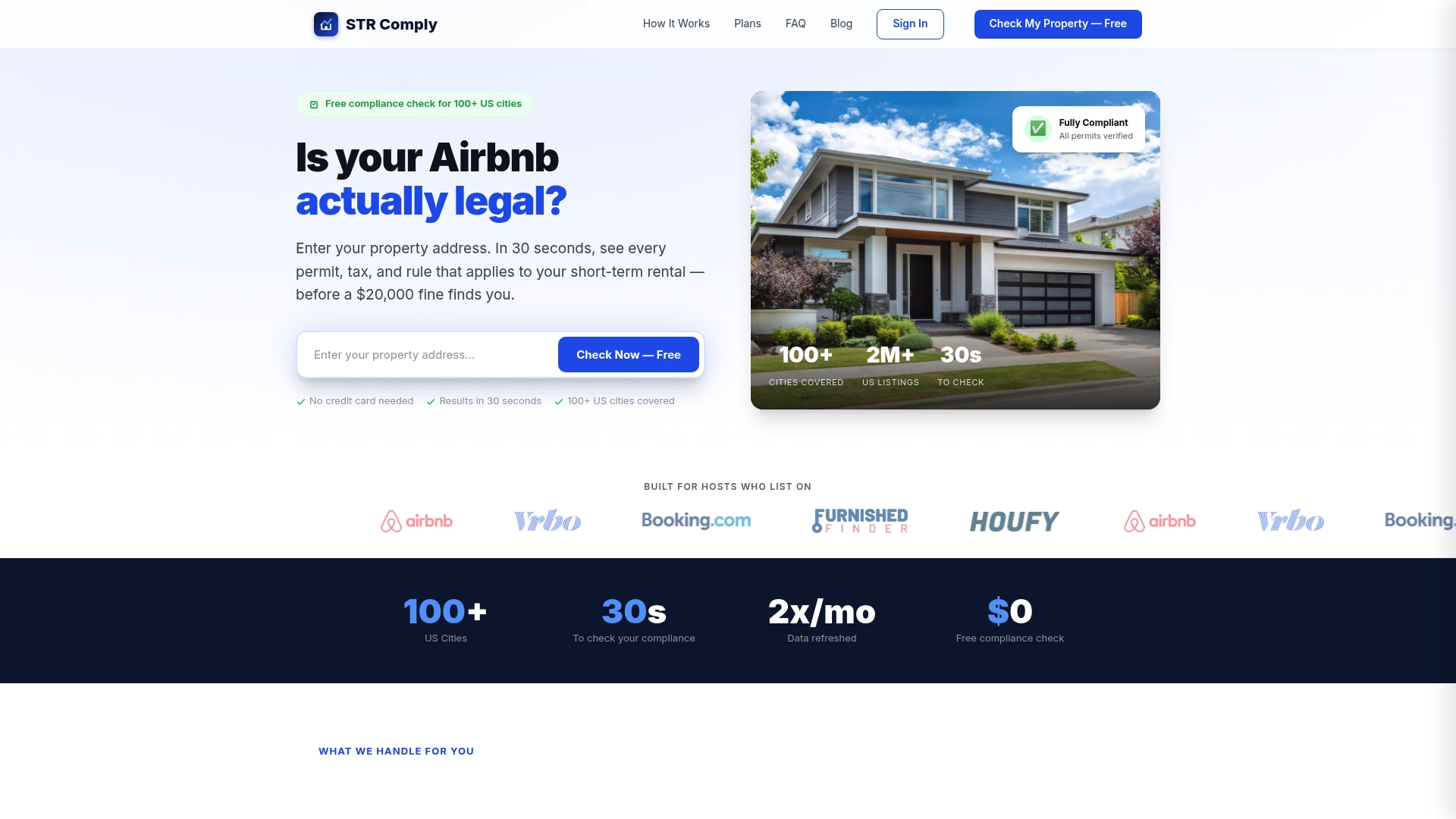
Strcomply’s free compliance check gives you an instant summary of the permit requirements, tax obligations, and operational restrictions that apply to your specific address. Paid plans add a portfolio dashboard, permit renewal alerts, and regulatory update notifications so you never miss a deadline. Whether you manage one property or twenty, Strcomply reduces the research burden and keeps your listings audit-ready. Visit Strcomply to run your first compliance check for free.
FAQ
What are operational limits for airbnb hosts?
Operational limits are the legal and platform-based rules that govern how long you can rent, how many guests you can host, what permits you must hold, and whether your property qualifies as an STR under local zoning law. They are set by local governments, not Airbnb.
How many guests can an airbnb host legally allow?
Guest limits are set by local fire codes and zoning ordinances, not Airbnb alone. Hosts can enforce their specific occupancy limit through Airbnb’s ground rules feature, which guests must acknowledge before booking.
Does airbnb report host data to local governments?
In California, SB 346 requires platforms like Airbnb to share host data with local governments, enabling cities to identify unregistered listings and enforce night caps without physical inspections.
What permits do airbnb hosts typically need?
Permit requirements vary by jurisdiction. Grant County, Washington requires an Annual Fire and Life Safety Operational Permit with a physical inspection. San Francisco requires registration with the Office of Short-Term Rentals and proof of primary residency.
What are the penalties for violating short-term rental rules?
Penalties include daily fines, back-tax assessments, and listing removal. San Francisco fines reach $484 per day for violations, and repeated non-compliance can result in permanent delisting from Airbnb.
Recommended
Check your city's STR regulations
Free compliance reports for 100+ US cities. Permits, taxes, zoning — all in one place.
Check My Address — Free