
A property manager is defined as a fiduciary agent who administers rental properties operationally, financially, and legally on behalf of the owner. Understanding what is property manager responsibility means recognizing that this role goes far beyond collecting rent. Property managers act under a signed management agreement that specifies their authority, fees, and duration, and that agreement activates formal fiduciary duties including loyalty, care, and full disclosure. For property owners and prospective landlords, knowing exactly what these duties cover is the first step toward protecting your investment.
What are the core property manager responsibilities for physical assets?
Core property management duties fall into three categories: physical asset management, tenant relations, and financial administration. The physical asset side is where most owners first feel the difference between self-managing and hiring a professional.
A property manager conducts regular inspections to document the property’s condition and catch problems before they become expensive repairs. These inspections follow a defined schedule, typically at move-in, move-out, and at set intervals during a tenancy. Documentation from each visit creates a legal record that protects the owner in disputes.

Vendor coordination is another core function. Property managers maintain relationships with licensed contractors, plumbers, electricians, and landscapers, often negotiating preferred rates through volume. They issue work orders, verify completed work, and track warranties on repairs.
Management agreements often include spending thresholds requiring owner approval above a certain amount, commonly $200–$500. Routine repairs below that threshold are handled autonomously. Anything above it requires prior owner authorization. This threshold protects owners from surprise expenses while giving managers the authority to act quickly on urgent issues.
Pro Tip: Ask any property manager candidate to show you their standard inspection checklist and vendor vetting process before signing a management agreement. A manager without documented procedures is a liability.
- Scheduled move-in and move-out inspections with written reports
- Preventive maintenance programs to extend property lifespan
- Vendor contract management and payment processing
- Safety code compliance checks including smoke detectors and egress
- Emergency repair protocols with defined response times
How do property managers handle tenant relations and leasing?
Property managers are the investment’s face to tenants, and when an owner is off-site, that relationship determines whether good tenants stay or leave. Tenant retention directly affects occupancy rates and long-term returns, which makes this one of the most consequential parts of the role.
The leasing process starts with marketing. Effective marketing includes professional listing photos, accurate descriptions, and syndication to major rental platforms to reduce vacancy duration. A well-marketed unit attracts qualified applicants faster, which cuts the cost of vacancy.
Tenant screening follows a defined process that must comply with the Fair Housing Act. Managers evaluate credit history, income verification, rental history, and criminal background within legally permitted parameters. Inconsistent screening criteria expose owners to discrimination claims, so documented and uniform procedures are non-negotiable.
- Market the unit with professional photos and platform syndication
- Screen applicants using consistent, Fair Housing-compliant criteria
- Execute the lease agreement and conduct a documented move-in walkthrough
- Manage ongoing communications, maintenance requests, and complaints
- Enforce lease terms and, when necessary, initiate eviction proceedings
Pro Tip: Require your property manager to use a written tenant communication log. Verbal-only interactions create gaps in documentation that become serious problems during eviction proceedings or security deposit disputes.
Lease enforcement is the part of tenant relations most owners prefer to avoid. Property managers handle late payment notices, lease violation warnings, and formal eviction filings when required. Working with a Seattle-area property management firm like Sagareus illustrates how local expertise in tenant law reduces the risk of procedural errors during evictions.
What financial responsibilities do property managers have to owners?
Financial administration is where property managers demonstrate their value most clearly to owners. Rent collection includes enforcing due dates, applying late fees, and tracking payment history using online portals. Technology reduces missed payments and cuts the administrative burden on both managers and owners.
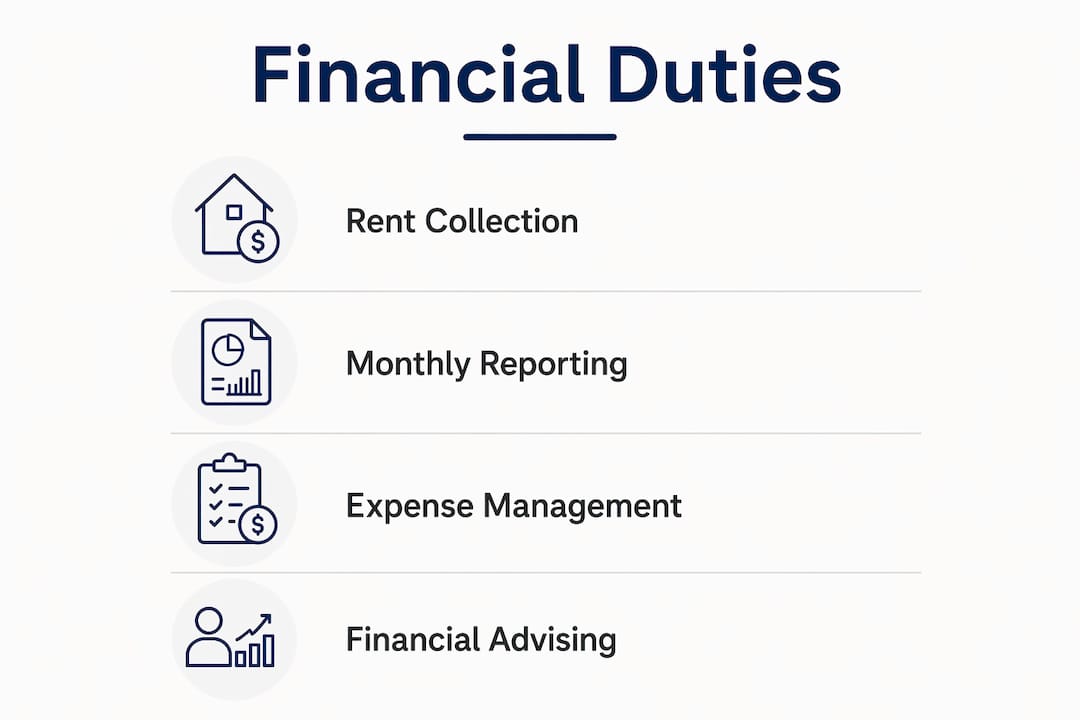
Beyond rent collection, property managers produce monthly financial statements, annual reports, and documentation needed for tax preparation. These reports give owners a clear picture of income, expenses, and net operating income. Owners who receive vague or infrequent financial reports are flying blind on their own investment.
The most forward-thinking managers go further. Top managers act as financial advisors, helping owners understand return on investment, capitalization rates, and even the mechanics of a 1031 exchange for tax-deferred reinvestment. This advisory role represents a significant shift from the traditional view of property management as purely operational.
| Financial task | What the manager does | Why it matters to owners |
|---|---|---|
| Rent collection | Enforces due dates and applies late fees via online portal | Reduces delinquency and improves cash flow predictability |
| Expense management | Approves routine costs within threshold; escalates larger items | Prevents unauthorized spending while maintaining property condition |
| Financial reporting | Produces monthly statements and annual summaries | Gives owners accurate data for tax filing and investment decisions |
| Strategic advising | Analyzes cap rates, ROI, and reinvestment options | Helps owners maximize long-term returns beyond day-to-day operations |
What legal and regulatory obligations do property managers uphold?
Compliance with Fair Housing laws and local landlord-tenant regulations is one of the most critical property management responsibilities. Violations expose owners to lawsuits, financial penalties, and in the case of short-term rentals, de-listing from platforms. Managers who stay current on local law protect owners from risks they may not even know exist.
Property managers must maintain legally compliant lease agreements that reflect current state and local requirements. A lease that was valid three years ago may not be valid today if local ordinances have changed. Managers who fail to update lease templates create liability for owners.
Proper record keeping with digital tools creates transparent, accessible documentation needed for legal compliance and dispute resolution. Digital document trails improve inspection transparency and make lease renewals more secure. Paper-only systems create gaps that are difficult to defend in court.
Key legal obligations property managers must fulfill include:
- Maintaining Fair Housing-compliant screening and leasing practices
- Keeping insurance policies current and verifying tenant liability coverage
- Filing required notices within legally mandated timeframes for late payments and evictions
- Retaining inspection reports, lease agreements, and correspondence for the required period
- Operating strictly within the authority granted by the management agreement
Property managers must also avoid overstepping their authority. They cannot provide legal advice, make unauthorized investment decisions, or act outside the scope defined in the management agreement. Owners who want to understand rental legal requirements in detail should review their agreement carefully before signing.
How is technology shaping property manager duties today?
Technology has changed what property managers can deliver and what owners should expect. Modern property managers use tech tools for communication, payments, and documentation, including parcel storage services, digital lease renewals, and online rent portals. These tools reduce legal risk and improve the tenant experience simultaneously.
Online payment platforms eliminate the check-in-the-mail problem. Tenants pay through a portal, payments post automatically, and the system flags late payments without manual follow-up. That automation frees managers to focus on higher-value tasks like tenant retention and vendor oversight.
Digital documentation portals give owners real-time access to inspection reports, lease documents, and maintenance records. Owners no longer need to call their manager to find out when the last inspection occurred or what repairs were completed. Transparency is built into the system.
- Online rent collection portals with automated late fee enforcement
- Digital lease signing and renewal platforms
- Inspection apps with photo documentation and time-stamped records
- Tenant communication portals for maintenance requests and notices
- Market data dashboards providing rent trend analysis and vacancy benchmarks
Property managers who use regulatory compliance tools alongside their operational platforms are better positioned to catch zoning changes, permit renewals, and tax obligation updates before they become violations. Technology does not replace judgment, but it eliminates the gaps that cause costly oversights.
Key Takeaways
A property manager’s core responsibility is to act as a fiduciary agent who protects the owner’s investment through disciplined operational, financial, and legal oversight.
| Point | Details |
|---|---|
| Fiduciary duty is foundational | The management agreement activates legal duties of loyalty, care, and disclosure that bind the manager to the owner’s interests. |
| Physical asset management protects value | Regular inspections, vendor coordination, and spending thresholds keep the property in good condition without surprise costs. |
| Tenant relations drive retention | Fair Housing-compliant screening, documented communication, and proactive lease enforcement reduce vacancy and legal risk. |
| Financial reporting must be transparent | Monthly statements, online rent collection, and strategic ROI advising give owners the data they need to make sound decisions. |
| Legal compliance is non-negotiable | Updated leases, digital records, and current knowledge of local landlord-tenant law protect owners from penalties and lawsuits. |
The balancing act most owners underestimate
Property management looks straightforward from the outside. You hire someone, they collect rent, they fix things. The reality is considerably more demanding. Property managers balance competing interests of owners, tenants, and vendors simultaneously, and failing that balance is the most common reason managers lose clients or burn out.
I’ve seen first-time landlords hire the cheapest manager available and spend twice as much fixing the consequences. A manager who skips tenant screening to fill a vacancy fast creates a delinquency problem that costs far more than a month of vacancy ever would. A manager who ignores a local ordinance change because they didn’t subscribe to regulatory updates hands the owner a fine that dwarfs the management fee.
The shift toward strategic partnership is real and worth paying for. Market trend analysis and forecasting from a knowledgeable manager gives owners an edge in deciding when to raise rents, when to renovate, and when to sell. That kind of insight does not come from a manager who is simply processing paperwork.
For short-term rental owners specifically, the compliance dimension has become the most urgent part of the role. Local regulations on permits, zoning, and transient occupancy tax change frequently and vary by city. A property manager who does not track those changes is not protecting your investment. The future of property management belongs to professionals who combine operational discipline with real-time regulatory awareness.
— Jure
How Strcomply supports property owners and managers
Managing short-term rental compliance across multiple markets is one of the most time-consuming parts of a property manager’s job. Strcomply is built specifically for that challenge.

Strcomply gives property owners and managers instant access to city-specific compliance summaries covering permits, zoning restrictions, transient occupancy tax obligations, and operational rules for Airbnb, VRBO, and similar platforms. The platform’s paid plans include permit tracking, renewal alerts, and regulatory update notifications so nothing falls through the cracks. For managers handling multiple properties across different jurisdictions, Strcomply’s compliance tips for 2026 and portfolio dashboard reduce the research burden significantly. Staying compliant protects your listings, your revenue, and your reputation.
FAQ
What is a property manager’s primary legal duty?
A property manager’s primary legal duty is to act as a fiduciary agent under the management agreement, which requires loyalty, care, and full disclosure to the property owner at all times.
What does a property manager do about tenant screening?
Property managers screen applicants using consistent criteria that comply with the Fair Housing Act, evaluating credit, income, rental history, and criminal background within legally permitted limits.
How do property managers handle maintenance expenses?
Management agreements typically set a spending threshold of $200–$500. Repairs below that amount are handled autonomously, while larger expenses require prior owner approval.
What financial reports should a property manager provide?
Property managers produce monthly income and expense statements, annual financial summaries, and documentation for tax preparation, giving owners a clear and current picture of their investment’s performance.
Why does regulatory compliance matter for property managers?
Non-compliance with Fair Housing laws and local landlord-tenant regulations exposes owners to lawsuits, fines, and platform de-listings, making compliance oversight one of the most critical property management responsibilities.
Recommended
Check your city's STR regulations
Free compliance reports for 100+ US cities. Permits, taxes, zoning — all in one place.
Check My Address — Free