
Rental de-listing risk is defined as the probability that a short-term rental listing will be removed or suspended from platforms like Airbnb or VRBO due to regulatory non-compliance, policy violations, or enforcement actions by local authorities. This risk is not theoretical. British Columbia mandated removal of all non-compliant listings by june 23, 2025, canceling future bookings in the process. Portland’s city auditor found that 25–40 rentals are delisted monthly due to invalid permit numbers alone. For hosts and property managers, understanding what drives delisting, and how to stay ahead of it, is now a core business requirement.
What is rental de-listing risk and how does it work?
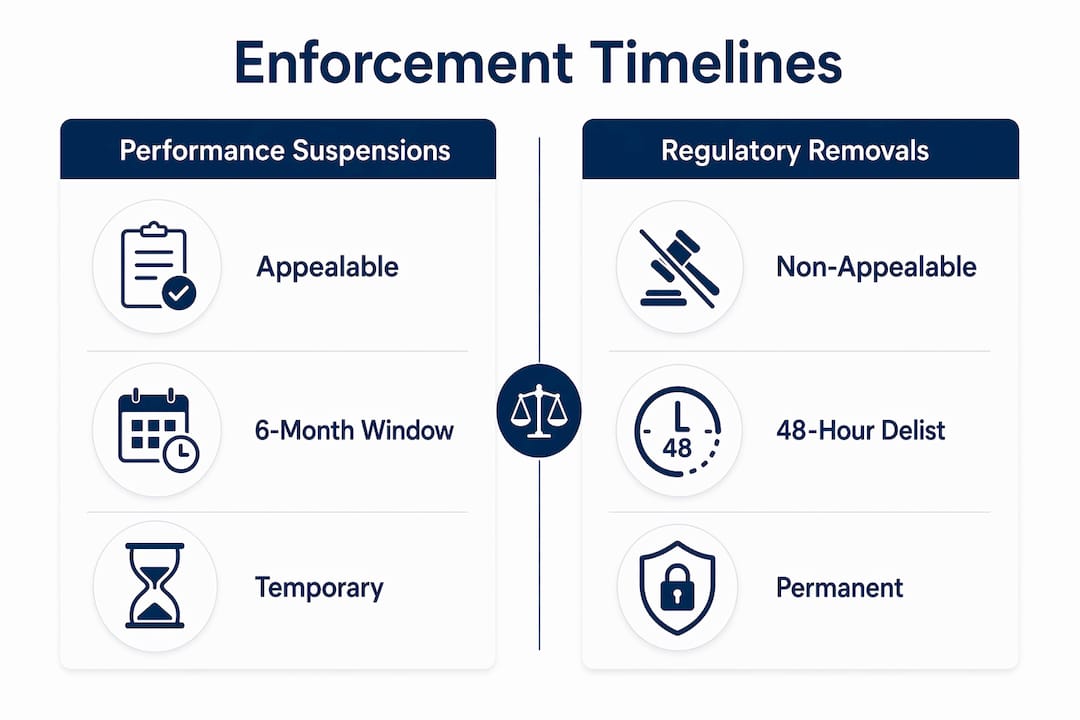
Rental de-listing risk, known in the industry as listing suspension or regulatory removal, describes two distinct enforcement pathways that hosts frequently confuse. The first is a performance-based suspension, triggered by low ratings, high cancellation rates, or repeated guest complaints. The second is a regulatory removal, triggered by a legal mandate from a city, state, or provincial authority. Regulatory removals are treated more severely than performance issues and are often permanent.
Performance suspensions vs. regulatory removals
Airbnb treats performance suspensions as correctable. The platform allows appeals within 6 months for temporary suspensions, giving hosts a window to resolve the underlying issue. Permanent removals, reserved for severe violations such as fraud, safety breaches, or confirmed regulatory non-compliance, are rarely reversed. That distinction matters enormously for your revenue planning.
Regulatory removals follow a different workflow entirely. A government authority identifies a non-compliant listing, typically through automated data review, then issues a formal order to the platform. The platform is then legally obligated to act. Platforms have 48 hours to delist a rental for serious violations and up to 10 working days for standard compliance issues after receiving that order. That timeline leaves almost no room for a reactive response.
How enforcement actually unfolds
The enforcement process is not fully automated, even in 2026. Automated API flags are initial triggers, but a human authority review and formal order are required before a platform must act. Portland’s enforcement program uses third-party compliance software to scan listings for invalid or mismatched permit numbers. When the software flags a listing, a city official reviews the case and issues a removal order. The platform then executes the delisting within the required window.

Pro Tip: If you receive any communication from a platform citing a compliance flag, treat it as a formal notice. Do not wait for a second message. Contact your local permitting office the same day to verify your registration status.
What risk factors increase the chance of listing removal?
Several specific conditions raise your de-listing risk factors significantly. Understanding them lets you prioritize where to focus your compliance efforts.
- Invalid or expired permits. Displaying a permit number that has lapsed, been revoked, or never existed is the single most common trigger for regulatory removal. Portland’s enforcement program detects these mismatches monthly.
- Listing data inconsistencies. If your listing address, unit type, or occupancy count does not match your official registration records, automated systems will flag the discrepancy. Even a minor address formatting difference can trigger a review.
- Permit cycling. This is the practice of repeatedly posting a listing with different or recycled invalid permit numbers after a removal. Permit cycling is detected by compliance software and results in full account bans, not just listing removals. It is the fastest path to losing your entire portfolio on a platform.
- Occupancy and behavioral violations. Exceeding posted guest limits, violating local noise ordinances, or hosting events in markets where they are prohibited all generate guest complaints and authority reports that feed into enforcement workflows.
- Local residency and booking day limits. Many cities, including San Francisco and New York City, require hosts to be primary residents of the listed property. Others cap the number of nights a property can be rented annually. Violating either rule puts you in direct regulatory non-compliance.
Pro Tip: Review your owner contracts now. Owner agreements often fail to assign liability for permit lapses to the property owner, which means the property manager absorbs the revenue loss when a listing is removed. Add a specific clause that places financial responsibility for permit and registration failures on the property owner.
How is automated data-sharing changing enforcement in 2026?
The enforcement environment has shifted from reactive to proactive. Governments in the EU, British Columbia, and several U.S. cities now require platforms to share listing data via APIs in real time. This means authorities no longer need to manually search for non-compliant listings. The data comes to them.
The table below summarizes how enforcement timelines and mechanisms differ across key markets.
| Market | Enforcement Mechanism | Delisting Timeline |
|---|---|---|
| Portland, OR | Third-party compliance software scans permit numbers | Ongoing; 25–40 delistings per month |
| British Columbia | Mandatory platform API data-sharing with provincial registry | Immediate upon non-compliance after june 23, 2025 deadline |
| European Union | Digital Services Act reporting requirements | Varies by member state; typically 10 working days |
| United Kingdom | Authority order after human review of API data | 48 hours (serious) or 10 working days (standard) |
Digital reporting regulations in the EU and BC signal a permanent shift toward automated compliance monitoring. This is not a temporary enforcement push. These systems are infrastructure. Once built, they do not get dismantled.
The practical implication is speed. In the past, a host might have weeks or months before a non-compliant listing attracted attention. Today, a listing with an invalid permit can be flagged within days of going live. Hosts must actively audit compliance status rather than assume their listing is fine because it has not been touched yet. Passive compliance is no longer a viable strategy.
For property managers running portfolios across multiple markets, the risk compounds. A single market’s regulatory change can trigger a cascade of removals if permit renewals are not tracked systematically. The legal requirements for rental operators in 2026 vary significantly by city, making centralized tracking a necessity rather than a convenience.
How can hosts prevent rental de-listing before it happens?
Preventing rental de-listing requires a structured, ongoing compliance practice. The following steps represent the minimum standard for hosts and property managers operating in regulated markets.
- Audit listing data against official records quarterly. Compare your Airbnb and VRBO listing details, including address format, unit type, and occupancy limits, against your current permit or registration certificate. Any discrepancy is a risk.
- Track permit expiration dates proactively. Set calendar reminders at least 60 days before any permit renewal deadline. Many cities have processing backlogs, and a lapsed permit during the renewal window still counts as non-compliance.
- Use compliance monitoring software. Tools that track regulatory changes by city and alert you to permit status issues reduce the manual burden significantly. Strcomply offers city-specific compliance summaries and renewal alerts for hosts managing properties across multiple U.S. markets. The host compliance checklist from Strcomply is a practical starting point.
- Update owner contracts to assign permit liability. As noted above, most standard property management agreements do not address who bears the financial loss when a listing is removed due to a permit lapse. Revise this now, before a removal event forces the conversation.
- Prepare a guest communication protocol for cancellations. If a listing is removed and bookings must be canceled, having a pre-written communication template reduces response time and limits negative reviews. Platforms like Airbnb factor cancellation rates into host performance scores, so even a compliance-driven cancellation can create secondary performance risk.
Pro Tip: Never attempt to relist a property under a new account or with a recycled permit number after a removal. Platforms share enforcement data internally, and permit cycling leads to account bans that affect every listing tied to your profile.
For hosts who want a deeper look at Airbnb-specific rules, the Airbnb compliance guide for 2026 covers platform policies alongside local regulatory requirements in detail.
Key takeaways
Rental de-listing risk is a direct, measurable threat to short-term rental revenue, driven by regulatory non-compliance, permit failures, and platform policy violations that now trigger automated enforcement within days.
| Point | Details |
|---|---|
| Two types of removal exist | Performance suspensions are reversible; regulatory removals are often permanent and harder to appeal. |
| Enforcement timelines are short | Platforms must delist within 48 hours for serious violations after receiving a formal authority order. |
| Permit cycling accelerates penalties | Reposting with invalid permits triggers account bans, not just listing removals. |
| Contracts must assign permit liability | Owner agreements should specify that property owners bear financial responsibility for permit lapses. |
| Proactive audits are required | Quarterly reviews of listing data against official records are the minimum standard in 2026. |
The part most hosts learn too late
I have reviewed compliance situations across dozens of markets, and the pattern is consistent. Hosts do not lose listings because they ignored the rules. They lose listings because they assumed nothing had changed since they last checked. A permit renewed late, an address formatted differently on a new platform account, a city ordinance updated mid-year without a notification email. These are the actual causes of most delistings I see.
The other thing I would push back on is the idea that compliance is primarily a legal problem. It is a revenue protection problem. A single delisting event on Airbnb during peak season can cost a host thousands of dollars in lost bookings, plus the time and stress of navigating an appeal process that may not succeed. That cost is almost always higher than the cost of a compliance monitoring subscription or a quarterly audit.
What concerns me most about 2026 is the speed of enforcement. The BC and Portland examples are not outliers. They are the model other cities are copying. When a government can identify a non-compliant listing within days of it going live, the old strategy of “fix it when you get a notice” no longer works. You need to be compliant before the listing goes live, and you need to stay compliant every day it remains active.
The hosts and managers who will operate successfully in this environment are the ones who treat compliance as a standing operational process, not a one-time setup task.
— Jure
Stay ahead of de-listing risk with Strcomply
Rental delisting concerns are not going away. If anything, enforcement is accelerating across U.S. markets as cities adopt the same data-driven tools that Portland and British Columbia have already deployed.
Strcomply is built specifically for this environment. The platform gives hosts and property managers instant access to city-specific compliance summaries, permit tracking dashboards, renewal alerts, and regulatory update notifications. Whether you manage one property or a multi-market portfolio, Strcomply’s compliance tools reduce the manual work of staying current and give you a clear view of where your listings stand before enforcement finds them first. Start with a free compliance check at Strcomply to see exactly where your listings stand today.
FAQ
What is rental de-listing risk in simple terms?
Rental de-listing risk is the chance that your short-term rental listing will be removed from Airbnb, VRBO, or a similar platform because of a permit issue, regulatory violation, or platform policy breach. It results in lost bookings and potential account penalties.
How quickly can a listing be removed after a violation is found?
Platforms must delist within 48 hours for serious violations after a formal authority order is issued. Standard compliance issues allow up to 10 working days.
Can you appeal a delisting on airbnb?
Airbnb permits appeals within 6 months for temporary suspensions, but permanent removals tied to severe regulatory violations are rarely reversible.
What is permit cycling and why is it dangerous?
Permit cycling means reposting a listing with a different or recycled invalid permit number after a removal. Compliance software detects this pattern and platforms respond with full account bans rather than another temporary removal.
How do property managers protect themselves from de-listing losses?
Property managers should update owner contracts to assign financial liability for permit and registration failures to the property owner, and use compliance monitoring software to track permit status across all active listings.
Recommended
Check your city's STR regulations
Free compliance reports for 100+ US cities. Permits, taxes, zoning — all in one place.
Check My Address — Free