
A step by step compliance audit is a structured process that verifies your short-term rental property meets every local regulatory requirement, from zoning permissions to tax filings, before a violation notice finds you first. For Airbnb and VRBO hosts, non-compliance is not a theoretical risk. In Houston alone, penalties reach $500 per violation day, totaling up to $15,000 in a single month. The formal term for this process is a regulatory compliance audit, and it covers licensing bodies, local zoning authorities, safety regulators, and tax agencies. This guide walks you through every stage of the compliance audit process so you can protect your listings and your income.
What preliminary permissions must you verify first?
The first layer of any compliance audit guide for short-term rentals is confirming your legal right to operate. Zoning and HOA permissions form this foundation, and skipping them makes every subsequent audit step meaningless. Many cities restrict STRs by zone or prohibit them in specific neighborhoods entirely. Confirming this before you audit anything else saves significant time and legal exposure.
Here is what to verify in this first layer:
- Zoning clearance. Check your local municipality’s zoning map or contact the planning department directly. Confirm your property’s zone classification permits short-term rentals. Some cities allow STRs only in owner-occupied units or specific districts.
- HOA and lease restrictions. Review your HOA bylaws, condo association rules, and lease agreement if you rent the property. Many HOA boards prohibit STRs outright, and a lease may contain a subletting clause that bars platforms like Airbnb.
- Licensing and registration. Verify the specific permit or license your jurisdiction requires. Houston, for example, requires a $275 application fee, $1 million in liability insurance, human trafficking training, and a designated 24-hour emergency contact.
- Display requirements. Some cities require your permit number to appear on every listing. Confirm whether this applies in your market and check that your Airbnb or VRBO listing reflects it.
- Written documentation. Obtain written confirmation of zoning clearance and any HOA approvals. Verbal permissions do not hold up during an audit.
Pro Tip: Request written confirmation from your HOA or local authority and save it as a PDF with the date in the filename. A document labeled “HOA_Approval_2026-03” is far easier to locate during an audit than a buried email thread.
How to collect and organize audit evidence effectively
Compliance audits focus on proving control effectiveness with current, traceable evidence, not just having policies on paper. This distinction matters because auditors ask “prove it,” and undocumented work or outdated screenshots regularly cause audit failures. Digital tracking cuts audit preparation time by 90% when records are timestamped, signed, and linked to specific requirements.
Follow these steps to build a defensible evidence package for each property:
- Create a property-level evidence file. Set up a dedicated digital folder for each unit. Use a consistent naming convention such as “PropertyName_City_2026.” Store all compliance documents in this folder, organized by category: permits, insurance, taxes, and safety.
- Digitize all physical documents. Scan permits, inspection certificates, and insurance declarations. Use a tool like Adobe Acrobat or Google Drive to maintain searchable PDFs. Paper files disappear; digital files with backups do not.
- Timestamp every document. Confirm that each file carries a visible date. For photos of safety equipment such as fire extinguishers or carbon monoxide detectors, use your phone’s timestamp feature or a camera app that embeds metadata.
- Collect signed records. Safety inspection reports, guest acknowledgment forms, and contractor sign-offs must carry a signature. Unsigned documents are treated as unverified during a formal audit.
- Map documents to requirements. Build a simple spreadsheet that lists each regulatory requirement in one column and the corresponding evidence file in the next. This evidence ledger approach mirrors the audit worksheet and lets you verify every requirement at a glance.
- Review your essential compliance documents by checking resources like the STR Comply compliance documents guide to confirm you have not missed a required record type.
Pro Tip: Never use a screenshot of a permit page as your primary evidence. Screenshots lack metadata and can be dismissed as unverifiable. Download the official PDF directly from the issuing authority’s portal instead.
How to conduct a compliance audit from start to finish
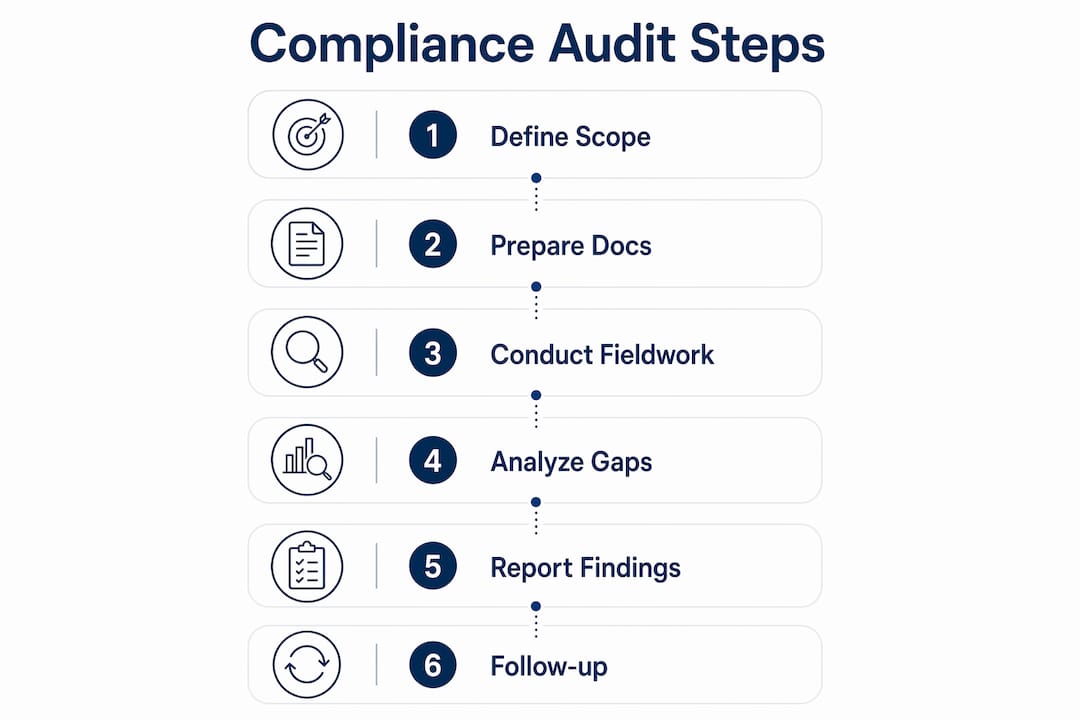
Compliance auditing is a structured, risk-prioritized process that maps requirements to controls and verifies them through review and testing. For STR hosts, this means working through a defined sequence rather than spot-checking random documents. The following six-step process applies to a single property or a full portfolio.
Step 1: Define scope and objectives. Identify which regulations apply to your property based on its city, zone, and platform. List every requirement: zoning, licensing, safety codes, transient occupancy tax, and listing accuracy. This scope document becomes your audit framework.
Step 2: Prepare documentation and brief your team. Gather all evidence files before fieldwork begins. If you manage multiple properties with staff, brief your team on what inspectors or local authorities may request. Assign a compliance owner for each property.
Step 3: Conduct fieldwork. Effective fieldwork covers document review, staff interviews, and physical inspections. Walk through the property and verify that safety equipment is present, functional, and documented. Confirm that posted permits are current and visible to guests.

Step 4: Analyze findings and identify gaps. Compare your evidence against the scope document. Flag any requirement that lacks current, signed, or timestamped proof. Categorize gaps by severity: critical (immediate risk of penalty), moderate (renewal due within 90 days), and minor (administrative updates needed).
Step 5: Report results with corrective actions. Produce a written audit report that lists each gap, its risk level, the corrective action required, and a deadline. This report protects you if a local authority questions your compliance history.
Step 6: Follow up on remediation. Set calendar reminders to verify that each corrective action is completed. Update your evidence files and audit checklist to reflect the resolved items.
| Audit stage | Key output |
|---|---|
| Scope definition | Regulatory requirement list by property |
| Preparation | Organized evidence file per unit |
| Fieldwork | Inspection notes and document review log |
| Gap analysis | Risk-categorized findings report |
| Reporting | Written corrective action plan with deadlines |
| Follow-up | Updated evidence files and closed gaps |
How often should STR hosts perform compliance audits?
Quarterly compliance audits reduce risk and allow timely corrections without disrupting bookings. Conducting reviews before each peak season, typically spring, summer, fall, and the winter holidays, aligns audit timing with periods of maximum guest volume and regulatory scrutiny. A single lapsed permit during a high-occupancy month carries far greater financial exposure than the same lapse in a slow period.
Beyond quarterly reviews, ongoing monitoring between audits keeps you continuously ready:
- Track license and permit expiration dates. Enter every renewal deadline into a shared calendar with a 60-day advance alert. Permit renewals often require inspections that take weeks to schedule.
- Monitor tax filing deadlines. Transient occupancy tax filings are typically monthly or quarterly depending on your jurisdiction. Missing a filing triggers penalties that compound quickly. The vacation rental tax guide from Strcomply covers filing schedules by state.
- Integrate safety checks into turnover workflows. Test smoke detectors, carbon monoxide alarms, and fire extinguishers during every deep clean between guest stays. Document each check with a dated log entry.
- Update your audit checklist after every regulatory change. Audit checklists must be living documents updated after each audit cycle to reflect new requirements. Subscribe to your city’s planning or licensing department newsletter to catch amendments early.
- Use regulatory monitoring tools. Platforms that track local STR regulation changes, such as those described in the regulatory monitoring guide, remove the burden of manual research between audit cycles.
Common compliance audit challenges and how to avoid them
Most STR compliance failures trace back to a small set of recurring problems. Treating zoning and HOA permissions as a separate first layer from operational compliance reduces audit failure risk significantly, yet many hosts conflate the two and miss critical gaps in both.
The most frequent audit blockers include:
- Documentation gaps. Hosts often have permits but cannot locate them during an audit. The fix is a centralized digital evidence file per property, maintained year-round rather than assembled under pressure.
- Ignoring zoning or HOA restrictions. Operating in a zone that prohibits STRs or in a building with a no-subletting clause is the most severe audit failure. It cannot be corrected with better paperwork. Verify permissions before listing.
- No assigned compliance owner. When nobody is specifically responsible for tracking renewals and filing deadlines, things fall through. Assign one person per property or portfolio segment and document that assignment.
- Outdated evidence. An insurance certificate from two years ago or a safety inspection photo without a timestamp fails the “prove it” standard. Replace outdated records immediately after each audit cycle.
“Aligning audit steps with specific risks and mapping pass/fail outcomes with evidence sources strengthens audit defensibility.” — Audit checklist in practice
Key takeaways
A defensible STR compliance audit requires current, signed, and timestamped evidence mapped to every local regulatory requirement, reviewed at least quarterly and updated after each regulatory change.
| Point | Details |
|---|---|
| Start with permission to operate | Verify zoning, HOA rules, and licensing before auditing any operational requirement. |
| Build a per-property evidence file | Organize timestamped, signed documents by category in a dedicated digital folder for each unit. |
| Follow a six-step audit process | Move from scope definition through fieldwork, gap analysis, reporting, and remediation follow-up. |
| Audit quarterly before peak seasons | Schedule reviews before high-occupancy periods to catch gaps before they become costly violations. |
| Treat your checklist as a living document | Update your audit checklist after every regulatory change and every completed audit cycle. |
Why reactive auditing costs more than you think
Most hosts I have worked with treat compliance auditing as something you do after a problem appears. A neighbor complains, a city inspector shows up, or a platform flags the listing. By that point, the corrective work costs three to five times more in time and fees than a proactive quarterly review would have. The audit process itself is not complicated. What makes it hard is the habit of deferring it.
The shift that makes the biggest practical difference is separating “permission to operate” from “how you prove you operate correctly.” These are two distinct audit tracks, and conflating them is where most hosts lose time. Zoning and HOA clearance is a one-time verification that you update only when regulations change. Operational evidence, such as current insurance, valid permits, and dated safety checks, is a continuous maintenance task. Once you treat them separately, the workload becomes manageable.
Digital evidence management is not optional for anyone running more than one property. A shared Google Drive folder with a consistent naming convention beats a filing cabinet every time an auditor asks for documentation. Large portfolios benefit from a dual-level audit structure: a jurisdiction-level compliance register that tracks rules by city, and a property-level evidence file that tracks proof by unit. This structure makes it possible to audit 20 properties with the same rigor you would apply to one.
Build simple, repeatable checklists tailored to your specific markets. A checklist designed for a Nashville property will differ from one built for a San Diego listing. Generic templates miss local requirements. The investment in a market-specific checklist pays back every quarter when your audit takes two hours instead of two days.
— Jure
How Strcomply simplifies your compliance audit process
Strcomply is built specifically for short-term rental hosts who need to stay audit-ready without spending hours on manual research. The platform provides city-specific compliance summaries covering permit requirements, tax obligations, zoning restrictions, and operational rules for Airbnb and VRBO listings across the United States. Paid plans include centralized document storage, permit tracking, renewal alerts, and regulatory update notifications, so your audit compliance checklist stays current without manual effort. Property managers overseeing multiple listings can use the portfolio dashboard to monitor compliance status across every unit from a single view. Visit Strcomply to run a free compliance check on your listing and see exactly where your gaps are before an auditor does.
FAQ
What is a compliance audit for short-term rentals?
A compliance audit for short-term rentals is a structured review that verifies your property meets all local zoning, licensing, safety, and tax requirements. It produces documented evidence that your operation is legally sound and defensible to local authorities.
How often should STR hosts conduct a compliance audit?
Quarterly audits are the recommended cadence, timed before each peak season to cover licenses, taxes, safety equipment, and listing accuracy. Ongoing monitoring between audits handles expiration dates and regulatory changes.
What documents are required for an STR compliance audit?
Required documents typically include your STR permit or license, proof of liability insurance, safety inspection records, transient occupancy tax filings, and any HOA or zoning approval letters. Each document must be current, signed, and timestamped to serve as valid audit evidence.
What happens if you fail a short-term rental compliance audit?
Penalties vary by jurisdiction but can be severe. In Houston, fines reach $500 per violation day, with monthly totals reaching $15,000. Platforms like Airbnb may also de-list your property if local authorities report non-compliance.
Can I use a checklist to conduct my own internal compliance review?
Yes. An internal compliance review using a structured checklist is an effective way to identify gaps before a formal audit. The checklist must be updated after each review cycle to reflect new regulations and resolved findings.
Recommended
Check your city's STR regulations
Free compliance reports for 100+ US cities. Permits, taxes, zoning — all in one place.
Check My Address — Free