
Many property owners discover too late that understanding registration for rental homes is not a one-time checkbox. It is an ongoing legal obligation with real consequences for those who ignore it. Mandatory registries have turned rental properties into public-facing compliance projects across dozens of U.S. cities. Whether you manage a long-term lease or list on Airbnb, the rules around permits, documentation, fees, and renewals are more demanding than most hosts expect. This guide breaks down what the rental property registration process actually involves, what separates short-term from long-term requirements, and how to stay compliant without losing track of deadlines.
Table of Contents
- Key takeaways
- Understanding registration for rental homes
- Steps to register a rental property
- Short-term vs. long-term rental registration
- Ongoing compliance after registration
- My perspective on getting rental registration right
- Stay compliant with Strcomply
- FAQ
Key takeaways
| Point | Details |
|---|---|
| Registration is ongoing | Most cities require updates within 30 to 60 days of any ownership or management change. |
| Short-term rentals face stricter rules | STR hosts must display registration numbers on listings or risk platform removal. |
| Deadlines are non-negotiable | Cities like Anchorage set hard deadlines; missing them results in fines and de-listing. |
| Documentation accuracy matters | Mismatched addresses or incomplete applications are the top reasons for registration delays. |
| Fees vary significantly by market | Some cities charge flat fees under $100, while others like Toronto charge $375 or more. |
Understanding registration for rental homes
A rental registry is a formal database that local governments use to track who owns and operates rental properties within their jurisdiction. When you register, you are providing your city or county with essential data: your contact information, an emergency contact, the property address, and often proof of insurance or a valid lease.
Why do municipalities require this? The reasons are practical and growing. Cities use rental registration to enforce housing codes, collect transient occupancy taxes, improve emergency response coordination, and monitor the impact of short-term rentals on housing supply. Rental registration has evolved into a fundamental operational step that facilitates inspections, tax compliance, and resident safety. It is no longer a bureaucratic formality in most markets.
The consequences of skipping registration are concrete. Consider these common enforcement outcomes:
- Fines ranging from $100 to $1,000 or more per violation, depending on the jurisdiction
- Forced removal of your listing from platforms like Airbnb or VRBO
- Legal liability exposure during tenant disputes or property incidents
- Delayed or denied permit applications for future renovations or additional units
“Property owners should view registration not as a bureaucratic hoop but as preparation for increasing local oversight.” — Rental Registration Shift in U.S. Cities
Landlord registration guidelines vary significantly from city to city, but the underlying logic is consistent: local governments want accountability from rental operators, and registration is their primary tool to achieve it.
Steps to register a rental property
Knowing how to register a rental home starts with research, not paperwork. The process looks different in every jurisdiction, so confirming your local requirements before you gather documents will save you significant time.
Here is the general sequence most property owners follow:
- Confirm your jurisdiction’s requirements. Search your city or county government website for terms like “rental registration,” “short-term rental permit,” or “landlord registration guidelines.” Some cities manage this through a housing department; others route it through the tax authority or planning office.
- Verify property eligibility. Check whether your property qualifies for rental use under local zoning laws. Some zones prohibit short-term rentals entirely, while others impose density limits. Verifying property classification before applying is critical because mismatches between your zoning status and your application will stall the process.
- Gather your documents. Most jurisdictions require proof of ownership (deed or title), a government-issued ID, proof of liability insurance, and a copy of any existing lease agreements. Some also require utility bills to confirm your address matches what is on your ID.
- Complete and submit the registration form. Many cities now offer online portals, but some still require mail or in-person submission. Fill out every field completely. Incomplete applications are one of the most common causes of delay.
- Pay the registration fee. Fees range widely. Toronto charges $375 for short-term rental registration in 2026. Other cities charge as little as $50. Most fees are non-refundable, even if your application is denied.
- Wait for approval and receive your registration number. Processing times range from a few days to several weeks. Once approved, keep your registration number accessible. You will need to display it on listings and reference it for renewals.
Pro Tip: Before you submit, cross-check the name on your ID, your deed, and your utility bills. A mismatch between even two of these documents is one of the most common reasons applications get rejected or delayed.
Common pitfalls in the rental property registration process include failing to designate a local agent (required in many cities for out-of-state owners), submitting an outdated insurance certificate, and using a property address that does not match your tax records. Take time to review requirements for an Airbnb legal registration before you begin, since platform-specific rules often add another layer to the standard municipal process.

Short-term vs. long-term rental registration
The registration requirements for short-term rental hosts are meaningfully different from those for traditional landlords. Understanding rental agreements and permits in both categories will help you determine exactly what applies to your situation.
Key differences between short-term and long-term rental registration
| Requirement | Short-term rentals | Long-term rentals |
|---|---|---|
| Registration deadline | Strict, often tied to calendar dates | Typically within 60 days of acquisition |
| Display of registration number | Mandatory on all online listings | Not typically required |
| Principal residence requirement | Common in many cities | Not typically applicable |
| Night limits | Often imposed (e.g., 90 or 180 nights per year) | No restrictions |
| Local agent requirement | Frequently required | Required in fewer jurisdictions |
| Renewal frequency | Annual or biennial | Annual in many cities |
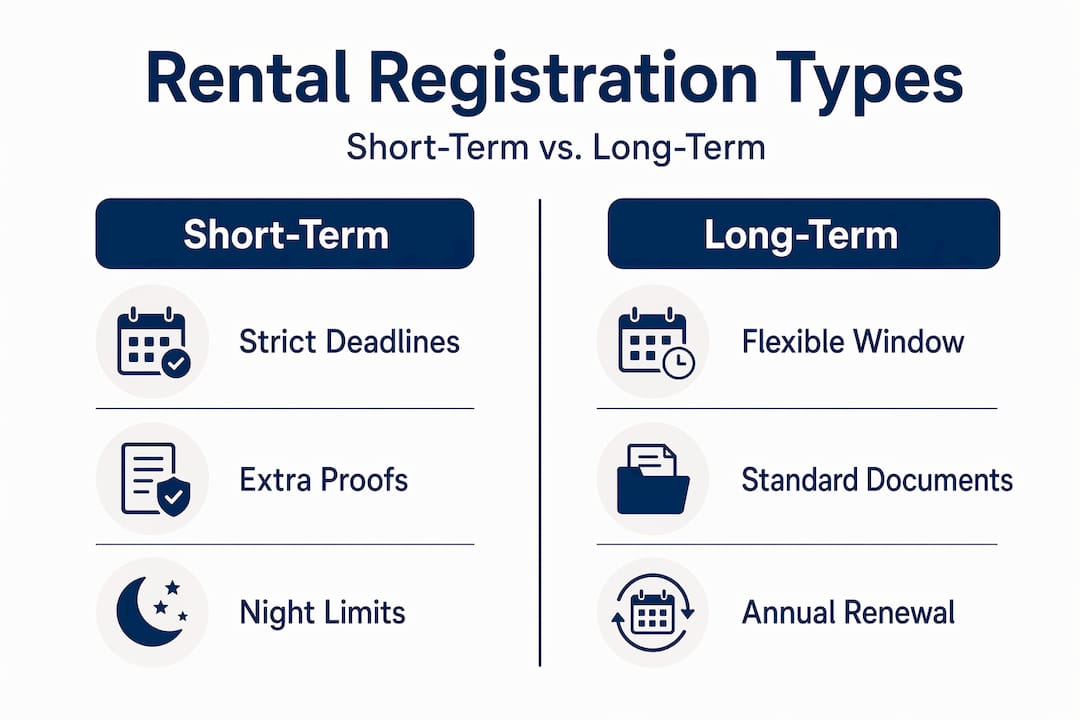
For short-term rental hosts, the stakes are particularly high. Anchorage requires vacation rental owners to register by July 30, 2026, with failure to comply resulting in fines and forced listing removal. Deadlines like this are not flexible. Platforms including Airbnb treat registration number display as a compliance condition. Listings without valid numbers are removed.
Here is what short-term rental hosts specifically need to prepare for:
- Proof of principal residence. Many cities only permit short-term rentals in a host’s primary home. You will need to prove residency through tax records, voter registration, or utility bills.
- Night limits. Some jurisdictions cap the number of nights you can rent per year. Exceeding this limit is treated as operating without authorization.
- Entire-unit vs. partial-unit distinctions. Renting a spare room while you live on-site is treated differently than renting out an entire property. Rules and fees may differ for each category.
- Local agent designation. Owners must designate a point-of-contact who can respond to emergencies within hours. This requirement is especially challenging for out-of-state investors.
For more detail on what registration means specifically for your hosting situation, the short-term rental registration guide at Strcomply covers jurisdiction-specific breakdowns worth reviewing.
Ongoing compliance after registration
Registration approval is not the finish line. Many property owners treat it that way, and that is exactly where compliance problems begin. Keeping your registration current is an active responsibility, not a passive one.
Hamilton County, Ohio mandates registration within 60 days of acquisition and requires updates within 60 days of any material change. Those changes include:
- A transfer of ownership or title
- A change in property management company or designated local agent
- A tenant moving out and the property becoming vacant
- Changes to contact information or emergency contacts
- Renovations that alter the unit count or occupancy capacity
Failing to update registration details within the required window results in fines that accumulate over time. Many owners are caught off guard because they assume registration is permanent once issued.
Annual renewals are also required in many cities. Some jurisdictions tie renewals to a fixed calendar date; others use the anniversary of your initial registration. Missing a renewal deadline can invalidate your registration entirely, which means your listing may be flagged or removed even if you were compliant the day before.
Pro Tip: Set calendar reminders 60 days before your registration anniversary date and at every anticipated ownership or management change. Pair this with a folder that holds your current registration certificate, insurance documents, and local agent contact so you can update quickly when needed.
Managing vacant properties adds another layer of complexity. Some cities require you to notify the registry if a unit sits vacant for more than a certain period. Ignoring this requirement can result in administrative penalties even if no tenant is being harmed. Review your local rules on permit renewal timelines to stay ahead of these obligations.
My perspective on getting rental registration right
I have seen hosts at every experience level treat registration as a box to check rather than a system to maintain. That mindset is expensive. What I have learned working through compliance requirements across multiple markets is that the hosts who stay out of trouble are not necessarily the most experienced. They are the most organized.
Registration is genuinely an opportunity to build operational discipline into your rental business. When you know your renewal dates, keep your documents current, and maintain a designated local contact, you are also preparing yourself for inspections, insurance claims, and tenant disputes. Everything connects.
The most common mistake I see is owners assuming that once they have a registration number, they are done. They are not. Cities are increasing oversight, and registration information must reflect your property’s current reality at all times. When it does not, the penalties feel sudden. They are not. They are the result of maintenance that was skipped.
My advice: treat registration the same way you treat your mortgage payments. It is not optional, it does not go away, and staying current is far less painful than catching up after a lapse.
— Jure
Stay compliant with Strcomply
Tracking registration requirements across multiple cities, renewal dates, and shifting local regulations is genuinely difficult to do manually.
Strcomply makes the process manageable. The platform lets you check your listing’s compliance in under 30 seconds, with city-specific summaries covering permits, taxes, zoning restrictions, and operational rules. For hosts managing multiple properties, paid plans include a compliance dashboard with permit tracking, renewal alerts, and real-time regulatory updates. You get the information you need without hours of legal research. If you want to know exactly where your rental stands before your next deadline, Strcomply is built for that.
FAQ
What is rental property registration?
Rental property registration is a formal process in which property owners submit their contact details, property information, and documentation to a local government registry. It is required in many U.S. cities to operate a rental legally.
How long does it take to register a rental home?
Processing times vary by jurisdiction, ranging from a few business days to several weeks. Submitting a complete application with accurate documentation is the single most effective way to avoid delays.
Do short-term rental hosts need a different registration than landlords?
Yes. Short-term rental registration typically involves stricter requirements, including principal residence proof, night limits, local agent designation, and mandatory display of a registration number on all listings. Long-term rental registration is generally less restrictive.
What happens if you miss a rental registration deadline?
Missing a registration deadline can result in fines, forced listing removal from platforms like Airbnb or VRBO, and loss of legal authority to operate your rental. Cities like Anchorage enforce hard deadlines with no grace period.
How often do you need to renew rental registration?
Most jurisdictions require annual renewal, though some use a biennial schedule. You also need to update your registration within 30 to 60 days of any material change, such as a new owner, manager, or emergency contact.
Recommended
Check your city's STR regulations
Free compliance reports for 100+ US cities. Permits, taxes, zoning — all in one place.
Check My Address — Free