
A compliance summary is a formal, structured document that provides an executive-level overview of a property’s adherence to local regulations, permits, tax obligations, and operational restrictions. For short-term rental hosts and property managers, this document is the single most important record you can maintain. It consolidates everything from transient occupancy tax filings to zoning restrictions into one audit-ready overview, reducing the risk of fines, permit loss, and de-listing from platforms like Airbnb and VRBO.
What is a compliance summary and why does it matter for hosts?
A compliance summary is defined as a structured report that captures an organization’s current status across all applicable regulatory requirements. In the short-term rental context, that means permits, tax registrations, guest log requirements, liability coverage, and local ordinance restrictions, all documented in one place. Compliance reporting identifies gaps, tracks corrective actions, and provides leadership with a clear picture of regulatory health.
The document serves two audiences at once. Internally, it helps you manage deadlines and spot problems before they become violations. Externally, it gives regulators and auditors verifiable proof that your property operates within the law.

Non-compliance carries real consequences. Incomplete reporting in short-term rentals can result in reputational harm, regulatory sanctions, lost permits, and removal from rental platforms. A complete compliance summary mitigates those risks by demonstrating proactive adherence rather than reactive scrambling.
What key elements are included in a compliance summary?
A well-built compliance summary contains five core sections. Each one serves a distinct purpose, and skipping any of them weakens the document’s value during an audit.
- Executive summary. This section distills the property’s overall compliance health into a brief, readable snapshot. Executive summaries are the first section reviewed by regulators and leadership, making clarity here non-negotiable.
- Compliance status indicators. Each requirement is labeled as compliant, partially compliant, or non-compliant. This color-coded or tiered system lets you identify problem areas at a glance.
- Documented gaps and corrective action plans. Any violation or missing document gets logged here along with a deadline and responsible party for resolution.
- Risk assessment. This section quantifies exposure. A lapsed permit in a city with active enforcement carries a different risk level than a missing guest log in a jurisdiction with minimal oversight.
- Supporting evidence. Timestamped permits, tax filing receipts, and insurance certificates belong in this section. Timestamped documentation is what auditors require to confirm compliance at specific past dates.
| Section | Purpose |
|---|---|
| Executive summary | Gives a high-level compliance health snapshot for quick review |
| Status indicators | Flags compliant, partial, and non-compliant items clearly |
| Gaps and corrective actions | Tracks violations and assigns resolution timelines |
| Risk assessment | Rates exposure level for each open compliance issue |
| Supporting evidence | Stores timestamped permits, filings, and certificates |
Pro Tip: Link each piece of evidence directly to the specific requirement it satisfies. An auditor should be able to trace any compliance claim back to a dated document in under two minutes.
How does a compliance summary support ongoing rental management?
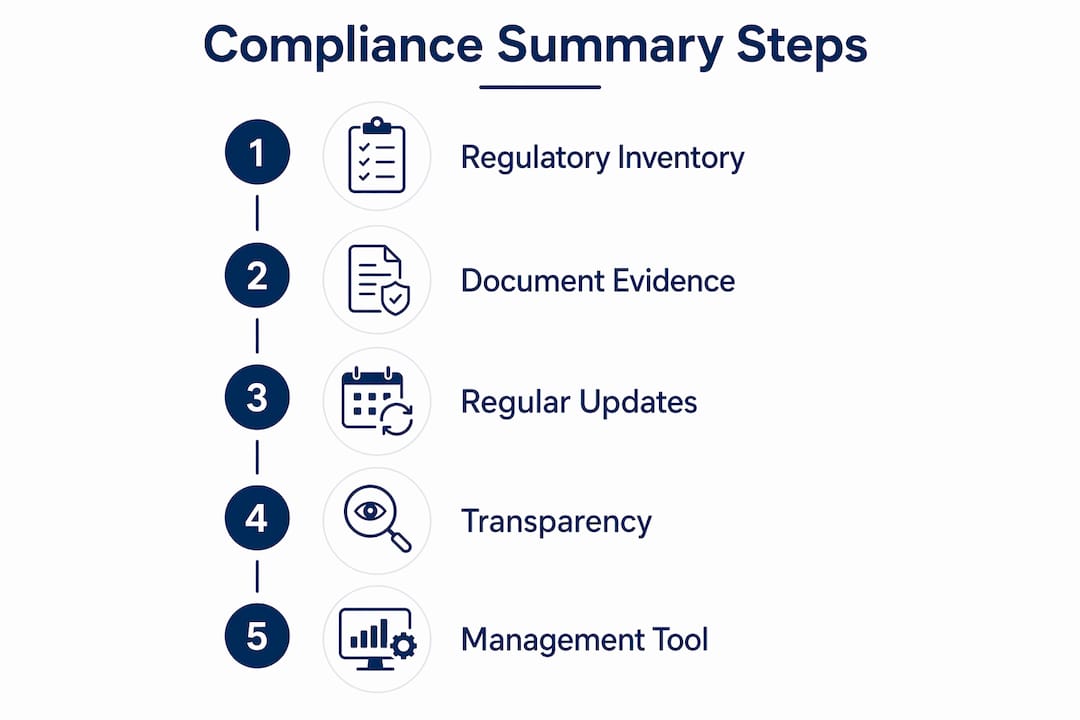
A compliance summary is not a one-time document. It functions as a living record that must be updated regularly to reflect your current regulatory standing. Compliance reporting requires updates at least quarterly or after significant local ordinance changes to maintain an accurate risk profile.
Short-term rental regulations change frequently. Cities across the United States have amended permit requirements, occupancy caps, and tax collection rules multiple times in recent years. A summary that was accurate in january may be dangerously outdated by april if your city council passed new restrictions in between.
Keeping the document current requires a structured approach. Here is a practical process for ongoing maintenance:
- Schedule quarterly reviews. Set a fixed date each quarter to review every compliance item against current local ordinances. Calendar this as a non-negotiable operational task.
- Link deadlines to operational workflows. Tax remittance schedules and guest registry requirements should connect directly to specific compliance summary deadlines so nothing falls through the cracks.
- Set automated alerts for permit renewals. Most permits have annual renewal windows. Missing a renewal window is one of the most common and avoidable compliance failures hosts face.
- Update after every ordinance change. When your city or county amends its short-term rental rules, update the summary within 30 days. Do not wait for the next quarterly review.
- Document every corrective action. When you fix a gap, record the date, the action taken, and attach the updated evidence. This creates a traceable compliance history.
Pro Tip: Treat your compliance summary the same way you treat your property’s maintenance log. Both require regular entries, both protect your investment, and both become critical records the moment something goes wrong.
The document also serves as a transparency tool with regulators. When an inspector or tax authority contacts you, producing a current, well-organized compliance summary signals that you operate professionally. That perception reduces the likelihood of escalated enforcement actions.
How does compliance reporting differ from general business reporting?
Compliance reporting and general business reporting address fundamentally different questions. Business reporting asks how the property is performing financially and operationally. Compliance reporting asks whether the property is operating legally. Compliance reporting focuses specifically on legal, regulatory, and ethical obligations rather than financial or operational metrics.
This distinction matters because the audience and consequences are different. A revenue report goes to your accountant or investors. A compliance summary goes to regulators, auditors, and local government agencies. The standard of proof is much higher, and the cost of errors is measured in fines and permit revocations rather than missed targets.
Compliance documentation must also meet a higher bar for traceability. General business reports can summarize trends and use estimates. Compliance records must be verifiable, specific, and dated. Every claim in a compliance summary needs a document behind it.
The consequences of poor compliance reporting are concrete:
- Fines. Cities with active short-term rental enforcement issue fines for operating without a valid permit or failing to remit transient occupancy tax on time.
- Permit revocation. Repeated violations or failure to respond to notices can result in permanent permit loss.
- Platform de-listing. Airbnb and VRBO both remove listings that violate local laws, cutting off your rental income entirely.
- Reputational damage. Public enforcement records are often searchable, affecting your standing with future guests and property management partners.
Compliance reporting also functions as a strategic management tool for accountability. When you document your regulatory status consistently, you build an institutional record that protects you in disputes and demonstrates good faith to authorities.
Best practices for preparing and maintaining a compliance summary
The most effective compliance summaries share one characteristic: they are treated as living documents, not static files. Successful managers use automated alerts and real-time monitoring rather than relying on memory or annual reviews.
Start with a complete regulatory inventory. Before writing a single line of your summary, list every regulation that applies to your property. This includes city permit requirements, county zoning restrictions, state tax registration, transient occupancy tax rates, and any homeowners association rules. Use your local government’s official short-term rental ordinance as the source of record.
Assign ownership for each compliance item. Every requirement in your summary should have a named responsible party and a due date. For solo hosts, that is you. For property managers overseeing multiple units, assign items to specific team members. Unassigned tasks do not get done.
Maintain a compliance checklist tied to your summary. The checklist handles the day-to-day tasks. The summary captures the overall status. Both documents should reference each other so nothing exists in isolation.
“Compliance reporting is not a box-ticking exercise. It is verifiable documentation of a proactive culture of adherence to laws and regulations.”
Avoid these common errors:
- Filing your compliance summary once and never updating it
- Storing evidence separately from the summary with no cross-reference
- Treating partial compliance as full compliance in your status indicators
- Ignoring local ordinance amendments between scheduled reviews
- Failing to document corrective actions after resolving a gap
Pro Tip: Review your compliance summary every time you renew a permit or file a tax return. These natural checkpoints align with regulatory deadlines and keep your document current without requiring a separate calendar reminder.
For hosts managing rental legal requirements in 2026, the regulatory environment is more active than ever. Cities are tightening enforcement, expanding permit requirements, and increasing audit frequency. A well-maintained compliance summary is your primary defense.
Key Takeaways
A compliance summary is the single document that determines whether a short-term rental host can prove regulatory adherence when it matters most, including during audits, inspections, and platform reviews.
| Point | Details |
|---|---|
| Core definition | A compliance summary is a formal, structured document covering permits, taxes, and local ordinance status. |
| Five required sections | Include an executive summary, status indicators, gaps, risk assessment, and timestamped evidence. |
| Living document rule | Update the summary at least quarterly and after every local ordinance change. |
| Distinct from business reporting | Compliance summaries address legal obligations, not financial performance, and require verifiable records. |
| Consequences of poor reporting | Incomplete summaries expose hosts to fines, permit loss, and de-listing from rental platforms. |
Why compliance summaries deserve more attention than they get
Most hosts I have seen treat compliance as a one-time task. They get the permit, register for transient occupancy tax, and assume the work is done. That assumption is the most expensive mistake in short-term rental management.
Regulations do not stay still. Cities amend ordinances, tax rates change, and new guest log requirements appear with little notice. A compliance summary that was accurate six months ago may now reflect a property that is technically out of compliance. The host does not know because they never updated the document.
The other mistake I see constantly is treating the compliance summary as a document for regulators only. The most useful compliance summaries I have reviewed are the ones hosts use internally every month. They catch renewal deadlines before they lapse. They flag tax filing windows before penalties accrue. They turn compliance from a reactive crisis into a routine operational task.
Technology has made this easier. Platforms that monitor local ordinances and send automated alerts remove the burden of tracking regulatory changes manually. That is not optional anymore for hosts managing multiple properties. It is the only way to stay current without dedicating full-time staff to the task.
My honest recommendation: build your compliance summary before you need it, not after an inspector asks for it. The hosts who treat compliance documentation as a core part of their operation are the ones who avoid the fines, keep their permits, and stay listed on every platform they operate on.
— Jure
Strcomply makes compliance summary management straightforward
Short-term rental compliance is complex, and keeping your summary current across multiple properties is a real operational challenge. Strcomply is built specifically for this problem.

Strcomply provides city-specific compliance summaries that cover permit requirements, transient occupancy tax obligations, zoning restrictions, and operational rules for your exact market. The platform tracks regulatory changes automatically and sends renewal alerts before deadlines pass. For property managers overseeing multiple listings, the portfolio dashboard gives you a consolidated view of compliance status across every property. Visit Strcomply to check your listing’s compliance status for free and see exactly where you stand.
FAQ
What is a compliance summary in short-term rentals?
A compliance summary is a formal document that consolidates a rental property’s adherence to permits, tax obligations, zoning rules, and local ordinances into one audit-ready report. It serves as verifiable proof of regulatory status for hosts, property managers, and regulators.
How often should a compliance summary be updated?
A compliance summary requires updates at least quarterly or immediately after any significant local ordinance change. Waiting longer risks operating under outdated information that no longer reflects current regulatory requirements.
What happens if a host does not maintain a compliance summary?
Hosts without current compliance documentation face fines, permit revocation, and de-listing from rental platforms like Airbnb and VRBO. Incomplete records also make it harder to defend against enforcement actions or regulatory audits.
How does a compliance summary differ from a business report?
A compliance summary focuses on legal and regulatory obligations, not financial performance. It is designed for regulators and auditors, requires verifiable and timestamped evidence, and carries legal consequences when inaccurate or incomplete.
What documents belong in the evidence section of a compliance summary?
The evidence section should contain timestamped permits, tax filing receipts, transient occupancy tax registration certificates, liability insurance documents, and any correspondence with local regulatory authorities. Each document should link directly to the specific requirement it satisfies.
Recommended
Check your city's STR regulations
Free compliance reports for 100+ US cities. Permits, taxes, zoning — all in one place.
Check My Address — Free