
An occupancy restriction is the legally mandated maximum number of people allowed to reside in a rental unit, determined by bedroom size, total square footage, and applicable safety codes. Property owners and rental hosts who ignore these limits face fines, forced closures, and fair housing complaints. The rules are not arbitrary. They flow from federal guidelines like HUD’s two-persons-per-bedroom standard, building codes like the International Property Maintenance Code (IPMC), and local zoning ordinances that vary significantly by city and county. Understanding what is occupancy restriction means understanding where those numbers come from and how they apply to your specific property.
How are legal occupancy limits calculated?
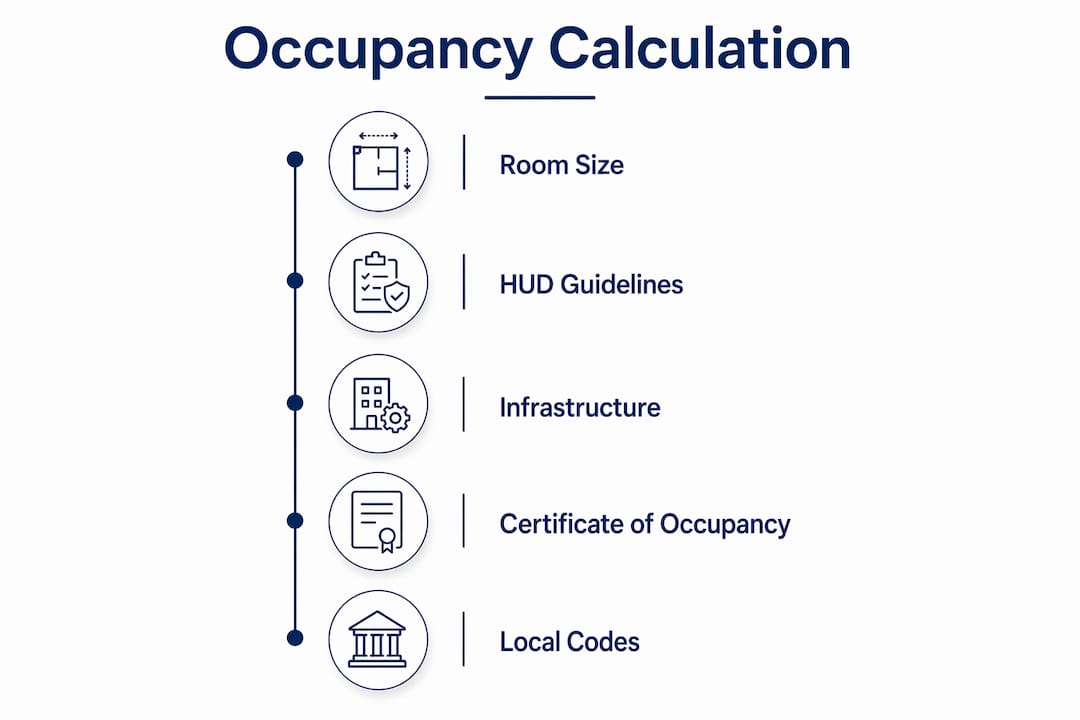
Residential occupancy limits follow a defined formula rooted in the IPMC. The code requires at least 70 sq ft per bedroom and 120 sq ft for living rooms, with 50 sq ft allocated per additional occupant sharing a bedroom. These are minimum thresholds, not targets. A bedroom that measures 80 sq ft technically qualifies, but it sets a tight ceiling on how many people can legally sleep there.
HUD’s commonly cited guideline sets a baseline of two persons per bedroom. That standard is widely used but not absolute. Local jurisdictions can and do modify it based on infrastructure capacity, housing density goals, and tenant protection laws. A two-bedroom unit in San Francisco may carry different occupancy rules than a two-bedroom unit in rural Texas.
The Certificate of Occupancy adds another layer of complexity. It lists the use category of a building, not the exact number of permitted occupants. That means property owners must calculate the actual occupancy limit themselves, using applicable codes or a licensed professional. Relying on the certificate alone is a common and costly mistake.
Local infrastructure also shapes the final number. Plumbing capacity, septic system size, and utility load can all reduce the maximum occupancy below what the square footage alone would allow. A property with a septic system rated for four people cannot legally house six, regardless of bedroom count.

Pro Tip: Hire a licensed building inspector or code consultant to calculate your property’s occupancy limit before listing it. The cost is minimal compared to the fines you face if your self-calculated number turns out to be wrong.
| Calculation factor | Standard applied |
|---|---|
| Bedroom minimum size | 70 sq ft per bedroom (IPMC) |
| Living room minimum size | 120 sq ft (IPMC) |
| Shared bedroom occupants | 50 sq ft per additional person |
| Baseline persons per bedroom | 2 persons (HUD guideline) |
| Infrastructure limits | Plumbing and septic capacity may reduce the total |
How do occupancy rules apply to short-term rentals?
Short-term rentals operate under a different set of pressures than long-term leases. Local zoning and housing codes heavily influence occupancy limits for Airbnb, VRBO, and similar platforms. A city may permit a three-bedroom home to host six guests under its standard residential code, but then cap short-term rental guests at four through a separate municipal ordinance. Hosts who rely only on platform defaults risk violating local law.
The consequences of getting this wrong are real. Enforcement of occupancy restrictions in the short-term rental space triggers:
- Fines and penalties. Many cities issue per-night or per-violation fines for exceeding posted occupancy limits. These accumulate fast.
- Permit suspension or revocation. Operating above the permitted occupancy count can void your short-term rental permit entirely.
- Forced closure. Local code enforcement officers can order a property vacated if occupancy violations are found during an inspection.
- Fair housing complaints. If your occupancy policy appears to target families or specific groups, you may face a discrimination complaint regardless of your intent.
- Platform de-listing. Airbnb and VRBO both reserve the right to remove listings that violate local law, including occupancy rules.
Aligning your lease terms and listing details with local codes is not optional. It is the baseline requirement for legal operation. Hosts who understand occupancy limits as part of their broader operational rules avoid the most common compliance failures.
Pro Tip: Check your city’s short-term rental ordinance directly, not just the platform’s guest limit field. Airbnb’s maximum guest setting does not override local law.
How do fair housing laws affect occupancy enforcement?
Fair housing laws create firm boundaries on how occupancy limits can be enforced. The Fair Housing Act prohibits policies that discriminate based on family size or the presence of children. Occupancy limits must be applied uniformly across all applicants and tenants. A landlord who enforces a strict two-person limit for a family with children but allows three unrelated adults in the same unit has created legal exposure.
Reasonable accommodation requests add another layer. Federal law can require accommodations that override occupancy limits for tenants with disabilities or other protected statuses. A tenant who needs a live-in caregiver may have a legal right to that additional occupant even if the unit is already at its stated maximum. Refusing that request without documented justification is a fair housing violation.
Best practices for uniform and defensible enforcement include:
- Document your occupancy policy in writing. State the limit, the legal basis for it, and how it applies to all tenants equally.
- Apply the policy consistently. Never make exceptions for some tenants while denying them to others without a documented, legally valid reason.
- Respond to accommodation requests in writing. Acknowledge the request, evaluate it against federal and state law, and provide a written decision with reasoning.
- Consult a housing attorney before denying any accommodation request. The cost of legal advice is far lower than the cost of a fair housing complaint.
- Review your policy annually. Local tenant rights laws change, and what was compliant last year may not be compliant today.
Occupancy limits must be treated as compliance issues, not just lease terms. Arbitrary or undocumented enforcement creates discrimination risk even when the underlying limit is legally sound.
How do building infrastructure and safety codes set occupancy caps?
Building infrastructure often sets a harder ceiling on occupancy than bedroom count or square footage alone. For commercial spaces and assembly areas within rental properties, occupancy is calculated by dividing gross floor area by specific load factors. Retail spaces use 60 sq ft per person, while unconcentrated assembly areas apply 15 sq ft per person. These numbers determine how many people can safely exit the building in an emergency.
Exit capacity is the factor most property owners overlook. If the exit widths of a building cannot support the occupant load calculated from floor area, exit capacity overrides the floor-area number and becomes the legal maximum. The lower of the two values always controls. This is a detail that matters most in properties with narrow hallways, single stairwells, or older door frames that do not meet current width standards.
Remodeling changes everything. Occupant load must be recalculated after any significant remodel or change of use. Converting a garage into a guest suite, adding a loft bedroom, or changing a dining room into a sleeping area all trigger a new occupancy calculation. Hosts who skip this step after renovations often discover the violation only when an inspector arrives.
| Occupancy calculation method | Controlling factor |
|---|---|
| Floor-area based (residential) | 70 sq ft per bedroom; 50 sq ft per shared occupant |
| Floor-area based (retail) | 60 sq ft per person |
| Floor-area based (assembly) | 15 sq ft per person (unconcentrated) |
| Exit capacity | Exit width in inches divided by 0.2–0.3 per occupant |
| Legal maximum | Lower of floor-area or exit-capacity calculation |
Official inspections and calculations by the local authority having jurisdiction (AHJ) are the only way to confirm your final number. Self-calculated occupancy limits that have not been verified by an AHJ carry legal risk if challenged.
Key Takeaways
Occupancy restrictions are legally binding limits set by building codes, HUD guidelines, and local ordinances, and violations carry fines, permit loss, and fair housing liability.
| Point | Details |
|---|---|
| Legal basis for limits | IPMC sets minimum room sizes; HUD sets a two-persons-per-bedroom baseline. |
| Certificate of Occupancy gap | The certificate lists use category only; owners must calculate the actual occupancy limit. |
| Short-term rental exposure | Local zoning ordinances often cap STR guests below standard residential limits. |
| Fair housing risk | Occupancy policies must be applied uniformly and accommodate protected classes. |
| Infrastructure controls | The lower of floor-area or exit-capacity calculations sets the legal maximum. |
The part most hosts get wrong about occupancy limits
Most hosts treat occupancy limits as a single number they find on a permit or a platform setting. That is the wrong frame. The real limit is the lowest number produced by three separate calculations: square footage per room, infrastructure capacity, and exit width. Any one of those three can override the others, and most property owners have never checked all three.
The second mistake I see constantly is assuming that the HUD two-persons-per-bedroom guideline is a ceiling. It is a floor, a starting point that local codes can tighten significantly. A city with a high-density housing shortage may cap occupancy well below what HUD would allow, and that local rule wins every time.
Fair housing is where the real legal risk lives. Hosts who set occupancy limits without documenting the legal basis for those limits are one complaint away from a federal investigation. The fix is straightforward: write down the code section that supports your limit, apply it the same way to every applicant, and respond to every accommodation request in writing. That paper trail is your defense.
The short-term rental market is also seeing more aggressive local enforcement in 2026. Cities that previously relied on complaint-driven enforcement are now conducting proactive audits of STR permits, including occupancy verification. Hosts who have not reviewed their rental legal requirements recently are operating on outdated assumptions. The compliance environment has shifted, and the hosts who adapt fastest will avoid the most expensive lessons.
— Jure
Strcomply makes occupancy compliance straightforward
Occupancy rules vary by city, property type, and rental platform. Checking them manually across multiple jurisdictions takes hours and still leaves room for error.

Strcomply gives property owners and hosts a fast, free way to check STR compliance for their specific address, including occupancy limits, permit requirements, zoning restrictions, and tax obligations. The platform pulls city-specific rules so you see exactly what applies to your listing, not a generic summary. Paid plans add permit tracking, renewal alerts, and regulatory update notifications for hosts managing multiple properties. If you want to confirm your occupancy limit is legally sound before your next booking, run a compliance report and get a clear answer in under a minute.
FAQ
What is an occupancy restriction in a rental property?
An occupancy restriction is the maximum number of people legally permitted to live in or use a rental unit, determined by bedroom size, square footage, and local building codes. Violating this limit exposes property owners to fines, permit loss, and fair housing complaints.
How is the occupancy limit for a short-term rental calculated?
Short-term rental occupancy limits combine IPMC room-size standards, HUD’s two-persons-per-bedroom guideline, and local zoning ordinances. The lowest number produced by those three factors is the legal maximum for your property.
Can a landlord set any occupancy limit they want?
No. Occupancy limits must be grounded in building codes or infrastructure capacity and applied uniformly to all tenants. Limits that appear to target families with children or other protected classes violate the Fair Housing Act.
Does a Certificate of Occupancy tell me my occupancy limit?
No. A Certificate of Occupancy lists the building’s use category, not the permitted number of occupants. Property owners must calculate the actual occupancy limit using applicable codes or consult a licensed professional.
What happens if I exceed the occupancy limit on my Airbnb listing?
Exceeding the occupancy limit can result in municipal fines, short-term rental permit revocation, forced closure by code enforcement, and removal of your listing from platforms like Airbnb or VRBO.
Recommended
Check your city's STR regulations
Free compliance reports for 100+ US cities. Permits, taxes, zoning — all in one place.
Check My Address — Free