
STR compliance tracking is the continuous process of monitoring local permits, tax obligations, zoning restrictions, and operational rules to keep a short-term rental legally active. Hosts who skip this process face fines up to $5,000 per incident and immediate delisting from platforms like Airbnb and VRBO. Understanding why track STR compliance matters is not a bureaucratic exercise. It is the difference between a profitable rental business and a costly legal problem. Automated platforms like Strcomply now make this process manageable for individual hosts and large property managers alike.
Why track STR compliance: the core reasons
Compliance tracking protects your rental from financial penalties, forced shutdowns, and platform removal. The risks are not theoretical. Non-compliance triggers insurance denial, back-tax obligations, and legal action that can cost far more than any fine alone.
The importance of STR compliance comes down to three interconnected risks:
- Financial exposure. Daily fines range from $250 to $5,000. Retroactive tax bills can cover years of uncollected transient occupancy tax (TOT), which is the local tax governments charge on short-term stays.
- Operational legitimacy. Platforms like Airbnb and VRBO cooperate with municipal enforcement. A single unresolved violation can trigger listing suspension without warning.
- Legal liability. Operating without a valid permit voids many insurance policies. If a guest is injured in an unlicensed property, the host bears full financial responsibility.
The benefits of tracking STR compliance extend beyond avoiding penalties. Hosts with clean compliance records build stronger relationships with local governments, face fewer neighbor complaints, and position their properties for long-term market viability. Regulation acts as a filter, excluding unprepared operators and protecting serious investors who treat compliance as a professional standard.
Pro Tip: Keep a dedicated compliance folder for each property with copies of permits, TOT registration certificates, and renewal notices. This single habit cuts audit response time significantly.
What are the core pillars of STR compliance tracking?
STR compliance monitoring covers four distinct regulatory areas. Each one carries its own deadlines, documentation requirements, and enforcement mechanisms.

| Compliance area | What to track | Common requirement |
|---|---|---|
| Zoning and permits | Valid STR license or permit | Annual or biannual renewal |
| Transient occupancy tax | TOT registration and remittance | Monthly or quarterly filing |
| Occupancy limits | Maximum guest count per listing | Set by local ordinance |
| Safety standards | Smoke detectors, egress, fire extinguishers | Inspection at permit renewal |
Zoning verification is the first step before listing any property. Many cities restrict STRs to owner-occupied homes, primary residences only, or specific zoning districts. Operating outside approved zones is the most common reason permits are denied or revoked.
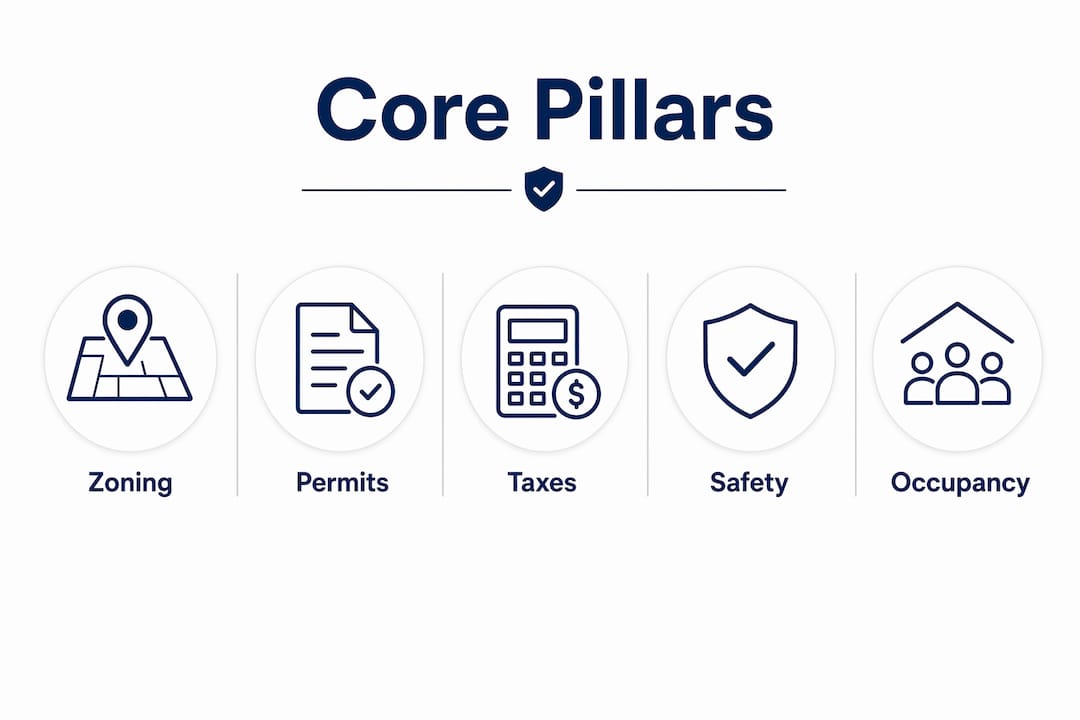
Transient occupancy tax obligations are equally critical. TOT rates reach 15% or higher in some jurisdictions, and hosts are personally responsible for collecting and remitting this tax even when platforms like Airbnb collect it on their behalf in some markets. Misunderstanding this split responsibility is a frequent source of back-tax liability.
STR permits and regulations change frequently. Permits typically expire annually or biannually, and new requirements often apply at renewal. A host who was compliant last year may be out of compliance today without knowing it. This is why compliance tracking must be ongoing, not a one-time check.
Safety and occupancy standards round out the core pillars. Local ordinances set maximum guest counts, and violations of these limits are now detectable through platform calendar data. Enforcement agencies use this data to identify properties operating above permitted capacity.
How does automated tracking compare to manual methods?
Manual compliance tracking using spreadsheets and calendar reminders produces compliance rates near 48%. Automated systems bring that figure to 95.3% compliance rates. That gap represents the difference between a business that survives regulatory scrutiny and one that does not.
The reason manual methods fail is not negligence. The problem is complexity, not bad faith. Regulations vary by city, county, and state. They update without public announcement. Renewal deadlines fall on different dates for different properties. No spreadsheet reliably handles that volume of variables across a portfolio.
Automated compliance monitoring addresses each of these failure points directly:
- Real-time alerts notify hosts when permit renewals are approaching.
- Tax-rate databases update automatically when local governments change TOT rates.
- Regulatory change feeds flag new ordinances before they take effect.
- Violation detection tools scan listing data for occupancy or operational breaches.
Automated API-based monitoring is now standard in enforcement. Cities can flag a property and issue a fine within 24 hours based on noise complaint data, calendar scraping, or platform listing information, without any human review in the initial process. Manual tracking cannot respond at that speed.
Automated tools also reduce administrative workload by over 90%. For property managers overseeing multiple listings across different markets, that reduction is not a convenience. It is a requirement for operating at scale without a dedicated compliance staff.
Pro Tip: Integrate your compliance monitoring tool with your property management system (PMS). When booking data, guest counts, and permit status share a single data source, human error in reporting drops to near zero.
Regulatory monitoring for STRs works best when it connects directly to local registries and tax authorities. This integration ensures the data your compliance system uses reflects current rules, not last quarter’s version.
What practical steps maintain STR compliance effectively?
Systematic compliance management follows a repeatable process. Professional management and systematic tracking allow large portfolios to stay compliant remotely and scale safely across multiple markets. The same principles apply to a single-property host.
- Verify zoning before listing. Confirm your property sits in an STR-permitted zone before investing in setup costs. Zoning status can change, so recheck at each permit renewal.
- Obtain and maintain all required permits. Register with your city or county, collect your STR license, and set calendar reminders 90 days before each renewal date.
- Register for TOT collection. Contact your local tax authority to register for transient occupancy tax. Understand whether your platform remits on your behalf or whether you must file independently.
- Implement automated compliance monitoring. Use a dedicated tool to track renewal deadlines, regulatory updates, and tax-rate changes across all your markets.
- Document every compliance action. Save copies of permit applications, approval letters, tax filings, and any correspondence with local authorities. This documentation is your primary defense in an audit.
- Monitor local ordinance changes continuously. Subscribe to city council meeting notices or use a platform that tracks regulatory updates automatically. New rules often apply to existing operators, not just new applicants.
- Engage proactively with your community. Respond to neighbor concerns before they become formal complaints. Complaints are now a data point that automated enforcement systems use to trigger inspections.
Managing rental legal requirements across multiple jurisdictions requires a centralized system. A host managing five properties in three cities cannot rely on memory or a single shared spreadsheet. Each property needs its own compliance record with current status, upcoming deadlines, and a history of filings.
Compliance tracking is not a one-time check. Updated rules apply at permit renewal, and new ordinances can take effect mid-year. The hosts who stay compliant treat this as a standing operational responsibility, not a task they complete once and forget.
Key takeaways
Tracking STR compliance through automated monitoring is the most reliable way to protect rental income, maintain platform listings, and avoid fines that can reach $5,000 per incident.
| Point | Details |
|---|---|
| Compliance tracking is ongoing | Regulations change at renewal and mid-year, requiring continuous monitoring rather than a one-time review. |
| Automation outperforms manual methods | Automated systems achieve 95.3% compliance rates versus 48% with spreadsheets and manual tracking. |
| Four pillars require tracking | Zoning, permits, transient occupancy tax, and safety standards each carry distinct deadlines and documentation needs. |
| Fines and delisting are immediate risks | Daily fines reach $5,000 and platform suspension can occur without prior warning under automated enforcement. |
| Documentation is your audit defense | Saved permits, tax filings, and correspondence records are the primary protection during regulatory review. |
Compliance is a moving target, not a finish line
I have watched hosts treat compliance as a box to check at the start of operations and then ignore it entirely. That approach worked in 2019. It does not work in 2026.
Enforcement has shifted from reactive to automated. Cities now use API connections to platform data, noise monitoring services, and calendar scraping tools to identify violations in real time. A property that was compliant six months ago can be flagged today because a local ordinance changed at renewal and the host missed the update. The fine arrives before the host even knows there was a problem.
What I find most telling is that the compliance gap is rarely about intent. Most hosts are not trying to break rules. They simply do not know the rules have changed. The research confirms this: the problem is complexity, not bad faith. That is exactly why technology matters here. A good compliance platform does not just alert you to deadlines. It translates a constantly shifting regulatory environment into a clear, current picture of where each property stands.
My recommendation is to treat compliance as a core operational function, not an administrative afterthought. The hosts and property managers who build systematic tracking into their workflow from day one spend far less time and money on compliance than those who react to violations after the fact. Proactive compliance is also a competitive advantage. Properties with clean records face fewer restrictions, attract better insurance terms, and are positioned to survive the next round of regulatory tightening.
View compliance not as a burden but as the professional standard that separates serious operators from those who will not last in this market.
— Jure
How Strcomply simplifies STR compliance tracking
Strcomply is built specifically for short-term rental hosts and property managers who need reliable, current compliance information without spending hours on legal research. The platform provides instant, city-specific compliance checks covering permits, zoning, tax obligations, and operational restrictions for Airbnb, VRBO, and similar listings across the United States. Paid plans include portfolio dashboards, permit renewal alerts, and regulatory update feeds that keep every property in your portfolio current. For hosts managing multiple markets, Strcomply replaces the manual tracking process that produces 48% compliance rates with an automated system proven to reach 95.3%. Start with a free compliance check to see exactly where your listings stand today.
FAQ
What does STR compliance tracking involve?
STR compliance tracking means continuously monitoring permits, zoning status, transient occupancy tax obligations, and safety requirements for each short-term rental property. It includes tracking renewal deadlines and responding to regulatory changes as they occur.
Why is STR compliance necessary for Airbnb and VRBO hosts?
Platforms like Airbnb and VRBO cooperate with local enforcement agencies. Unresolved violations can trigger immediate listing suspension, and fines for non-compliance reach $5,000 per incident under current 2026 enforcement standards.
How often do STR regulations change?
STR permits typically expire annually or biannually, and new requirements often apply at each renewal. Local ordinances can also change mid-year, making continuous monitoring the only reliable way to stay current.
What is transient occupancy tax and why does it matter?
Transient occupancy tax (TOT) is the local tax governments charge on short-term rental stays. Rates reach 15% or higher in some jurisdictions, and hosts are responsible for registration and remittance even when platforms collect it on their behalf in certain markets.
Is automated compliance tracking worth it for a single property?
Yes. Automated tools eliminate the risk of missed renewal deadlines and undetected regulatory changes that manual tracking routinely misses. For a single property, the cost of one fine or a listing suspension far exceeds the cost of an automated monitoring subscription.
Recommended
Check your city's STR regulations
Free compliance reports for 100+ US cities. Permits, taxes, zoning — all in one place.
Check My Address — Free